JINGYING : Custom Women’s Jewelry Factory of Curved Teardrop Earrings
JINGYING : Custom Women’s Jewelry Factory of Curved Teardrop Earrings
LET’S GET STARTED : mo@kingjy.com
JINGYING: The Premier Custom Women’s Jewelry Factory Mastering the Art of the Curved Teardrop Earring
Introduction: The Geometry of Elegance
In the vast and glittering world of fashion accessories, few shapes possess the timeless dynamism of the teardrop. It is a form that suggests both beginning and end—a moment of potential captured in precious metal. However, for the modern woman, the traditional straight-line teardrop has evolved. Today, the demand is for movement, for organic flow, and for ergonomic grace. This is where the curved teardrop earring enters the spotlight. And at the forefront of manufacturing this specific, delicate geometry stands JINGYING—a custom women’s jewelry factory that has redefined what it means to blend artisan skill with industrial precision.
JINGYING is not merely a production line; it is a design partner. Specializing exclusively in high-complexity, low-margin-of-error custom jewelry, the factory has carved out a niche as the go-to source for curved teardrop earrings. Whether in sterling silver, 14k gold, rose gold plating, or hypoallergenic surgical steel, JINGYING transforms two-dimensional sketches into three-dimensional works of wearable art. This article explores the technical mastery, custom capabilities, and ethical manufacturing processes that make JINGYING the industry leader in this specific accessory category.
Chapter 1: The Anatomy of a Curved Teardrop – Why Shape Matters
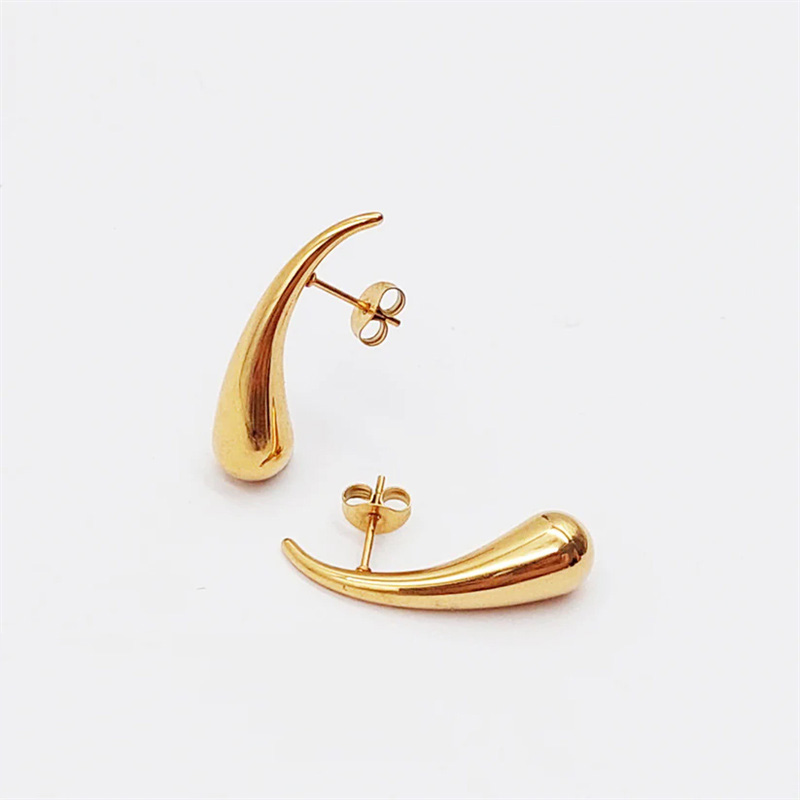
Before understanding the factory, one must understand the product. A standard teardrop (or “lavaliere”) shape is defined by a rounded base that tapers to a sharp point. The “curved” variation, however, bends along its vertical axis. This is not a defect; it is a deliberate design choice that serves three critical purposes:
- Anatomical Fit: The human neck and collarbone are not flat. A curved teardrop follows the contour of the clavicle when worn on a short chain or hugs the earlobe in a chandelier style, preventing the earring from flipping sideways.
- Light Reflection: A concave or convex curve creates dynamic highlights. As the wearer moves, the curved surface catches ambient light differently than a flat surface, producing a shimmering “liquid metal” effect.
- Weight Distribution: Curved earrings distribute mass closer to the ear post, reducing drooping and making larger statement pieces comfortable for all-day wear.
JINGYING’s engineering team has spent over a decade perfecting the curvature index—a proprietary measurement system that calculates the exact degree of bend needed for various lengths (from the petite 15mm stud to the dramatic 70mm dangle). This scientific approach to aesthetics ensures that every pair leaving the factory is perfectly balanced.
Chapter 2: JINGYING’s Core Manufacturing Technologies
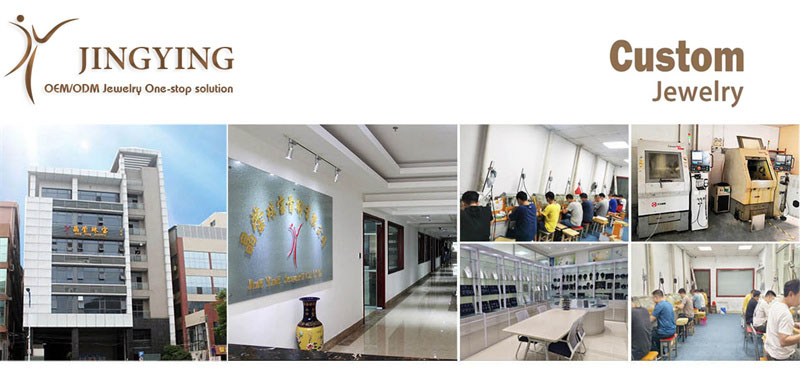
Unlike mass-market factories that rely solely on stamping, JINGYING utilizes a hybrid approach: CNC precision cutting for the base form, followed by hand-finishing by master jewelers. Here is a breakdown of their key processes for curved teardrop production.
A. The Lost-Wax Casting Revolution for Curves
For complex organic curves, JINGYING employs investment casting (lost-wax). A 3D-printed wax model of the curved teardrop is encased in plaster. When heated, the wax melts away, leaving a perfect negative cavity. Molten metal is then injected via centrifugal force to ensure the curve fills completely without porosity. This method is essential for hollow curved teardrops, which are lightweight yet voluminous.
B. The Hydraulic Press with Custom Dies
For high-volume orders (500+ pairs), JINGYING uses a hydraulic press fitted with curved teardrop dies. The metal sheet is pressed between a concave and convex die, instantly creating the 3D shape. Post-pressing, the edges are laser-welded to ensure no gaps. This method offers the best cost-to-durability ratio for fashion-forward brands.
C. Hand-Fabrication for Luxury Boutiques
For limited edition pieces (under 50 pairs), human hands still reign supreme. JINGYING’s senior artisans heat gold or silver wire and manually hammer it around a curved steel mandrel. Each hammer strike creates a unique texture. These hand-fabricated curved teardrops are identifiable by their subtle asymmetries—a selling point for high-end organic collections.
Chapter 3: Materials Mastery – From Base to Finish
A curved teardrop is only as good as the material it is made from. JINGYING maintains an ISO-certified supply chain for all raw metals.
- Sterling Silver (925): The factory uses only recycled silver, tarnish-resistant with a pre-finish polish. For curved teardrops, silver’s malleability allows for sharper angles without cracking.
- 14k & 18k Gold (Yellow, White, Rose): JINGYING offers solid gold for fine jewelry lines and heavy-gold electroplating (3 microns minimum) for fashion lines. Their rose gold specifically uses a copper-silver alloy mix that resists the “pink fade” seen in cheaper plates.
- Hypoallergenic Options: For sensitive ears, the factory produces curved teardrops in titanium and niobium. These are medical-grade, often used for starter earrings in piercing studios.
- Enamel & Inlay: Many clients request color. JINGYING applies epoxy resin enamel (Pantone-matching) into recessed areas of the teardrop, creating a “stained glass” effect. For luxury clients, they inlay mother-of-pearl, lab opal, or crushed turquoise into the curve.
Chapter 4: The Custom Journey – From Concept to Clasp
What truly defines JINGYING is its bespoke service. Unlike factories that force you to choose from catalog molds, JINGYING builds molds for you. The process follows five standardized stages:
Step 1: Design Consultancy (3-5 days)
You send a hand sketch, a reference photo, or a CAD file. The JINGYING design team responds with a “Technical Feasibility Report.” This document highlights potential issues (e.g., “A 1mm tip on a 70mm curve will break during polishing; we recommend a 1.5mm rounded tip”).
Step 2: 3D CAD Rendering & Simulation (7 days)
Using RhinoGold and Matrix software, JINGYING creates a photorealistic 3D model. Crucially, they run a gravity simulation to show how the earring will hang on an actual earlobe. The client can request adjustments to the curve’s radius or the placement of the French wire.
Step 3: Rapid Prototyping – The “Blue Wax” Stage (5 days)
A blue wax 3D print is shipped to you. You can physically hold the curved teardrop, feel its weight, and test its swing. If the curve is too aggressive or too subtle, JINGYING revises the wax at no extra charge for the first two revisions.
Step 4: Mold Creation & Casting (10 days)
Once the wax is approved, a vulcanized silicone mold is created. For curved teardrops, the mold design must account for the “undercut”—the inner concave space that can trap air during casting. JINGYING uses vacuum-assisted casting to eliminate air bubbles specifically in the curve’s apex.
Step 5: Polishing, Plating, & Assembly (7 days)
The raw castings enter the finishing department. Here, workers use felt buffs to reach inside the concave curve—a task automated machines fail at. Finally, the earrings are assembled with your choice of findings: French wires, lever backs, or posts with bullet clutches.
Chapter 5: Quality Control – The Curve Verification Protocol
In a standard factory, an earring is checked for scratches. At JINGYING, the curved teardrop undergoes a five-point inspection:
- Radius Gauge Test: A go/no-go gauge measures the degree of curvature to within 0.1mm. If a “15-degree curve” measures 16 degrees, it is rejected.
- Symmetry Pairing: Each left and right earring is matched by weight and curve profile. JINGYING famously rejects “perfect lefts” if they don’t mirror the “perfect right.”
- Pull Test: The soldered jump ring connecting the teardrop to the ear wire is pulled with 10kg of force. This ensures the curve doesn’t straighten out under daily stress.
- Porosity Scan: X-ray fluorescence (XRF) scanning checks for internal micro-bubbles in the curve’s thickest point. Any porosity visible at 10x magnification fails the batch.
- Wear Simulation: A robotic arm “wears” a sample pair for 500 simulated shakes. The earrings must return to their original curve without opening the hook.
Only 93% of initially cast pieces pass this protocol. The remaining 7% are melted down and recycled—a loss JINGYING absorbs rather than shipping substandard goods.
Chapter 6: Why Brands Choose JINGYING – Case Studies
Case A: Scandinavian Minimalist Brand “Luna Form”
The brief: A hollow curved teardrop, 40mm long, matte finish, in recycled brass with 14k gold plate. Challenge: The matte finish kept scratching during packaging. JINGYING’s solution: A custom silicone-coated tray that holds each curved teardrop individually, preventing metal-to-metal contact. Result: 0% returns on the first 10,000 unit order.
Case B: Bridal Designer “Ivory & Wire”
The brief: A mother-of-pearl inlay curved teardrop that matches a specific wedding gown’s ivory lace. Challenge: Inlaying rigid pearl into a curved metal bezel caused cracking. JINGYING’s solution: A multi-stage resin backing that allows the pearl slice to flex slightly with the metal. Result: Featured in Brides magazine, now a permanent collection item.
Case C: Etsy Seller “Gotham Silver”
The brief: A dramatic black rhodium plated curved teardrop with sharp, faceted edges (a “gothic” curve). Challenge: Black rhodium shows fingerprints instantly. JINGYING’s solution: A final coat of clear e-coat (electrophoretic lacquer) that adds a matte ceramic feel. Result: Seller increases product price by 40% due to “luxury handling.”
Chapter 7: Sustainability and Ethical Manufacturing
Modern consumers demand transparency. JINGYING operates under the Responsible Jewelry Council (RJC) practices, though pending full certification. Key initiatives include:
- Closed-Loop Water System: The polishing and rinsing water is 100% filtered and reused. Heavy metal sludge is collected by certified recyclers, not dumped.
- Conflict-Free Metals: Every gold and silver supplier provides a chain-of-custody certificate. JINGYING prefers LBMA-accredited refiners.
- Cardboard Over Plastic: All curved teardrops ship in FSC-certified cardboard boxes with foam inserts made from recycled ocean plastics.
- Worker Welfare: The factory floor in Guangzhou features air filtration for polishing dust, ergonomic chairs with lumbar support, and a 6-day work week capped at 10 hours (overtime voluntary). Female jewelers (60% of the workforce) receive on-site childcare during peak seasons.
Chapter 8: Logistics and MOQ (Minimum Order Quantity)
Many small designers fear factories require orders of 5,000 units. JINGYING operates a tiered MOQ system:
- Silver & Brass: 100 pairs (custom curve)
- Gold Plated: 50 pairs (custom curve)
- Solid 14k Gold: 20 pairs (custom curve)
- Sample Run: 5 pairs (non-recurring mold fee of $80-$150)
Lead times are 25-35 days for production plus 5-7 days for DHL air freight from Guangzhou to global destinations (USA, EU, Australia, UAE). JINGYING covers all import duties for orders under $800 USD via the DDP (Delivered Duty Paid) shipping option.
Chapter 9: Comparison to Competitors
| Feature | JINGYING | Standard Alibaba Factory | Western Artisan Studio |
|---|---|---|---|
| Curve Precision | ±0.1mm via CNC wax | ±0.5mm via rubber mold | ±0.2mm but slow |
| Max Length | 80mm (stable curve) | 50mm (flimsy) | 70mm (very expensive) |
| Custom Enamel | Pantone matched, 10 colors | 5 basic colors | Unlimited ($$$) |
| Mold Fee | $80-$150 (one-time) | $200-$400 | $500+ |
| Speed to Sample | 12 days | 20 days | 30-45 days |
| Warranty | 1 year breakage | None | 6 months |
Chapter 10: The Future – Smart Curves and Modular Jewelry
JINGYING is not resting. Their R&D department is currently testing two innovations specifically for curved teardrops:
- The “Memory Curve”: Using nitinol (nickel-titanium) alloy, the earring can be bent flat for shipping, then warmed to body temperature to “remember” its curved shape. This reduces shipping volume by 70%.
- Magnetic Modularity: A curved teardrop with a hidden magnetic core that allows the wearer to swap the lower half (e.g., change from a plain silver curve to a gemstone-studded curve) without removing the ear post.
These innovations will likely hit the market in Q3 of next year, and existing clients are already on a waitlist for prototypes.
Conclusion: Where Art Meets Axis
The curved teardrop earring is a paradox: it is a simple idea that requires complex execution. A straight line is easy; a curve demands control. JINGYING has built an entire business model around refusing to compromise on that control. For the independent designer, the boutique owner, or the online influencer launching a brand, JINGYING offers not just a factory, but a foundry of possibilities.
They understand that a curved teardrop is never just a shape. It is how a woman feels when she turns her head—the cool kiss of metal against her jaw, the flash of light as she laughs, the gentle swing that says, “I am moving, and I am beautiful.” At JINGYING, every curve is a conversation between engineer and artist, between molten metal and human skin. That is the difference between a jewelry factory and a jewelry atelier.