Custom OEM ODM Silver Jewelry Ribbed Teardrop Stud Earrings In Gold Vermeil
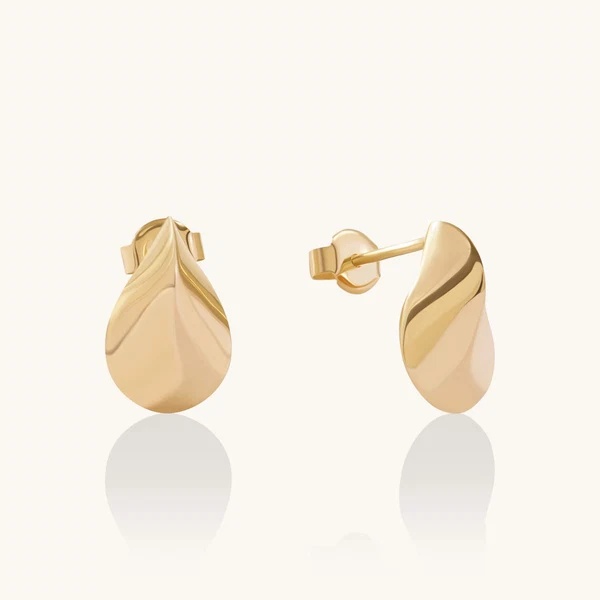

Custom OEM ODM Silver Jewelry Ribbed Teardrop Stud Earrings In Gold Vermeil
LET’S GET STARTED : mo@kingjy.com
How to Custom Make Sterling Silver Ribbed Teardrop Stud Earrings in Gold Vermeil
Sterling silver ribbed teardrop stud earrings in gold vermeil represent a sophisticated fusion of organic geometry, tactile texture, and enduring luxury. The teardrop—or pear—silhouette offers a graceful, elongated shape that flatters the ear, while the ribbed texture adds visual interest and a contemporary edge. The gold vermeil finish—a thick layer of 18K gold electroplated over sterling silver—elevates the piece to near-solid-gold quality at a fraction of the cost. For jewelry brands, boutique owners, or individuals seeking a distinctive custom accessory, understanding the complete manufacturing process is essential. This guide provides a comprehensive walkthrough of how to custom make sterling silver ribbed teardrop stud earrings with gold vermeil—from initial concept to finished product.
Understanding the Product: What Makes Ribbed Teardrop Stud Earrings Special
The teardrop shape, also known as a pear shape, is one of jewelry’s most elegant silhouettes. It combines the sparkle of a round form with the elongating effect of a pointed tip, creating a shape that is simultaneously classic and contemporary. When rendered as stud earrings, the teardrop offers a substantial presence on the ear while remaining lightweight and comfortable for all-day wear.
The ribbed texture—characterized by parallel raised ridges running across the surface—adds a tactile dimension that catches light from multiple angles. This texturing creates depth and visual rhythm, transforming a simple teardrop into a piece with architectural interest. The ribs are typically designed with a depth of approximately 0.8 to 1.0 millimeters to ensure they remain visible and distinct even after polishing and plating.
The gold vermeil finish is what elevates these earrings from simple silver studs to luxury accessories. Vermeil (pronounced “ver-MAY”) is a legally defined category of gold-plated jewelry. To be classified as vermeil under U.S. Federal Trade Commission guidelines, the jewelry must have a sterling silver base (92.5% pure silver) and be plated with at least 10-karat gold at a minimum thickness of 2.5 microns. Premium vermeil—such as the 18K gold vermeil commonly used in fine jewelry—features a gold layer that is approximately ten times thicker than standard gold plating (which is typically 0.5 to 1 micron). This substantial thickness accounts for vermeil’s superior durability and color retention compared to ordinary plated jewelry.
Step 1: Concept Development and Design Brief
The custom manufacturing journey begins with a clear design vision. Whether you have a hand-drawn sketch, a reference image, or a fully formed concept, the first step is translating your idea into a detailed design brief.
Defining the Teardrop Silhouette: The teardrop shape must be precisely dimensioned. Typical teardrop stud earrings measure approximately 15mm to 25mm in length and 10mm to 15mm in width, though sizes can be customized based on client preferences. Key design decisions include the curvature of the top (whether rounded or slightly pointed), the sharpness of the bottom point, and the overall proportion of width to length.
Designing the Ribbed Texture: The ribbed pattern requires careful consideration of several parameters:
- Rib direction: Vertical ribs running from top to bottom, horizontal ribs across the width, or diagonal ribs for a dynamic effect
- Rib spacing: The distance between each ridge affects the visual density of the texture
- Rib depth: Typically 0.8–1.0mm to ensure the texture remains distinct through polishing and plating
- Rib profile: Whether the ribs are rounded (softening the texture) or sharp (creating a more dramatic, architectural look)
Stud Backing Design: As stud earrings, the backing mechanism is critical. Common options include:
- Standard push-back (butterfly clutch) for simplicity and security
- Screw-back for enhanced security
- Friction back with a comfort-fit post
Defining the Vermeil Specification: For gold vermeil, you must specify:
- Gold purity: 18K yellow gold is the most popular choice for its rich color and durability, though 14K and 22K are also available
- Plating thickness: Minimum 2.5 microns for vermeil classification; 5 microns for premium French-standard vermeil
- Barrier layer: A palladium layer (approximately 0.3 microns) between the silver and gold can prevent silver migration and extend the plating’s lifespan
Step 2: CAD Modeling and Digital Design
Once the design brief is finalized, the next step is creating a digital 3D model using Computer-Aided Design (CAD) software. Most modern jewelry manufacturing begins with a CAD file, which serves as the precise blueprint for everything that follows.
Software and Workflow: Professional jewelry CAD is typically created using specialized software such as Rhinoceros (Rhino), MatrixGold, or RhinoGold. These programs allow designers to build precise NURBS (Non-Uniform Rational B-Splines) surfaces that accurately represent the curves, contours, and textures of the final piece.
Modeling the Teardrop Base: The teardrop shape is created by defining its cross-sectional profile—a smooth, continuous curve that narrows to a point at one end. The model must account for:
- The thickness of the earring body (typically 1.5–2.5mm for stud earrings)
- The post attachment point on the back
- The overall dimensions and proportions
Creating the Ribbed Texture in CAD: The ribbed texture is one of the most technically demanding aspects of the CAD modeling process. The texture is typically created by:
- Generating a series of parallel curves across the teardrop surface
- Using sweep or loft operations to create raised ridges
- Ensuring the rib depth is consistent and appropriately scaled
- Maintaining clean mesh topology optimized for jewelry manufacturing workflows
Technical Requirements: The CAD model must meet specific parameters for successful casting:
- Minimum wall thickness: 1.0mm to ensure structural integrity
- Minimum layer separation: 0.4mm between adjacent features
- Texture depth: 0.8–1.0mm to preserve detail through polishing
- Clean geometry: No overlapping surfaces or non-manifold edges
Design Validation: The CAD model allows for virtual rendering to visualize the final piece before production. Renderings can simulate different gold colors, lighting conditions, and angles to ensure the design meets expectations.
Step 3: Prototyping and Mold Making
With the CAD design finalized, the next phase involves creating physical prototypes and production molds.
3D Printing the Wax Model: The CAD file is sent to a 3D printer that produces a castable resin or wax model. This physical prototype allows designers and clients to:
- Validate the proportions and ergonomics
- Check the feel and weight of the earring
- Verify that the ribbed texture is visually and tactilely as intended
- Make any final adjustments before committing to production
Mold Creation: Once the prototype is approved, a vulcanized rubber or silicone mold is produced. This mold serves as the master for creating multiple wax copies of the earring. The mold represents a one-time investment that enables efficient serial production—a standard mold can produce anywhere from one to hundreds of identical units with consistent detail.
Step 4: Lost-Wax Casting
The lost-wax casting technique, refined over thousands of years, is the industry standard for producing sterling silver jewelry.
Wax Tree Assembly: The rubber mold is filled with high-performance wax to create precise wax copies of the earring design. These wax models are attached to a central wax stem, forming a structure known as a “wax tree.” The arrangement of wax pieces on the tree requires great skill, as their positioning directly affects the final casting quality.
Investment: The wax tree is placed in a casting flask and filled with a special plaster-like material called investment. The investment hardens around the wax tree, creating a solid mold.
Burnout: The flask is heated in a high-temperature furnace, typically overnight. During this process, the wax melts and burns away, leaving behind a precise cavity in the shape of the earrings.
Casting: Molten .925 sterling silver is poured into the cavity under vacuum pressure to ensure the metal fills every intricate detail of the mold. After cooling, the flask is quenched in water, and the investment material is washed away, revealing the rough silver castings.
Step 5: Filing, Finishing, and Polishing
Raw castings emerge from the mold with rough surfaces, sprue attachments (where the wax connected to the tree), and minor imperfections. The finishing process transforms these rough castings into refined, polished pieces.
Sprue Removal and Filing: The first step is cutting away the sprue attachments and removing any excess metal. Artisans use files and abrasive tools to smooth the surface and eliminate casting flaws.
Surface Preparation: The pieces undergo progressive sanding—starting with coarse grits and moving to finer grits—to achieve a smooth, even surface. This is particularly critical for ribbed textures, as the ribs must remain distinct while the valleys between them are properly smoothed.
Polishing: Polishing occurs in multiple stages:
- Rough polishing: For shaping and removing deeper scratches
- Fine polishing: To achieve brightness and smoothness
- Mirror polishing: Using a velvet cloth to achieve a high-gloss, Ra0.05μm smooth surface
For ribbed textures, polishing requires exceptional skill. The polisher must:
- Preserve the depth and definition of the ribs
- Avoid over-polishing that would soften or eliminate the texture
- Achieve a consistent finish across both the raised ribs and the recessed areas
Finish Options: Beyond the standard high-polish finish, ribbed teardrop earrings can be finished in various ways:
- High polish/mirror: Maximum shine and reflection
- Satin/brushed: A soft, matte finish that contrasts with the texture
- Oxidized: Darkening the recessed areas to highlight the ribbed pattern
Quality Inspection: Each piece undergoes hand inspection at this stage. Quality control checks include examining for casting flaws, verifying that the ribbed texture is intact and properly defined, and ensuring dimensional accuracy.
Step 6: Gold Vermeil Plating—The Transformation
Gold vermeil plating is where the sterling silver ribbed teardrop earrings acquire their luxurious golden appearance. The process is technically complex and requires strict adherence to quality standards.
Pre-Treatment (Cleaning): The silver pieces undergo ultrasonic degreasing using a mild alkaline jewelry cleaner. This is followed by electro-cleaning and acid activation to ensure the surface is perfectly clean and free of oxidation. Silver tarnishes instantly; plating over tarnished silver will cause the gold to peel.
Palladium Barrier Layer (Recommended): Before gold plating, a thin palladium layer (approximately 0.3 microns) is often applied. This barrier serves a critical function: it prevents silver atoms from migrating into the gold layer. Silver migration can cause the gold to fade to a pale green or white color over time. The palladium barrier significantly extends the plating’s lifespan and is a hallmark of premium vermeil jewelry.
Gold Strike Layer: Silver cannot be directly plated with thick gold. A thin “strike” layer of gold is applied first to create an adhesion anchor. This pale yellow coating immediately seals the silver surface and prepares it for the main plating.
Main Gold Plating: The pieces are immersed in an electroplating bath containing gold ions. Through electrodeposition, gold atoms are deposited onto the surface one layer at a time. The plating parameters—temperature, current density, and duration—are carefully controlled to achieve the desired thickness.
Plating Thickness for Vermeil: To legally qualify as vermeil, the gold layer must be at least 2.5 microns thick. However, premium vermeil often features a 5-micron layer—approximately ten times thicker than standard gold plating (0.5–1 micron). This substantial thickness accounts for vermeil’s superior durability and color retention.
Gold Purity: The gold used for vermeil must be at least 10-karat purity. However, 18K gold is the most common choice for fine vermeil jewelry, offering a rich, warm color that rivals solid gold.
Step 7: Quality Control and Certification
Every custom piece should undergo rigorous quality control before shipping.
Inspection Checkpoints: Typical quality control includes six inspection stages:
- Raw silver material testing
- Casting flaw screening
- Polishing smoothness verification
- Texture integrity check (ensuring ribs are properly defined)
- Plating thickness and adhesion testing
- Finished size and weight calibration
XRF Metal Testing: X-ray fluorescence (XRF) testing confirms the silver purity meets 925 standards and the gold plating meets the specified purity (e.g., 18K). This ensures compliance with international regulations such as EU REACH and U.S. FTC guidelines.
Hallmarking: Finished pieces should bear the “.925″ or “sterling” hallmark, certifying their silver content. Vermeil pieces may also be stamped with the gold purity (e.g., “18K GP” for gold plated or “18K Vermeil”).
Vermeil Certification: To legally market the earrings as “vermeil” in the United States, the jewelry must meet all FTC requirements:
- Sterling silver base (92.5% pure silver)
- Gold purity of at least 10 karats
- Gold layer thickness of at least 2.5 microns
Customization Options Beyond the Basics
Beyond the core manufacturing process, custom ribbed teardrop earrings offer numerous personalization possibilities:
- Gold Color: 14K yellow gold, 18K yellow gold, 18K rose gold, 18K white gold, or two-tone combinations
- Plating Thickness: Standard vermeil (2.5 microns) or premium vermeil (5 microns)
- Rib Patterns: Vertical, horizontal, diagonal, or curved ribs; varying rib widths and spacing; contrasting ribbed and smooth sections
- Surface Effects: High polish, satin, brushed, or oxidized finishes
- Stone Setting: Cubic zirconia, natural pearls, or precious gemstones can be set into the teardrop
- Engraving: Laser engraving for logos, initials, or custom messages
- Earring Backing: Push-back, screw-back, or comfort-fit options
Minimum Order Quantities and Cost Considerations
Custom manufacturing typically requires minimum order quantities (MOQs). Many manufacturers offer flexibility with MOQs as low as 30–50 pairs for wholesale orders, while custom plating specifications may require 100 units or more.
Cost Factors:
- Silver weight: The weight of sterling silver is a primary cost driver
- Plating thickness: Premium vermeil (5 microns) costs significantly more than standard vermeil (2.5 microns)
- Mold fees: One-time tooling costs for rubber or silicone molds
- Texture complexity: Intricate ribbed patterns require more skilled labor and increase production time
- Finishing: Custom finishes or additional stone setting add to the cost
Care and Maintenance for Gold Vermeil Earrings
To maximize the lifespan of custom gold vermeil ribbed teardrop earrings, proper care is essential:
- Daily Care: Wipe gently with a soft, dry cloth after each wear to remove oils and sweat
- Cleaning: For deeper cleaning, use warm water with a few drops of mild dish soap. Soak briefly, rinse with clean water, and pat completely dry with a soft cloth
- Storage: Keep earrings in a dry, cool place away from prolonged sunlight or humidity; store separately in sealed bags to prevent scratching
- What to Avoid: Never use abrasive polishes, silver cloths, toothpaste, baking soda, ultrasonic cleaners, or silver dips—these will scratch and strip the gold layer
- Chemicals: Avoid contact with perfumes, lotions, cosmetics, and water; remove earrings before swimming, showering, or exercising
With proper care, gold vermeil jewelry can maintain its golden brilliance for many years—often a decade or more. The thick 2.5-micron (or 5-micron) gold layer provides significantly greater durability than standard gold plating, which typically wears off within months.
Conclusion
Custom making sterling silver ribbed teardrop stud earrings in gold vermeil is a sophisticated process that transforms a design concept into a wearable piece of art. From CAD modeling that precisely defines the teardrop silhouette and ribbed texture, to lost-wax casting that brings the design to life in sterling silver, to meticulous polishing and precision gold electroplating—each step requires specialized skills and careful quality control.
The result—a geometric, textured teardrop earring with a thick layer of 18K gold over sterling silver—offers the luxury and appearance of solid gold with the durability and affordability of silver. The ribbed texture adds tactile interest and visual depth, while the teardrop shape provides an elegant, flattering silhouette that stands out in any jewelry collection.
Whether you are a jewelry brand looking to expand your product line, a boutique owner seeking exclusive designs, or an individual desiring a truly personalized accessory, understanding this manufacturing process empowers you to make informed decisions about materials, finishes, and customization options. With proper care, these custom creations will maintain their golden brilliance for years to come.