JINGYING :The Process of Custom Men and Women’s Jewelry Gold Chunky Waterdrop Ring
JINGYING :The Process of Custom Men and Women’s Jewelry Gold Chunky Waterdrop Ring
LET’S GET STARTED : mo@kingjy.com
Engineering Elegance: The Process of Custom Men and Women’s Jewelry Gold Chunky Waterdrop Ring
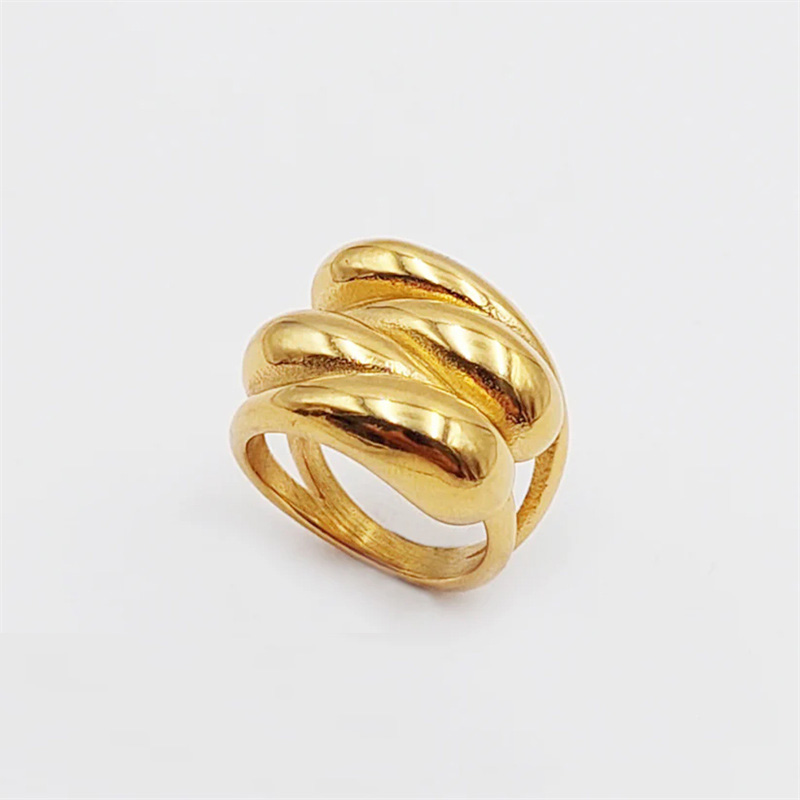
In the evolving landscape of fine jewelry, the demand for bold, sculptural pieces is reshaping manufacturing paradigms. The “Gold Chunky Waterdrop Ring” has emerged as a unisex icon—merging the organic softness of a water droplet with the architectural heft of a signet ring. Unlike mass-produced items, custom versions of this ring represent a pinnacle of precision metallurgy and digital craftsmanship.
Creating a solid gold ring of this magnitude—often weighing 20 to 40 grams—requires a departure from traditional hand-carving alone. To achieve the perfect symmetry of a water droplet while retaining the organic tactile sensation, modern workshops utilize a hybrid manufacturing ecosystem. This process combines Computer Numerical Control (CNC) technology for the master pattern with traditional lost-wax casting and hand-finishing.
Based on current industry data and metallurgical best practices, this is the step-by-step journey of the Gold Chunky Waterdrop Ring from a digital render to a physical luxury asset .
Phase 1: The Digital Sculpture (CAD & Simulation)
The “Waterdrop” geometry is deceptively complex. Unlike a sphere or a standard dome, a waterdrop features an asymmetric tension curve—stout at the base, tapering to a soft apex. For a “chunky” ring (typically 8mm to 12mm in width at the top), precision is non-negotiable.
The process begins with Computer-Aided Design (CAD) using software like RhinoGold or Matrix. The designer does not simply draw the ring; they engineer it. A critical calculation made at this stage is metal shrinkage allowance. Gold contracts as it cools. Without compensating for this in the digital file—usually scaling up the design by 2% to 2.5%—the final ring would be a half-size too small .
Once the 3D model is approved, CNC programming software converts the geometry into toolpaths. Here, the goal is not to carve the final gold but to mill a master pattern. Modern jewelry CNC machines can achieve a resolution of 15 to 20 microns, compared to 200 microns with manual methods . This resolution ensures that the “soft” ripple of the water droplet shape is mathematically perfect.
Phase 2: CNC Milling the Master Wax
While traditional lost-wax casting involves hand-carving wax, the custom chunky ring demands CNC milling. The machinist selects a block of high-density jeweler’s wax. Using a 4-axis or 5-axis CNC mill fitted with micro ball-nose bits (as small as 0.2mm), the machine begins the subtractive process .
The machine carves the waterdrop geometry layer by layer. For a chunky ring, the interior wall (the part touching the finger) must be perfectly straight or slightly concave for comfort, while the exterior swells organically. CNC technology ensures that the thickness is uniform.
Why CNC for the Master?
Human hands struggle to carve perfectly identical, high-volume rings. If a client orders a custom 9ct Gold Chunky Fluid Ring or a heavy 18k variant, the CNC ensures that the sweeping curves of the water droplet are mathematically identical to the designer’s vision . Furthermore, it eliminates the “hand fatigue” asymmetries common in manual wax carving. Once the milling is complete, the wax receives a solvent wash to remove burrs, but crucially, it is not annealed yet, as heat can distort the fine edges .
Phase 3: Spruing and Investment (The Ceramic Mold)
The delicate wax model cannot survive the molten gold. It must be sacrificed. This is the lost-wax stage.
The jeweler attaches the wax waterdrop ring to a rubber base via wax “sprues” (channels). These sprues act as highways for the molten gold and as air exits. For a chunky ring (thick cross-section), careful consideration is given to the sprue design. Unlike thin chains, a heavy waterdrop ring requires thick sprues to feed the metal quickly and prevent premature freezing, which causes porosity .
The assembly is placed into a steel flask, and investment plaster (a heat-resistant ceramic) is poured around it. The flask is then placed in a vacuum chamber. This step is vital: the vacuum pulls air bubbles out of the plaster. Even one micro-bubble on the surface of the waterdrop design will translate into a raised bump of gold, requiring extensive polishing later.
Phase 4: Burnout and Metal Selection
The flask enters a kiln for the “burnout cycle,” typically lasting 8 to 12 hours. The kiln heats to approximately 750°C (1380°F). The wax melts and vaporizes (“lost wax”), leaving a perfect hollow cavity of the waterdrop ring inside the plaster. If the CNC wax had internal stresses, they would release here, cracking the mold—which is why skilled technicians rely on precision milling .
Metal Preparation:
While the mold bakes, the gold is prepared. For a Custom Unisex Chunky Ring, the choice of alloy is crucial for the “chunky” aesthetic:
- 9ct Gold: Popular for its durability and lower cost. It is harder, making the ring resistant to scratches from daily wear.
- 18ct Gold: Contains 75% pure gold. It offers a richer color and a higher density (heavier feel). However, it is softer, so a waterdrop design in 18ct requires thicker walls to avoid denting .
The caster calculates the exact weight of gold needed. For a chunky waterdrop ring, this is often a significant investment.
Phase 5: Casting (Vacuum or Centrifugal)
The moment of creation. The jeweler retrieves the flask from the kiln (glowing red hot) and places it into a casting machine.
- Vacuum Casting: Preferred for high-detail waterdrop shapes. The vacuum pulls molten gold down into the cavity. Statistics show that vacuum-assisted casting can reduce defects in organic shapes by up to 12% compared to centrifugal methods .
- Centrifugal Casting: Uses force to sling the metal into the mold.
Molten gold at approximately 1,050°C to 1,200°C (depending on carat) is poured or injected into the cavity. The metal fills the negative space, capturing the waterdrop geometry and the texture of the CNC master. Within seconds, the gold solidifies.
Phase 6: Quenching, Cutting, and the “First Look”
Once the metal solidifies but the plaster is still hot, the flask is dropped into cold water. The thermal shock shatters the investment plaster, revealing a rough, branching tree of solid gold with the waterdrop ring attached via sprues.
This is the “raw casting.” It is covered in a black oxidation layer (from the plaster reaction). The jeweler clips the waterdrop ring off the tree using a jeweler’s saw.
The ring now looks nothing like a finished piece of jewelry. It is matte, grey-black, and has little “nubs” where the sprues were attached.
Phase 7: The Hand-Finishing Paradox
Here is the “dirty secret” of high-end CNC jewelry: the machine cannot replace the human eye. While CNC provided the perfect symmetry, hand-finishing gives the ring its soul .
Step 1: Filing and Grinding
The jeweler uses needle files to remove the sprue nubs flush with the ring’s surface. Because this is a “chunky” ring, the mass allows for aggressive filing to ensure the waterdrop profile is uninterrupted. The ring is then sanded with increasingly fine grits of abrasive paper (from 400 to 1200 grit) to remove tool marks.
Step 2: The “Fluid” Organic Touch
A pure CNC waterdrop is mathematically rigid. To make it a “Statement Chunky Fluid Ring,” the artisan may use a radial wheel or pumice to soften the edges slightly. This creates a hand-finished, brushed texture that feels organic to the touch. It removes the “machine-made” harshness while retaining the perfect silhouette .
Step 3: Polishing
The ring is mounted on a motorized polishing lathe. It is touched to different mops impregnated with polishing compounds (Tripoli for cutting, Rouge for high shine). The goal is a mirror finish that allows light to flow over the waterdrop shape like actual water. For the interior of the ring (the sleeve), a satin or high-polish finish is chosen based on client preference.
Phase 8: Hallmarking and Quality Control
Before the ring can be sold, it must be hallmarked. This is a legal certification of purity.
The ring is sent to an Assay Office (such as the London Assay Office or a local equivalent). They test the gold—usually via XRF (X-ray fluorescence) which is non-destructive—to verify it is, for example, 9ct or 18ct. They then laser-stamp or traditionally punch the hallmark into the inside of the shank. For a chunky waterdrop ring, this is easy to place without disrupting the exterior aesthetic .
Final QC:
- Dimensional check: Does it fit the size 7 or 9 ordered?
- Weight check: Is the 40-gram gold weight accurate within tolerance? .
- Visual check: Under a loupe, is there any porosity (tiny bubbles) that could cause a crack later?
Phase 9: The Unisex Appeal
The final stage is presentation. The “Gold Chunky Waterdrop Ring” is cleaned in an ultrasonic tank and steamed to remove any polishing compound residue.
The result is a piece of art that weighs heavily in the hand—solid, not hollow . It appeals to men because of its architectural mass and “signet ring” presence on the finger. It appeals to women as a statement piece, often worn on the index or middle finger, juxtaposed against delicate chains or minimalist outfits.
The Manufacturing Verdict
The process of creating a Custom Gold Chunky Waterdrop Ring is a marriage of cold, hard engineering and warm craftsmanship. CNC technology provides the reliability (reducing defect rates from ~15% in manual carving to under 2%) . Traditional casting provides the density and weight that defines luxury.
For the modern jewelry buyer, understanding this process clarifies the price tag: you are paying for the micron-perfect CAD modeling, the risk of the burnout cycle, the volatile price of solid gold, and the hours of hand-polishing required to make a waterdrop truly shine.
Whether in 9ct yellow gold for daily wear or 18ct white gold for a wedding stack, this ring is a testament to how technology has amplified, rather than replaced, the ancient art of the goldsmith.