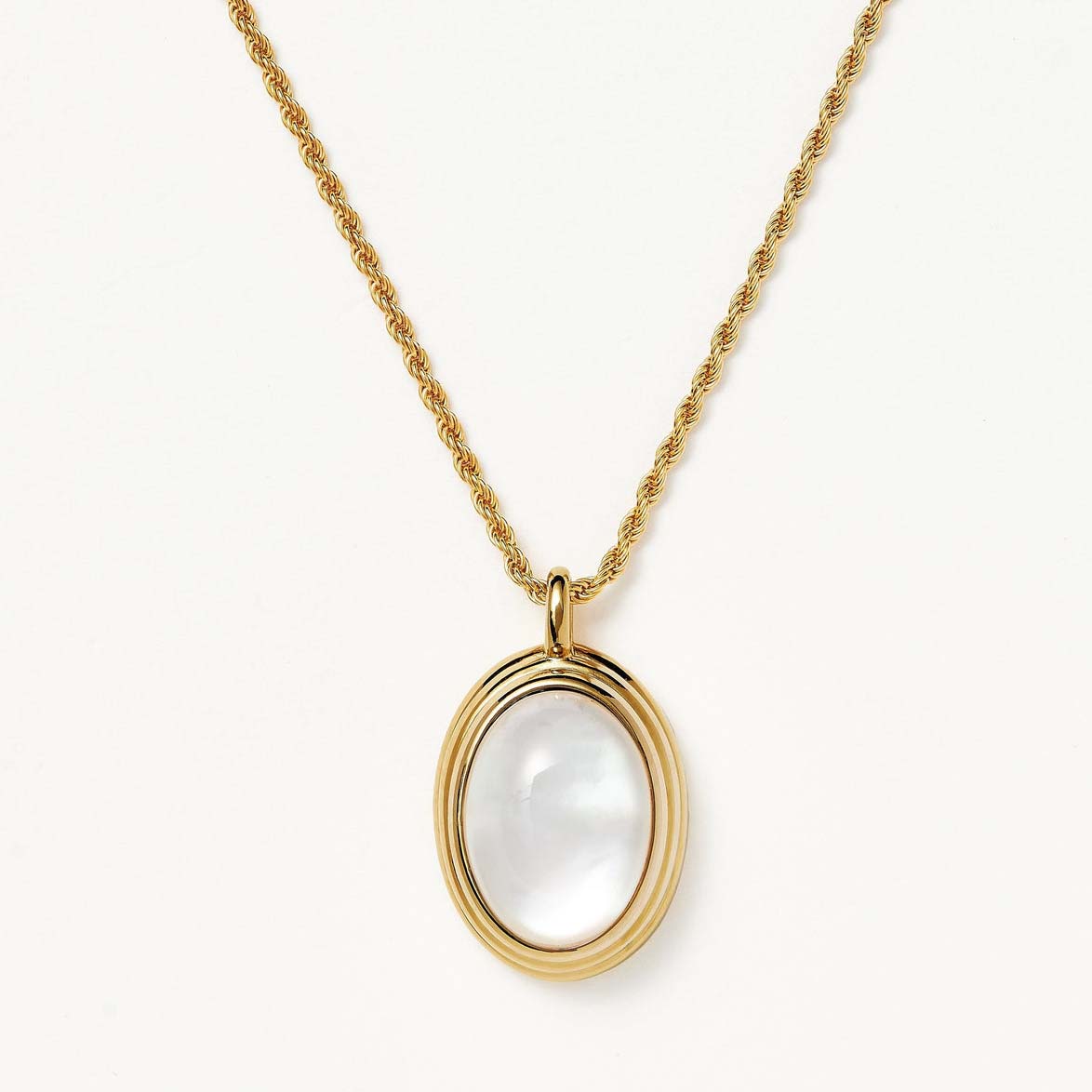
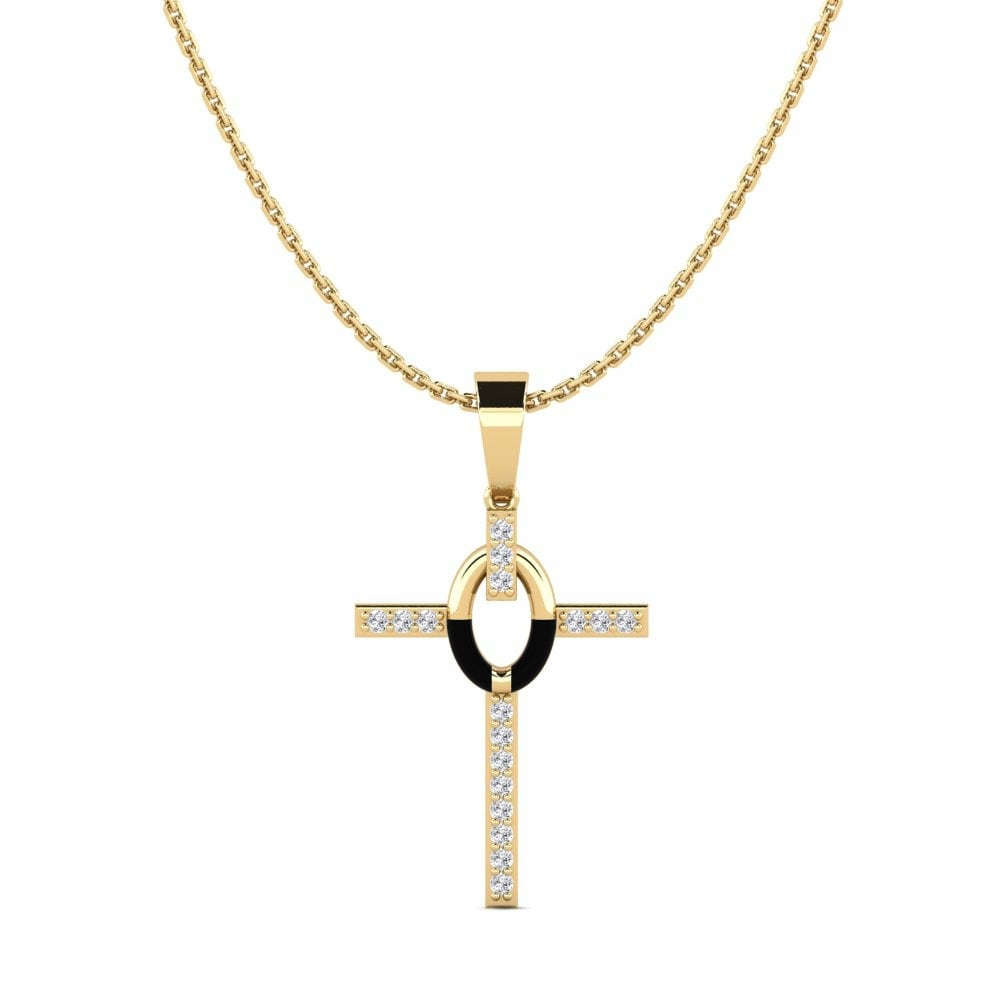
JINGYING : Custom Design Fashion Necklace in Sterling Silver manufacturer
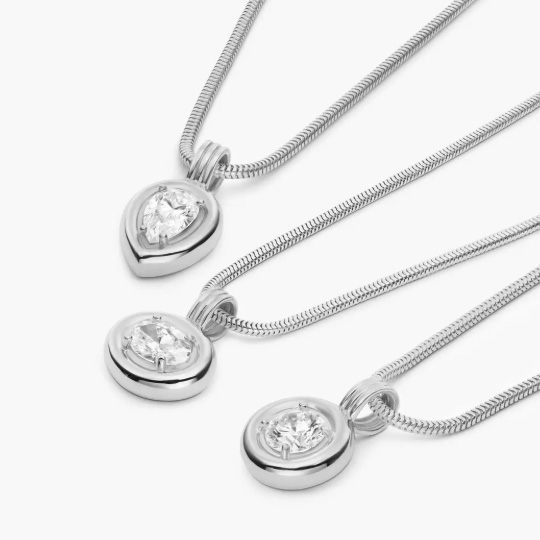
JINGYING : Custom Design Fashion Necklace in Sterling Silver manufacturer
LET’S GET STARTED : mo@kingjy.com
Beyond the Chain: The Art and Engineering of Custom Sterling Silver Necklaces at JINGYING
In the global jewelry industry, sterling silver occupies a unique position. It is a democratizing force—offering the whiteness of platinum and the warmth of gold at an accessible price point. However, for the modern brand, sourcing a sterling silver necklace is not merely about procuring a metal chain. It is about capturing identity, ensuring durability, and delivering a unboxing experience that resonates with the end consumer.
JINGYING Jewelry has spent over two decades (since 1998) perfecting the alchemy of this process . As a leading OEM/ODM manufacturer in Guangzhou, JINGYING has moved far beyond simple casting. The company represents a convergence of German-engineered CNC precision, Japanese micro-inlay technology, and Italian design aesthetics, all applied to the humble 925 sterling silver necklace.
This article explores why JINGYING has become the benchmark for custom design fashion necklaces, dissecting the technical specifications, the manufacturing philosophy, and the hidden engineering that turns a simple sketch into a best-selling jewelry asset.
Part 1: The Material Advantage – Why 925 Sterling Silver Defines Fashion
Before a single mold is cut, the material must be chosen. In the world of fashion jewelry, there is a massive gap between “disposable costume jewelry” and “fine jewelry.” JINGYING anchors its production strictly in the latter, using 925 Sterling Silver.
1.1 The Metallurgy of Performance
Many consumers fear jewelry that turns their skin green or tarnishes after two wears. JINGYING solves this at the metallurgical level.
- The Composition: Sterling silver is defined as 92.5% pure silver and 7.5% copper (or other alloys). This specific ratio provides the tensile strength required for thin necklace chains while retaining the hypoallergenic properties of pure silver .
- The Guarantee: JINGYING utilizes XRF (X-ray fluorescence) analyzers to test every batch of incoming raw silver. This non-destructive testing verifies the purity down to 0.1%, ensuring that the final product carries the legal “925″ stamp with integrity .
1.2 The Plating Paradox: Vermeil and Rhodium
Raw silver is reactive; it tarnishes when exposed to sulfur in the air. To make a necklace “waterproof & sweat-proof,” JINGYING employs a rigorous double-plating system .
Unlike mass-market manufacturers who flash-plate (a layer measured in nano-meters), JINGYING uses 3-micron thick plating as a standard for gold finishes—a thickness that qualifies as “Vermeil” in the US market. For silver color finishes, they utilize Rhodium, a platinum-group metal harder than silver, which provides a mirror-like, scratch-resistant finish that never needs polishing .
Part 2: The JINGYING Workflow – From Concept to Masterpiece
Customization is the buzzword of the decade, but few manufacturers can execute it without prohibitive MOQs or quality loss. JINGYING’s process is segmented into four distinct phases: Design, Molding, Casting, and Setting.
Phase 1: The Digital Atelier (CAD & Original Design)
The process begins with a “spark.” Whether a brand arrives with a napkin sketch, a mood board, or a 3D file, JINGYING’s design team transforms it into a manufacturable reality using Computer-Aided Design (CAD) .
- The Rendering: The design team maps the thickness, the weight of the silver, and the center of gravity. For a necklace, balance is crucial—a pendant that flips over is a design failure. Engineers calculate the exact position of the bail (the hoop connecting the pendant to the chain) to ensure the pendant hangs flush against the chest.
- Rapid Prototyping: Once the CAD is approved, the design is 3D printed in high-resolution wax. This allows the client to hold the necklace before any metal is cast, offering a “tactile approval” stage that eliminates guesswork .
Phase 2: Precision Mold Making (CNC Mastery)
This is where JINGYING diverges from standard competitors. Many jewelry factories use hand-carved waxes, which can have millimeter-level deviations. JINGYING uses CNC (Computer Numerical Control) machining to carve the master mold directly out of solid brass or silver .
- Why it matters: A CNC-milled master is perfectly symmetrical. For a necklace pendant with sharp geometry (like a logo or a specific architectural shape), CNC ensures that the edges are razor-sharp and the curves are mathematically smooth. This precision is transferred to the rubber molds, ensuring that every single piece in a 10,000-unit order looks identical to the prototype.
Phase 3: Lost Wax Casting (High-Temperature Integrity)
The production process utilizes the ancient “lost wax” method but with modern industrial efficiency.
- The rubber mold is injected with wax to create a tree of necklace components.
- The wax tree is invested in a plaster-like material, which hardens into a mold.
- The mold is fired in a kiln at extreme temperatures (approx. 1,000°C+). The wax melts and burns away, leaving a perfect cavity.
- Molten 925 silver is forced into the cavity via centrifugal or vacuum casting machines, filling every microscopic detail .
Phase 4: The Finishing Line (Assembly & Setting)
Once the raw silver castings are clipped from the tree, the “rough” stage begins.
- Tumbling & Polishing: The raw castings are placed in a tumbler with steel shot and polishing compounds to smooth the surface.
- Stone Setting: JINGYING has invested heavily in Japanese Micro-inlaid machines for stone setting. This technology allows for “micro-pave” settings where 1.0mm to 1.5mm cubic zirconia (CZ) or moissanite stones are set so close together that the metal between them is nearly invisible, creating a “floating diamond” effect . Their quality control (QC) includes a “drop test” (dropping the necklace from 3 meters) and a “steel needle test” to ensure zero stones fall out .
Part 3: The Product Portfolio – Defining the Fashion Necklace
While JINGYING produces rings and earrings, the fashion necklace remains the flagship category for brand expression. The company specializes in three distinct sub-categories:
3.1 The Statement Pendant (Motif Jewelry)
This includes symbolic designs such as the Four-Leaf Clover (faith, hope, luck, love) or celestial motifs (stars and moons). For these pieces, JINGYING often utilizes Moissanite.
- Why Moissanite? Moissanite is lab-grown silicon carbide. It has a refractive index (2.65 – 2.69) higher than that of a diamond (2.42), meaning it sparkles more. For a brand selling luxury fashion necklaces at a mid-tier price point, Moissanite offers the optics of a diamond without the ethical or financial baggage .
3.2 The Layering Chain (The Foundation)
The chain itself is often overlooked, but JINGYING pays meticulous attention to the “clasp.”
- The Engineering: A necklace is only as secure as its clasp. JINGYING uses CNC technology to manufacture lobster clasps and magnetic clasps with internal springs that are tested for cycles. A standard clasp might break after a few months; a JINGYING CNC-machined clasp is designed to withstand thousands of open-close cycles without losing tension .
3.3 The Multi-Material Fusion (Gold & Silver)
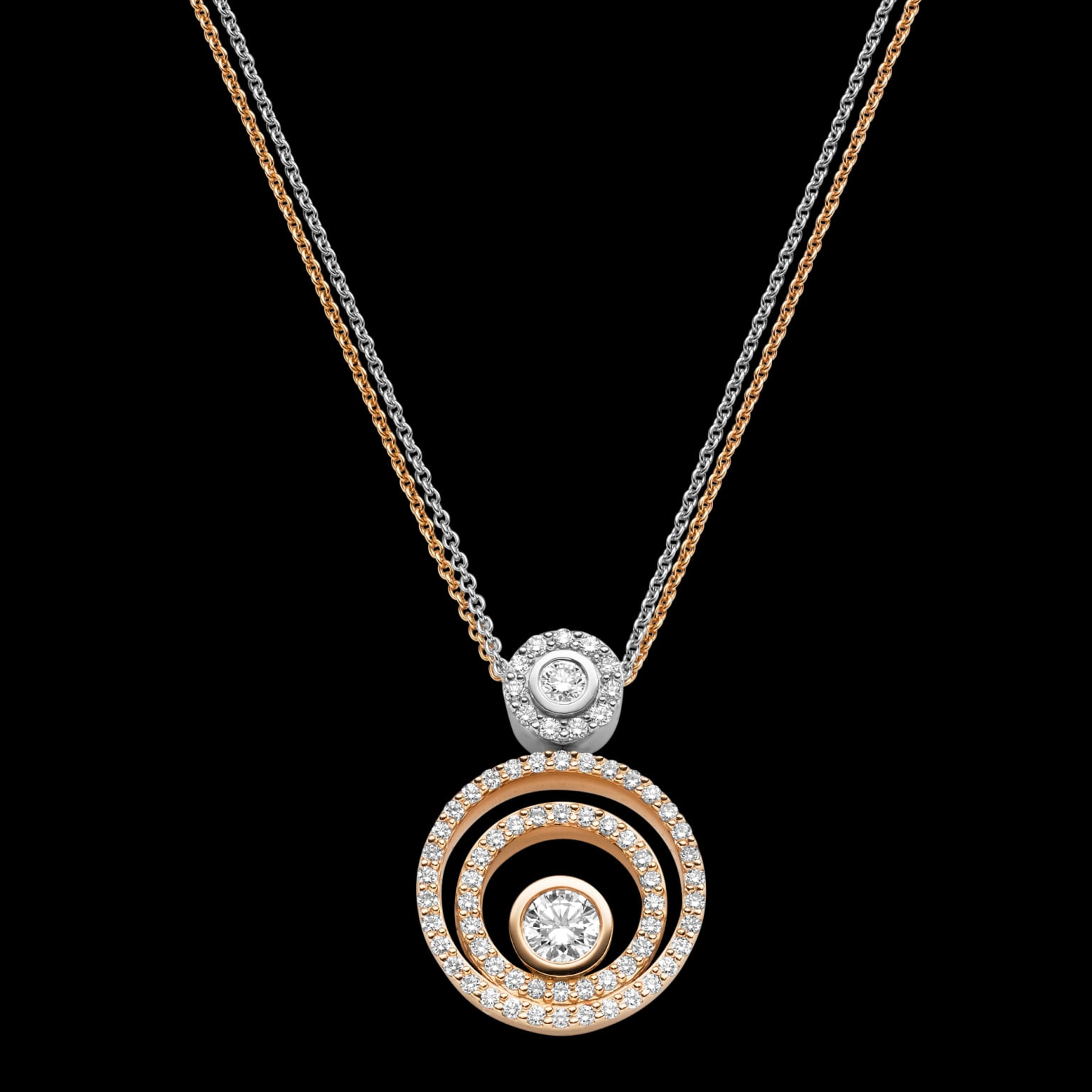
JINGYING excels at “two-tone” designs. A sterling silver necklace can be masked and partially plated with 14k, 18k, or 24k Gold (Yellow, White, or Rose).
- The Technique: By plating silver with rose gold, the piece achieves the “vermeil” standard, offering the warmth of gold but the weight and affordability of silver. This is highly popular for fashion brands releasing seasonal colors .
Part 4: Quality Control – The “Zero Lost Stone” Policy
One of the most frustrating experiences for a jewelry buyer is losing a stone from a new necklace. JINGYING has operationalized a strict anti-loss protocol.
- The Tensile Test: In their facility, QC engineers use professional steel needles to probe every set stone. If a stone can be popped out with the needle, it fails.
- The Drop Test: Items are dropped from a height of 3 meters onto a hard surface. If a stone falls out, the entire batch is re-examined .
- Plating Adhesion: They perform a “rubbing test” using professional tools to manually abrade the metal surface for five minutes. If the gold does not flake or discolor, the batch passes .
This level of quality is why JINGYING offers repair guarantees (typically 3-6 months) for non-human-damaged quality issues—an assurance rarely given by wholesale manufacturers .
Part 5: Why Brands Choose JINGYING (B2B Value Proposition)
For a Western fashion brand or a jewelry startup, choosing a manufacturer in Guangzhou is a decision fraught with risk. JINGYING mitigates this through transparency and capacity.
5.1 Logistics Capacity
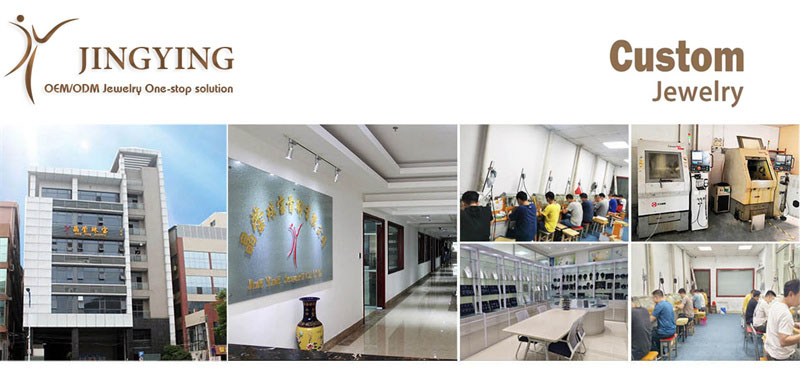
JINGYING operates a substantial facility (over 1,100 square meters) with a workforce exceeding 150 skilled artisans . The monthly production capacity exceeds 50,000 to 100,000 pieces . This scalability means they can handle a small batch of 100 pieces for a test launch or a bulk order of 10,000 pieces for a global retail chain.
5.2 Speed to Market
- Sampling: 7 days (rapid prototyping via 3D printing).
- Mass Production: 20-30 days (depending on stone setting complexity) .
5.3 Intellectual Property (IP) Protection
Brands are terrified of their designs being copied. JINGYING operates with strict Non-Disclosure Agreements (NDA) and confidential production lines. They are a B2B partner, not a B2C retailer, so your design stays your own.
5.4 Certification
The factory adheres to international standards including ISO9001:2016 (Quality Management) and SA8000 (Social Accountability), ensuring ethical working conditions and consistent manufacturing protocols .
Part 6: Case Study – The Four-Leaf Clover Moissanite Necklace
To understand JINGYING’s execution, examine a flagship product: the *Custom 925 Sterling Silver Four-Leaf Clover Moissanite Pendant Necklace with Rose Gold Plating* .
- The Design Challenge: Creating a four-leaf clover motif that looks organic (nature-inspired) but has the structural integrity to hold stones on thin “petals.”
- The JINGYING Solution: The master mold is CNC-machined to ensure each of the four heart-shaped petals is geometrically identical. The petals are then micro-paved with round brilliant moissanite stones.
- The Finish: The base is 925 silver, plated with a thick layer of rose gold. The contrast between the warm rose gold and the brilliant white moissanite creates a “pop” effect on the skin.
- The Result: A piece that retails as “Luxury Fashion” but is manufactured at an accessible cost, allowing the brand to achieve high margins.
Conclusion: The Future of Fashion Jewelry is Engineered
The days of flimsy, tarnishing fashion necklaces are ending. The modern consumer is educated; they know what 925 means, and they know the difference between a glued-in stone and a prong-set stone.
JINGYING Jewelry represents the next generation of manufacturing: a fusion of artisan hand-finishing with CNC precision. For a brand looking to launch a custom necklace line, the choice of manufacturer dictates the brand’s reputation.
With JINGYING, brands are not just buying silver; they are buying security (no lost stones), longevity (3-micron plating), and precision (CNC geometry).
Whether it is a minimalist bar necklace, a sparkling moissanite pendant, or a heavy curb chain, JINGYING has the technical stack to bring it to life. For brand owners, designers, and retailers, the path to a successful jewelry line begins not with a sketch, but with a conversation about engineering.
Contact JINGYING:
For OEM/ODM inquiries and custom design consultations, reach the sales team directly at mo@kingjy.com .