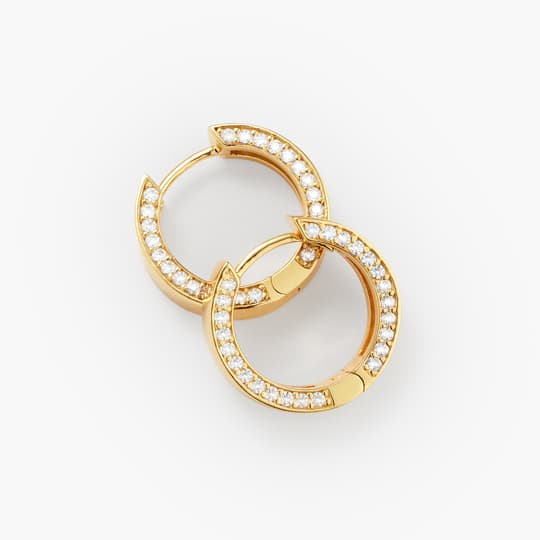
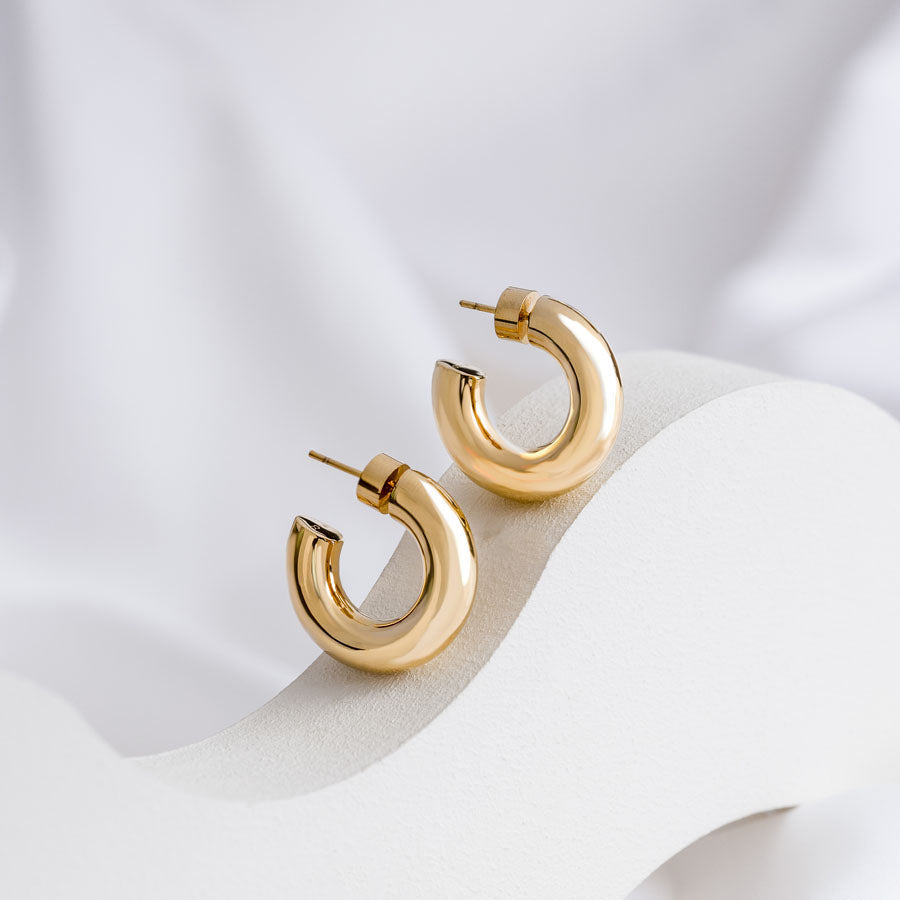
CUSTOM MAKE GOLD BROWN CRYSTAL C-SHAPED HOOP EARRING AT JINYING
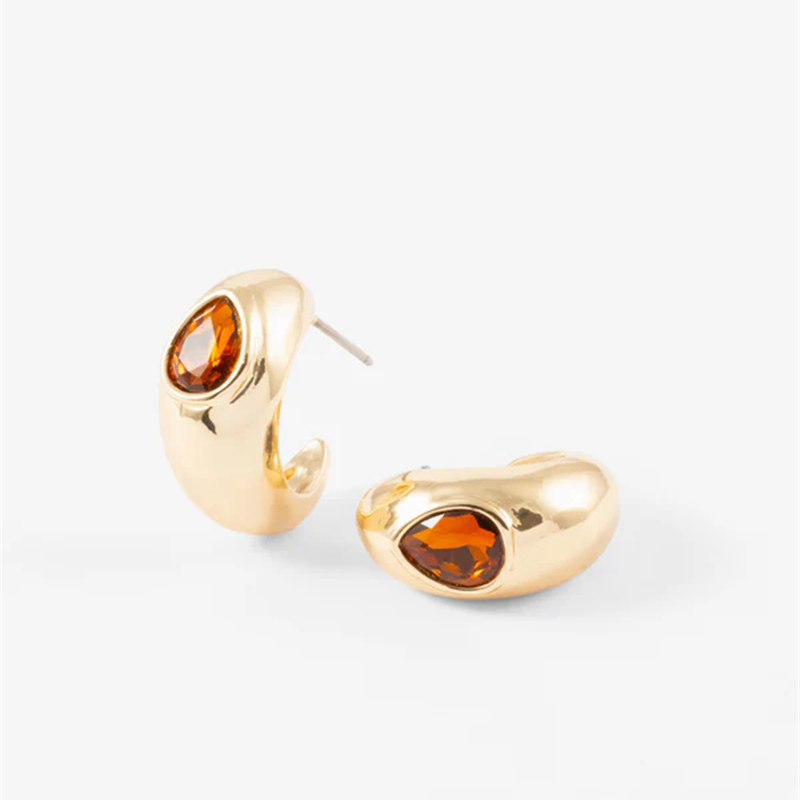
CUSTOM MAKE GOLD BROWN CRYSTAL C-SHAPED HOOP EARRING AT JINYING
LET’S GET STARTED : mo@kingjy.com
The Alchemy of the Arc: Crafting Gold-Brown Crystal C-Shaped Hoop Earrings at Jingying
Introduction: The Geometry of Light
In the constellation of jewelry design, the hoop is the most primitive and persistent form—a circle signifying eternity, unity, and the cyclical nature of life. Yet, at Jingying, we have chosen to break the circle. The “C” shape, or the open hoop, represents a different philosophy: it is the embrace that leaves room for breath, the unfinished thought that invites completion, and the tension of a line that yearns to meet its other end. When this broken circle is rendered in the warm, terrestrial glow of gold-brown crystal, it ceases to be merely an accessory; it becomes a piece of captured sunlight.
Creating a gold-brown crystal C-shaped hoop earring is not merely a manufacturing process; it is a dialogue between fire and earth, precision and artistry. At Jingying, our workshop is a sanctuary of this dialogue. Here, we do not simply produce jewelry; we cultivate it. The journey from a raw bar of metal and a rough-hewn crystal to a luminous earring involves over forty meticulous steps, but we can distill the essence into four fundamental pillars: the creation of the “C” frame, the preparation of the crystal, the setting of the stone, and the art of finishing.
Part I: The Armature – Forging the “C”
The soul of the earring is its frame. For the C-shaped hoop, structural integrity is paramount. Unlike a closed hoop, which derives its strength from its continuous geometry, the open “C” carries its load on its terminals. If the metal is too soft, the earring will warp; if too hard, it will be brittle. At Jingying, we primarily use 925 sterling silver or 14k gold-filled wire, chosen not only for their hypoallergenic properties but for their “memory”—the ability to hold a shape while offering a whisper of flexibility for the wearer.
Step 1: The Metallurgical Prelude
We begin with the raw material: a wire rod, 2.5mm in thickness. Before any shaping occurs, the metal must be annealed. Annealing is the process of heating the metal to a specific temperature (roughly 600°C for silver, 650°C for gold-filled) and then quenching it in water. This is not merely to soften it; it is to reset the metallic grain structure. When a metal is worked, its crystalline lattice becomes distorted and hard. Annealing releases that tension, returning the metal to a state of ductility. At Jingying, we have an experienced hand for this—we watch for the “glow,” that faint cherry-red hue that signals the metal is ready to be remade.
Step 2: The Draw and the Arc
The soft wire is then passed through a rolling mill to achieve the precise gauge of the earring. For a C-shape to sit elegantly on the ear, the center of the arc must be thicker than the tips to provide structural support, or vice versa, depending on the design. We use a “draw plate” to achieve the exact 1.8mm gauge required.
The shaping begins on a mandrel—a cylindrical steel tool that dictates the curvature. The C-shape is not a semicircle; it is a three-quarter circle, leaving a gap of approximately 8mm for the post. Using a nylon mallet (to avoid marring the surface), the artisan gently taps the wire around the mandrel, coaxing it into the “C” without rushing. Speed is the enemy of symmetry. The artisan’s eye ensures that the arc is perfect; the ends must align on a level plane to ensure the earring hangs straight once the crystal is set.
Step 3: The Binding – The Post and Hinge
The functional core of the earring is the post. At Jingying, we prefer a “French wire” or a standard post, but for the C-shape, a sleek, hidden hinge is often favored. A small cylinder is soldered to the top terminal of the “C”. This requires a laser welder, as traditional torch soldering could melt the delicate curve. The laser allows us to direct heat precisely to a millimeter-square area, fusing the hinge component without altering the temper of the rest of the hoop. This hinge will house the earring post, ensuring the C-shape clicks securely into place.
Part II: The Heart – The Gold-Brown Crystal
If the metal is the skeleton, the crystal is the heart. “Gold-brown” is a color that defies easy description. It is the hue of autumn leaves at sunset, the sheen of aged whiskey in a crystal decanter, or the gleam of a tiger’s eye. However, in the world of crystals, this color is rarely natural; it is an alchemy of science.
Step 4: Sourcing and Cutting
At Jingying, we do not work with glass rhinestones; we work with high-lead crystal (usually 32% PbO) sourced from regions renowned for optical clarity. The gold-brown color is achieved through a “metallic oxide doping” process during the crystal melt—adding gold chloride (for a pink/brown undertone) and iron oxide (for the golden warmth).
The rough crystal arrives as a “boule” or a block. We cut these into “cabochons” for the C-shape, because a C-shape is often too dynamic for faceted corners. A cabochon—a flat-bottomed, domed-top stone—creates a gentler, more organic feel, ideal for the fluidity of the “C”. The cutting is done on a diamond-edged circular saw, lubricated with water to prevent thermal shock. The shape is specifically sized to fit the interior of the “C” – often a teardrop or an oval that fills the void of the curve.
Step 5: The Grinding and Polishing
The rough-cut stone is then passed to the grinding wheel. Here, the artisan sands the edges to fit the bezel of the earring perfectly. This is a delicate operation; a fraction of a millimeter too much, and the stone will rock in its setting. Too little, and it won’t sit flush. The dome of the crystal is ground using progressively finer grits—from 120 grit to 600 grit—until the surface is opaque and smooth. Then comes the polishing step. We use a felt wheel with cerium oxide powder. This is the “magic dust” that brings the gold-brown color to life. As the cerium oxide fills the microscopic scratches, the light begins to refract properly. The color transforms from a dull mud-brown to a vibrant, glowing amber, revealing the depth of the crystal.
Part III: The Marriage – Setting the Crystal into the “C”
This is the most critical phase of the process. The setting, or “mounting,” is where the “C” frame and the crystal become a single entity. In the Jingying workshop, we utilize a “bezel setting” for the C-shape. A bezel is a strip of metal that wraps around the edge of the stone, holding it in place without prongs. For a dynamic “C” shape, prongs can catch on clothing, but a bezel offers a smooth, continuous line.
Step 6: Fabricating the Bezel
A thin strip of gold-filled metal is formed into a circle matching the base of the crystal. This bezel wire is soldered onto the front of the “C” frame, exactly where the crystal will sit. The artisan uses a jeweler’s saw to cut a “seat” or a ledge inside the bezel. This seat is the shelf upon which the crystal will rest. It must be impeccably level; if it is tilted, the entire earring will appear skewed.
Step 7: The Drop and the Burnish
Before setting the stone, the crystal is dropped into the bezel to check the fit. It should drop in with a satisfying “click” of tolerance—not too tight, not too loose. The artisan then uses a “pusher”—a flat, polished steel tool—to gently fold the bezel wall over the edge of the crystal. This is done on a “bezel roller” or with a series of fine “punching” movements.
However, the gold-brown crystal is notoriously brittle. Too much pressure, and the dome will shatter from the inside. The pressure must be applied not to the crystal itself but to the metal, rolling it over the edge like a blanket. We use a “burnisher” to finally smooth the bezel over the stone. The burnisher is made of hardened steel, and it works by friction, pushing the metal a micron at a time. The final pass of the burnisher is done with a lubricant to achieve a mirror-like finish on the bezel rim, framing the gold-brown crystal like a sunset in a window.
Part IV: The Refinement – The Jingying Standard
The piece is now an earring, but it is not yet a Jingying piece. The “C” shape must be flawless. We spend nearly half our time not making the earring, but finishing it.
Step 8: Sanding and Polishing the Metal
The soldered joints need to be hidden. We use a sequence of sanding sticks—from 400 grit to 2000 grit—to blend the bezel into the base wire of the “C.” We sand across the grain to remove scratches and then along the grain to create a uniform texture. The interior of the “C” (the concave side) is the trickiest. We use rubberized polishing wheels and cotton mops loaded with “Tripoli” compound (a coarse polish) and then “Rouge” (a fine red polish). The earring is held against a rotating polishing spindle, and the artisan moves the metal to catch the light. The goal is a “specular” finish—a reflection so clear that you can see the workshop’s fluorescent lights reflecting off the gold-brown hue of the crystal.
Step 9: The Electroplating
For longevity, the earring is sent for electroplating. We use a “Rhodium” plating over the sterling silver to prevent tarnishing, but for the gold-filled version, we often apply a thin layer of 18k gold plate to enhance the “gold-brown” theme, making the metal casing as warm as the crystal. This happens in a chemical bath where the earring is connected to an anode, and a current deposits a layer of precious metal atoms onto the surface.
Step 10: Quality Control – The “Eye of Jingying”
Before packaging, the earring goes through a battery of tests. This is not a mechanical checklist; it is a human inspection.
- The Symmetry Check: The “C” is placed on a graph paper grid. Are the tips equidistant? Is the arc smooth?
- The Drop Test: The earring is held at a height of 15cm and dropped onto a leather pad. Does the stone rattle? If the bezel is too tight, the stone will crack internally; if too loose, it will move. The drop test reveals the “tone” of the setting. A good setting sings—a solid “thud” of a seated stone.
- The Light Test: The earring is held under a 10x triplet loupe (magnifying glass). We look for “sparkle” or “fire” in the crystal—the dispersion of light into spectral colors. The gold-brown should have a subtle green flash in the center and a red glow at the edges.
- The Assembly Test: The post is inserted into the hinge and engaged. It must click with a definitive snap, indicating that the spring tension is perfect.
Part V: The Human Element – Why Jingying?
I have often been asked, “Why not just machine these? A CNC machine can cut a C-shape in seconds. A robot can set a stone.” Indeed, this is a valid question. The answer lies in the etymology of “Jingying,” which translates to “precision” or “brilliance” but also implies “spirit.” In our workshop, every C-shaped hoop has a unique “soul” because the human hand introduces a variable that machines cannot: empathy.
When a machine sets a stone, it uses a predetermined pressure. It does not “feel” the crystal giving way. At Jingying, our artisans have trained for years to interpret the “feedback” of the metal. We feel the burnisher “grabbing” against the bezel. We hear the high-pitched whine of the polishing motor change pitch as the metal smooths out. We sense the heat of friction and know when to stop and dip the piece in water to cool it.
The C-shape is particularly demanding because it is an “open” form. It must be weighted perfectly. If we add a heavy crystal on one side, the earring will droop on the ear. Thus, we often adjust the thickness of the metal wall on the “top” arm of the C to counterbalance the weight of the bottom. We might hollow out the back of the top curve to reduce weight, ensuring the earring sits flush against the lobe. This kind of weight distribution mathematics is intuition gained over time—it is the “art” within the “craft.”
Conclusion: The Resonance of the Arc
As the finishing touches are applied—a final wipe with a micro-fiber cloth to remove finger oils, a delicate placement in the Jingying velvet box—the earring is ready. The gold-brown crystal glows with an inner light, the warm metal hugs it securely, and the open “C” shape promises elegance.
Wearing a Jingying gold-brown crystal C-shaped hoop is not about ostentation. It is about quiet confidence. The open hoop frames the neckline without overwhelming it. The terrestrial warmth of the gold-brown complements every skin tone, from porcelain to ebony. It reflects the light of the wearer, not just the light of the sun.
In the end, making this earring is a process of reduction. We take a block of metal and reduce it to a line. We take a rough stone and reduce it to a gem. We take the infinite and reduce it to a finite form that captures the infinite—the arc of a sunset, the curve of a smile, the gesture of a hug. At Jingying, we don’t just craft earrings; we crystallize moments. And in the gold-brown glow of the C-shape, we hope the wearer sees not just a piece of jewelry, but a piece of themselves—beautifully formed, perfectly imperfect, and open to the possibilities of the world.
This concludes the technical and philosophical guide to crafting the Gold-Brown Crystal C-Shaped Hoop Earring at Jingying.