Custom Factory Of Italian 14kt Two-Tone Gold Oval-Link Bracelet
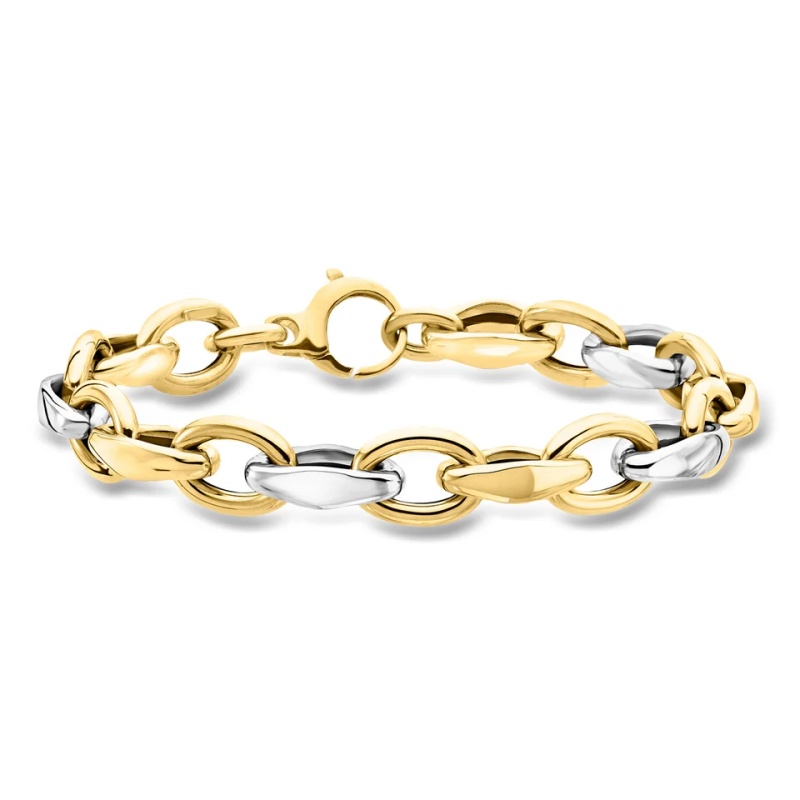
Custom Factory Of Italian 14kt Two-Tone Gold Oval-Link Bracelet
LET’S GET STARTED : mo@kingjy.com
How to Custom an Italian 14kt Two-Tone Gold Oval-Link Bracelet at JINGYING
Introduction: The Allure of Italian Two-Tone Gold
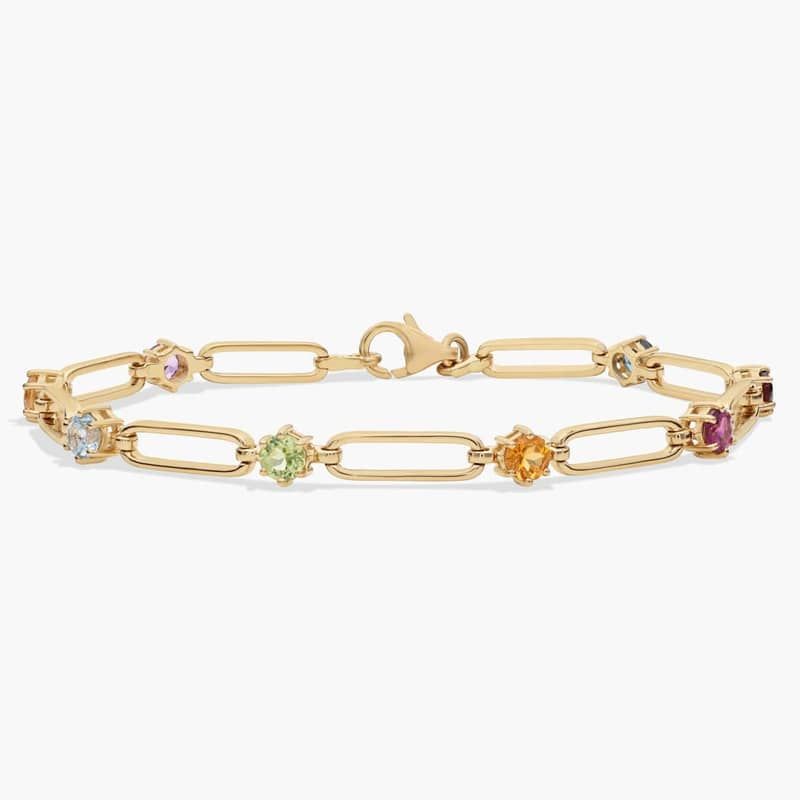
The Italian 14kt two-tone gold oval-link bracelet represents a convergence of Old World artistry and modern customization demands. Characterized by the rhythmic interplay of yellow and white gold oval links, this bracelet style has become a cornerstone of luxury jewelry collections, retailing at prestige brands for upwards of $2,995 for an 8.3-gram piece. What distinguishes the Italian tradition is not merely the material—14-karat gold, an alloy of 58.5% pure gold—but the engineering philosophy behind it. Italian goldsmiths have historically prioritized fluid articulation and impeccable finishing, ensuring that each link moves with the wrist rather than against it.
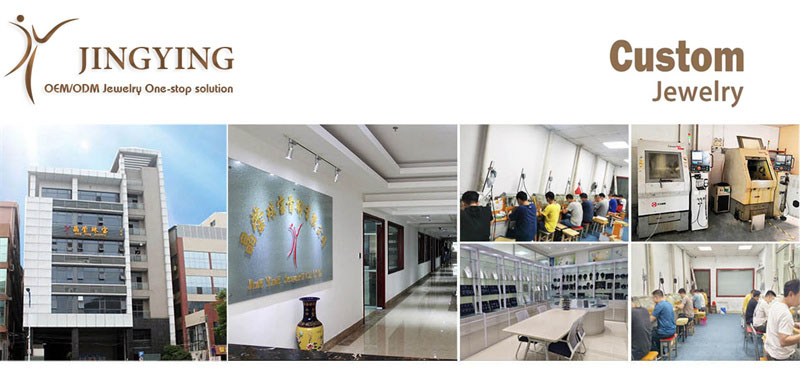
For brands and designers seeking to develop their own iteration of this classic, JINGYING Jewelry offers a comprehensive OEM/ODM customization pathway. Founded in 1998 and operating from a 15,000-square-meter facility in Guangzhou, JINGYING has evolved from a small workshop into a vertically integrated manufacturer exporting to over 30 countries. The company specializes in 9K, 10K, 14K, and 18K gold jewelry, producing pieces that satisfy the technical and aesthetic requirements of the Italian two-tone oval-link archetype. This article provides a detailed, step-by-step guide to navigating that customization process—from initial consultation through final quality assurance—while examining the material science, design variables, and manufacturing protocols that define a JINGYING collaboration.
Phase One: Consultation and Design Brief
The customization journey at JINGYING does not begin with metal or machinery; it begins with a conversation. According to the company’s documented workflow, the first step involves direct communication between the client and JINGYING’s design team to establish the “intention” of the piece: the accessory type, the color palette of any gemstones, the budget range, and the preferred aesthetic direction. For a two-tone oval-link bracelet, this consultation establishes several critical parameters that will govern every subsequent decision.
First, the client must specify the desired wrist circumference. Unlike bangles that slide over the hand, oval-link bracelets with lobster clasps require precise sizing. JINGYING’s guidance recommends measuring the wrist at its widest point using a rope or measuring tape, then adding 1 to 2 millimeters of tolerance to accommodate variations in hand bone structure and to prevent discomfort during wear. For oval-shaped bracelet designs specifically, an additional 2 millimeters should be added to the appropriate inner diameter to ensure the links articulate without binding. This attention to ergonomic detail distinguishes a professionally fitted bracelet from a generic retail offering.
Second, the consultation addresses the two-tone color strategy. The “two-tone” designation in the Italian tradition most commonly refers to a combination of 14kt yellow gold and 14kt white gold, though rose gold and white gold combinations are also viable. The client must decide whether the two metals will alternate link-by-link, whether one metal will serve as the primary structure with the other as accent detailing, or whether a more complex graduated pattern will be employed. JINGYING’s designers can provide reference imagery and material samples to facilitate this decision, drawing upon the company’s extensive archive of completed projects.
Third, the consultation establishes intellectual property protections. For unique or proprietary designs, JINGYING executes a Non-Disclosure Agreement before any design work commences, ensuring that the client’s original concepts will not be replicated for competitors. This is particularly important for brands developing signature collections where the two-tone oval-link bracelet serves as a core product.
Phase Two: Material Science and Alloy Specification
Once the design brief is finalized, the project transitions to material sourcing and alloy formulation. This phase is where JINGYING’s metallurgical expertise becomes most visible. The “14kt” designation means the alloy contains 58.5% pure gold, with the remaining 41.5% composed of copper, silver, zinc, and other metals selected to achieve specific color and mechanical properties. For two-tone bracelets, this means two distinct alloy batches must be formulated and tracked separately throughout production.
For the yellow gold component, JINGYING’s internal protocols emphasize tensile strength and color consistency. A typical 14kt yellow gold alloy might incorporate 58.5% gold, with copper and silver in proportions that yield a warm, saturated yellow hue. For the white gold component, the alloy requires the addition of palladium or nickel to neutralize the natural yellow of gold, followed by rhodium plating to achieve the bright, reflective white finish characteristic of high-end Italian two-tone jewelry. Before any metal is melted, JINGYING employs X-ray fluorescence spectrometry to verify the alloy composition, rejecting any batch that deviates beyond a ΔE<1.0 threshold in CIELab color measurement.
This rigorous quality control extends to the raw gold itself. JINGYING sources gold from established supply chains and maintains batch traceability for every order. For clients requiring GIA certification on any set stones, the company can accommodate that documentation requirement as part of the production package. The material cost of the finished bracelet is calculated according to a transparent formula: the actual weight of gold used multiplied by the daily gold price, plus the stone cost (if applicable), plus labor and design fees. This transparency allows clients to understand precisely where their investment is allocated.
Phase Three: CAD Engineering and Design for Manufacturing
With materials specified, the design enters the digital realm. JINGYING’s CAD engineers convert the client’s sketches, reference photos, or existing CAD files into high-resolution 3D models. However, the process is not a simple digitization; it involves a Design for Manufacturing analysis that anticipates and resolves production challenges before they occur.
For an oval-link bracelet, several technical parameters must be optimized. The dimensions of each oval link—typically ranging from 10mm to 15.5mm in width for a substantial two-tone piece—determine the visual weight and flexibility of the bracelet. The wall thickness of each link must be sufficient to withstand daily wear without deforming, yet thin enough to maintain the elegant proportions associated with Italian design. JINGYING’s CAD team calculates the precise gap between links to ensure smooth articulation without snagging on clothing or skin. The weight distribution of the clasp and any decorative elements is adjusted to prevent the bracelet from rotating on the wrist.
The tolerance standards at this stage are exacting. JINGYING’s CNC waxing process allows for a precision tolerance of ±0.01mm, ensuring that every link in the production run is dimensionally identical. For two-tone designs, the CAD model must account for the different shrinkage rates of yellow and white gold during casting, a subtle variable that can cause misalignment if not properly compensated. The engineering team performs a DFM review that includes stress point analysis and simulation of the casting process, identifying any undercuts or thin sections that might cause porosity or incomplete fill.
Phase Four: Casting, Assembly, and Two-Tone Integration
The transition from digital model to physical metal occurs through lost-wax casting. JINGYING utilizes SLA/DLP 3D printers to produce high-resolution wax patterns for each component. For an oval-link bracelet, the links are typically cast as individual units rather than as a continuous chain, because the undercuts and articulating joints cannot be efficiently stamped from flat sheet metal. The wax patterns are assembled onto a “tree” and invested in a plaster mold, which is then heated to melt away the wax, leaving a negative cavity. Molten gold alloy is centrifugally cast into this cavity, and after cooling, the plaster is broken away to reveal the raw cast links.
The two-tone integration occurs at the assembly stage. Yellow gold links and white gold links are cast separately from their respective alloys, then joined through a combination of laser welding and mechanical interlocking. Laser welding is preferred over traditional soldering because it produces a cleaner joint with minimal heat-affected zone, preserving the color and finish of both gold alloys. Each link is individually inspected for dimensional accuracy and surface quality before assembly.
The clasp selection is another customization variable. JINGYING offers lobster claw clasps, box clasps with safety catches, and toggle clasps, each with specific advantages for different wearer preferences. A lobster clasp, common in Italian bracelet designs, provides secure closure with a familiar mechanism. For higher-end pieces, a box clasp with a figure-eight safety catch offers a more streamlined profile and greater security. The clasp material should match the dominant gold tone of the bracelet, with the tongue or accent components potentially rendered in the contrasting tone to create a cohesive two-tone statement.
Phase Five: Finishing, Quality Assurance, and Delivery
The final phase transforms the assembled bracelet into a finished luxury product. Polishing is performed in multiple stages, beginning with abrasive media to remove casting texture and progressing to fine rouge compounds that produce a mirror finish. For two-tone bracelets, the polishing process requires careful management: white gold components may receive rhodium plating after polishing to enhance their brightness and tarnish resistance, while yellow gold components are left with their natural luster or given a subtle satin finish if the design calls for texture contrast.
Quality assurance at JINGYING follows a multi-point inspection protocol. Each bracelet is checked for dimensional accuracy against the approved CAD specifications, surface finish consistency, clasp function, and overall weight within acceptable tolerances. The “14K” or “585″ stamp is applied to the clasp or a dedicated tag, accompanied by the JINGYING maker’s mark for traceability. If the bracelet includes gemstones, a final setting inspection confirms stone security and alignment.
Packaging and branding complete the JINGYING experience. The company offers private label solutions, including custom jewelry boxes, pouches, and authentication cards that carry the client’s brand identity. For international orders, JINGYING manages export documentation and shipping logistics to over 30 countries, ensuring that the finished bracelet arrives ready for retail presentation or direct consumer delivery.
Conclusion: Why JINGYING for Your Italian Two-Tone Oval-Link Bracelet
The Italian 14kt two-tone gold oval-link bracelet is a deceptively complex piece. Its apparent simplicity—two colors of gold, a series of oval links, a clasp—belies the metallurgical precision, CAD engineering, and hand-finishing expertise required to execute it at a luxury standard. JINGYING’s 23-year history as an OEM/ODM manufacturer, its vertically integrated 15,000-square-meter facility, and its documented quality control protocols position the company as a capable partner for brands seeking to develop this classic silhouette.
The customization process at JINGYING is structured to demystify luxury jewelry manufacturing. From the initial consultation that establishes sizing, color strategy, and budget, through the material science of two-tone alloy formulation, to the CAD engineering and lost-wax casting that bring the design to life, every phase is documented and subject to verification. For designers and brands accustomed to the opacity of traditional jewelry supply chains, this transparency is a significant advantage. Whether the goal is a single sample for evaluation or a production run of hundreds of units, the pathway is the same: begin with a conversation, specify the intention, and let JINGYING’s engineers transform the concept into a wearable expression of Italian-inspired luxury.