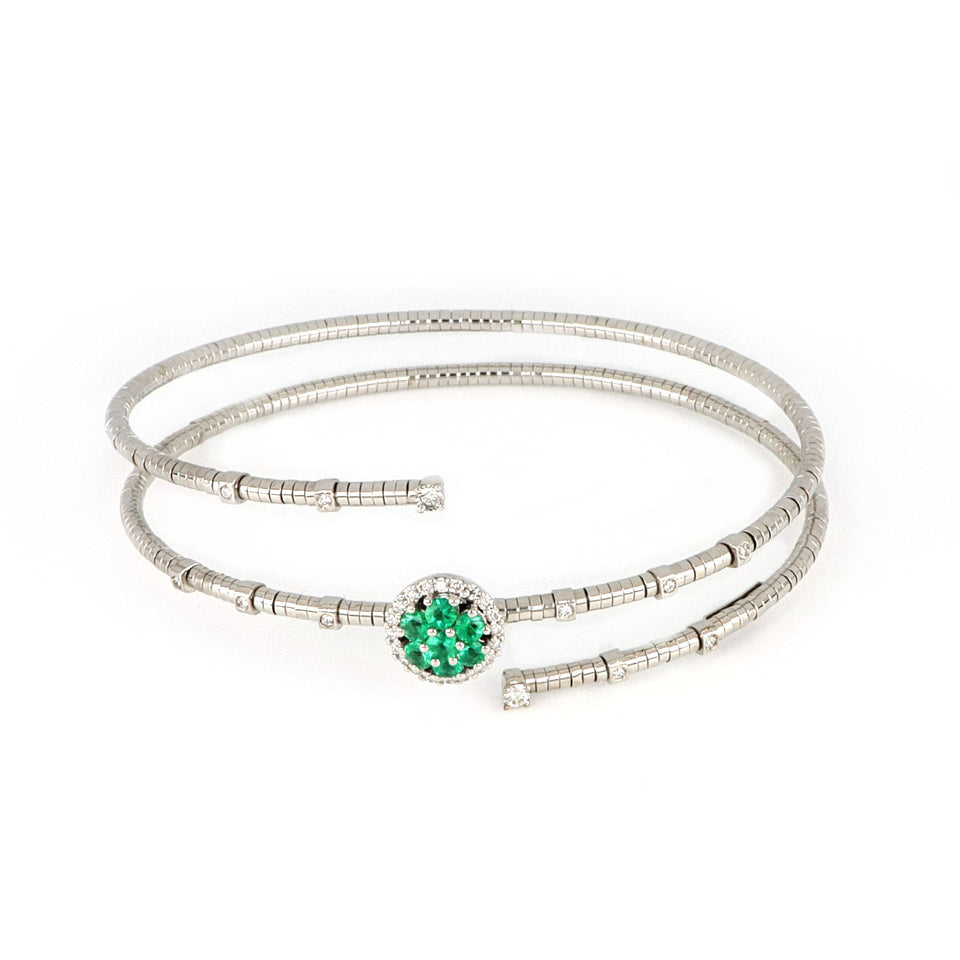
The OEM Process of White Gold Bracelets with Emeralds and Diamonds at JINGYING
In the competitive landscape of fine jewelry, the journey from a designer’s sketch to a finished, high-quality product demands a manufacturing partner capable of blending artistry with industrial precision. For brands and designers seeking to create a complex piece like a white gold bracelet set with emeralds and diamonds, the choice of an Original Equipment Manufacturer (OEM) is critical. JINGYING Jewelry, a prominent manufacturer based in Guangzhou, China, has positioned itself as a key player in this domain, offering a comprehensive suite of services that bridge the gap between creative vision and tangible luxury . The OEM process for such a sophisticated item is a meticulously orchestrated sequence of digital engineering, metallurgy, and artisanal craftsmanship, ensuring that every piece meets the exacting standards of the global market.
Conceptualization and Digital Engineering
The OEM process at JINGYING begins long before metal is cast or stones are set. It starts with the client’s concept, which can range from a rough sketch to a detailed Computer-Aided Design (CAD) file. JINGYING’s team of engineers and designers works closely with the client to optimize the design for manufacturability, focusing on structural integrity and cost-efficiency without compromising aesthetic intent . This collaborative phase is crucial for a complex piece like a gem-set bracelet, where the interplay of metal, diamonds, and emeralds must be balanced with wearability and durability.
Once the design is finalized, JINGYING employs industry-standard CAD software, such as Rhino, Matrix, and ZBrush, to create a precise 3D digital model . This model serves as the definitive blueprint for the piece. For intricate bracelets, this step allows designers to visualize the flow of the links, the geometry of the settings, and the precise placement of each emerald and diamond. The digital model ensures that every angle and detail is perfected before any physical production begins, allowing for rapid iterations and modifications, which are far more costly to make later in the process .
Prototyping and Mold Creation
Following the digital design phase, JINGYING utilizes high-resolution 3D printing technologies, such as SLA or DLP, to produce a physical resin prototype . This prototype is a vital quality control checkpoint. It allows clients to hold a tangible representation of their design, ensuring that the proportions, size, and comfort of the bracelet align with their expectations. For a white gold bracelet with emeralds and diamonds, this is also the stage where the intricate details of the setting—the prongs, bezels, or channel walls that will hold the precious stones—are rigorously examined and approved. The client’s sign-off on this prototype signals the official start of production.
For designs intended for larger production runs, JINGYING can create durable rubber molds from the approved prototype . These molds are essential for the efficient and consistent production of wax patterns used in the lost-wax casting process. However, for high-precision pieces with sharp angles or intricate geometric patterns, JINGYING may leverage its advanced Computer Numerical Control (CNC) machining capabilities. CNC machining allows for the direct milling of metal components from a solid block, achieving tolerances within ±0.01mm and ensuring perfect repeatability—a critical factor for the uniform links of a bracelet .
Metallurgy and Casting
The creation of the bracelet’s foundation requires expert metallurgy. JINGYING is equipped to handle various precious metals, including 10k, 14k, and 18k gold in yellow, rose, and white varieties . The process for making a white gold bracelet begins with alloying pure gold with white metals such as palladium, silver, or nickel to achieve the desired color and strength . The precise alloy composition is crucial, as it affects the metal’s workability, durability, and final color. While white gold has a natural off-white hue, it is its signature brilliant white finish that is achieved in a later stage.
The metal components are created primarily through the lost-wax casting process. In this process, wax patterns—either from rubber molds or directly 3D-printed—are attached to a wax “tree,” invested in a heat-resistant material, and placed in a kiln. The heat burns out the wax, leaving a perfect negative cavity of the bracelet components. Molten white gold is then poured into this cavity using vacuum or centrifugal casting techniques to eliminate porosity and ensure a flawless metal structure .
Precision and Refinement
After casting, the raw metal components, known as “castings,” are meticulously prepared for assembly. This involves cutting them from the sprue, the casting tree, and a rigorous process of filing, grinding, and sanding. The goal is to smooth the metal to a precise fit, preparing it for final assembly. This is where JINGYING’s focus on precision becomes evident. For the bracelet to function correctly, its links must move seamlessly. CNC-machined components offer an advantage here, as they often require less manual finishing and guarantee perfectly fitting joints, resulting in a fluid drape and superior comfort .
The individual links and clasp mechanism are then assembled and soldered together. This process demands immense skill, as any misalignment would compromise the entire piece. Once assembled, the bracelet undergoes its first major polishing stage. This initial polishing removes minor surface imperfections and creates a uniform, smooth base.
The Art of Gemstone Setting
The setting of the emeralds and diamonds is arguably the most delicate and defining stage of the process. JINGYING’s craftsmen, specializing in various techniques like prong, bezel, or pavé settings, begin the intricate work of securing the gemstones . For a bracelet, which is subject to more movement and potential knocks than a pendant or earring, the security of each stone is paramount. Each prong must be meticulously cut and bent over the gemstone, or each bezel carefully pushed, to secure the stone without damaging it.
The setting process for a multi-stone bracelet is painstaking. Every diamond must be aligned perfectly, and every emerald, a softer and more brittle stone, must be treated with extreme care to prevent cracking. The craftsmen must also ensure that the settings themselves are aesthetically pleasing, creating a seamless and beautiful frame for the gemstones . This human touch is irreplaceable; it is the skill of the setter that transforms a beautifully made metal bracelet into a sparkling piece of high jewelry.
Finishing and Plating
With the stones securely set, the bracelet enters the final finishing stages. It undergoes a series of polishing steps to achieve its final luster. Depending on the design, it may receive a high-polish, mirror finish, a contemporary satin or brushed finish, or a combination of both .
The signature bright white color of the bracelet is achieved through rhodium plating. Rhodium, a member of the platinum family, is a hard, silvery-white metal that is electroplated onto the white gold. This process is essential because white gold’s natural color is a greyish-white; the rhodium plating gives it the brilliant, reflective white hue that consumers expect and also provides an extra layer of protection against scratches and tarnishing . JINGYING employs advanced electroplating labs to ensure a consistent and durable rhodium finish, a critical element in the final aesthetic of the piece .
Rigorous Quality Control
Throughout the entire OEM process, quality control is an ever-present factor. JINGYING implements strict protocols at every stage, from material inspection to final assembly. The metal’s purity is verified, plating thickness is tested using XRF analyzers, and every stone is checked for tightness and alignment under magnification . This multi-point verification system ensures that the final product is not only beautiful but also durable and safe for the end consumer.
Conclusion
The OEM process of a white gold bracelet with emeralds and diamonds at JINGYING is a masterclass in modern jewelry manufacturing. It seamlessly integrates digital design and CNC precision with the irreplaceable skills of master setters and polishers. From the initial CAD file to the final rhodium-plated masterpiece, every step is meticulously managed to ensure that the final product reflects the brand’s vision and meets the highest standards of the luxury market. This process, driven by technology and perfected by human skill, is what allows JINGYING to serve as a trusted partner for brands seeking to create exceptional, commercially viable fine jewelry