JINGYING: Pioneering the Future of Custom Jewelry Through Design-Led, Made-to-Order Manufacturing
Abstract
This comprehensive article examines how JINGYING Jewelry has established itself as a premier partner for custom jewelry design and made-to-order production. With over two decades of manufacturing expertise, state-of-the-art facilities spanning 25,000 square meters, and a workforce of 450+ skilled professionals, JINGYING represents the convergence of traditional craftsmanship and cutting-edge technology. The article explores the company’s comprehensive design input methodology, its end-to-end production workflow, the strategic advantages of its low minimum order quantity model, and its position as a global OEM partner serving over 200 brands across 35 countries. Through detailed analysis of design processes, manufacturing capabilities, quality assurance protocols, and client partnership approaches, this article demonstrates how JINGYING enables designers, brands, and individuals to transform creative visions into tangible, wearable art while maintaining the flexibility and responsiveness demanded by today’s dynamic jewelry market .
1. Introduction: The Renaissance of Personalized Adornment
The desire for personalized adornment is as old as humanity itself. From ancient amulets carved from bone to heirlooms passed through generations, jewelry has always served as a profound medium for expressing identity, commemorating milestones, and celebrating individual style. Yet in the modern marketplace, this timeless desire has often clashed with the reality of mass-produced, off-the-shelf designs that prioritize uniformity over uniqueness .
In an era of conscious consumerism and digital connectivity, a fundamental shift is occurring. Today’s consumers increasingly reject homogenized, fast-fashion accessories in favor of pieces that reflect personal narratives, ethical values, and distinctive aesthetics. They seek objects that resonate not merely with their sense of style, but with their very identity—objects that tell their stories, celebrate their relationships, and mark their milestones .
This cultural transformation has created unprecedented opportunities for designers, entrepreneurs, and established brands alike. Yet the traditional barrier to entry—prohibitively high minimum order quantities demanded by conventional manufacturers—has historically stifled countless creative visions. Enter JINGYING, a company that has redefined the relationship between designer and manufacturer, offering a bridge forged from expertise, technology, and artistic sensibility .
JINGYING stands at the intersection of imagination and tangible reality. The company’s core promise is elegantly simple: provide a vision—be it a photograph, a sketch, a 3D file, or even just a mood board—and JINGYING will engineer, craft, and deliver a piece of custom jewelry that breathes life into that idea. This article serves as a comprehensive exploration of the JINGYING ecosystem, examining how the company supports custom designs and a made-to-order production model that empowers creators at every level .
2. The JINGYING Foundation: Heritage, Philosophy, and Global Reach
2.1 Corporate Identity and Founding Principles
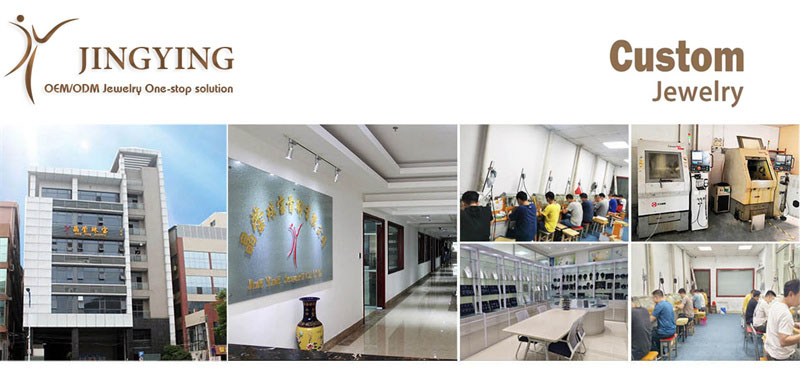
Guangzhou JingYing Jewelry Co., Ltd., established in 1998, has evolved from a local workshop into an international manufacturing powerhouse. The company operates two state-of-the-art factories located in Guangzhou and Wuzhou, employing a skilled workforce of over 200 professionals dedicated to the design, production, and export of high-end fashion jewelry . More recent expansions have grown this footprint to three specialized factories spanning 25,000 square meters with 450+ professionals .
The name 晶英 (JINGYING) embodies the company’s core principles: 晶 (JING), meaning “crystal,” represents clarity, purity, and brilliant light, while 英 (YING), meaning “essence” or “excellence,” signifies the pinnacle of quality and spirit. This philosophy—”Precision in Execution, Excellence in Delivery, Partnership in Growth”—is woven into every piece JINGYING creates .
2.2 Manufacturing Capabilities and Infrastructure
JINGYING’s manufacturing capabilities reflect a commitment to technological excellence. The company’s infrastructure includes dedicated facilities for casting and metalwork (8,000 square meters), stone setting and assembly (10,000 square meters), and plating and finishing (7,000 square meters). This specialized approach ensures that each stage of production receives focused attention from expert craftsmen working with advanced equipment .
The company’s equipment portfolio reads like a catalog of jewelry manufacturing innovation:
- 25 CNC milling machines capable of 0.01mm precision
- 15 vacuum casting machines with sophisticated temperature control
- 8 automated plating lines with environmental controls
- 12 SLA/DLP 3D printers for rapid prototyping
- 6 laser welding and engraving systems
- Micro-inlay machines imported from Japan for precise gemstone setting
This technological arsenal enables JINGYING to achieve a monthly production capacity of up to 500 kilograms of silver jewelry, with the ability to produce 150,000-200,000 pieces monthly and scale capacity by 40% within 30 days when client demand requires expansion .
2.3 Global Market Position
JINGYING’s products are exported worldwide, serving over 200 brands across 35 countries. The company’s production volume is distributed strategically across global markets: North America accounts for 45% of production, the European Union for 35%, Asia-Pacific for 15%, and emerging markets for the remaining 5%. This diversified global footprint reflects JINGYING’s ability to navigate international trade regulations, cultural preferences, and logistics requirements .
Industry recognition includes ISO 9001:2015 certification, Responsible Jewellery Council membership, and Sustainable Jewelry Council compliance—credentials that assure clients of JINGYING’s commitment to international quality and ethical standards .
3. Supporting Custom Designs: A Comprehensive Input Methodology
The journey of creating a custom piece at JINGYING begins with understanding that inspiration manifests in many forms. The company has structured its design input process to be as flexible and accommodating as client creativity demands, recognizing that a vision may arrive as a photograph, a rough sketch, a precise 3D file, or an abstract collection of references .
3.1 The Power of Photographic Inspiration
Sometimes, the vision for a piece of jewelry is not another piece of jewelry at all, but a feeling, a memory, or an object of beauty. A client may provide a photograph of a wilting rose from a wedding bouquet, the intricate geometry of a historic building, the elegant curve of a seashell, or a beloved pet. JINGYING’s design team specializes in translating these two-dimensional images into three-dimensional works of art .
The process begins with detailed analysis of the photograph, identifying key lines, textures, and focal points. Using this visual reference, JINGYING’s artists create a series of interpretive sketches, proposing how the essence of the image can be captured in a wearable form. This collaborative interpretation involves discussing which elements to emphasize for dramatic effect and which to simplify for structural integrity. Through this dialogue, emotion begins to take physical shape .
3.2 The Clarity of Hand-Drawn Sketches
A hand-drawn sketch—whether a rough doodle on a napkin or a detailed technical drawing—provides a direct window into the client’s mind’s eye. It offers clear intent regarding form, proportion, and layout, making it one of the most common and effective starting points for custom pieces .
Upon receiving a sketch, JINGYING’s CAD engineers—who function as sculptors in a digital realm—begin their work. Their task extends beyond mere translation; they must understand the intent behind every line while analyzing the design for anatomical feasibility. This includes ensuring that a ring shank will be comfortable, that a pendant will hang correctly, that a bracelet will have necessary flexibility, and that delicate elements will possess sufficient thickness for durability .
The engineers then translate the sketch into a precise digital model, adding necessary elements like internal galleries for stone settings, appropriate wall thickness, and ergonomic considerations that may not be apparent in a two-dimensional drawing. This 3D model is sent to the client for review, ensuring the digital incarnation perfectly aligns with the original sketch before any metal is poured .
3.3 The Precision of 3D Files
For clients with advanced design capabilities—such as independent jewelry designers or established brands—a provided 3D file represents the most streamlined path to production. Files in formats like .STL, .OBJ, or .Rhino serve as definitive blueprints, leaving minimal room for interpretation and maximizing efficiency .
When a client provides a 3D file, JINGYING’s first step is a comprehensive Digital Design for Manufacturing analysis. This process runs the file through specialized software that checks for common production issues:
- Non-manifold edges: Loose or “naked” edges that can cause errors in 3D printing
- Wall thickness: Ensuring every part of the model can withstand casting and daily wear
- Undercuts and trapped volumes: Features that might prevent clean mold-making
- Stone settings: Verifying prong and bezel dimensions for specified gemstone sizes
JINGYING provides clients with a detailed report containing optimization recommendations. This proactive approach saves time, reduces costs, and prevents frustration by ensuring designs are not only beautiful but also manufacturable and durable .
3.4 The Design Brief and Technical Specification
For clients beginning their journey without visual materials, JINGYING guides them through creation of a comprehensive Design Brief. This document serves as the primary communication tool and includes:
- A mood board: A collage of images, colors, textures, and existing jewelry pieces that evoke the desired feeling
- Target audience description: Clear definition of who the design serves
- Competitive analysis: Identification of similar products and differentiation strategies
- Key descriptors: Five to ten words defining the design ethos
This conceptual foundation is then translated into a Technical Specification Sheet that includes detailed sketches with labeled dimensions, bulleted lists of materials (base metal, plating type and thickness, stone specifications), descriptions of clasp mechanisms, and any special instructions regarding comfort or functionality .
4. The Made-to-Order Production Model: From Concept to Completion
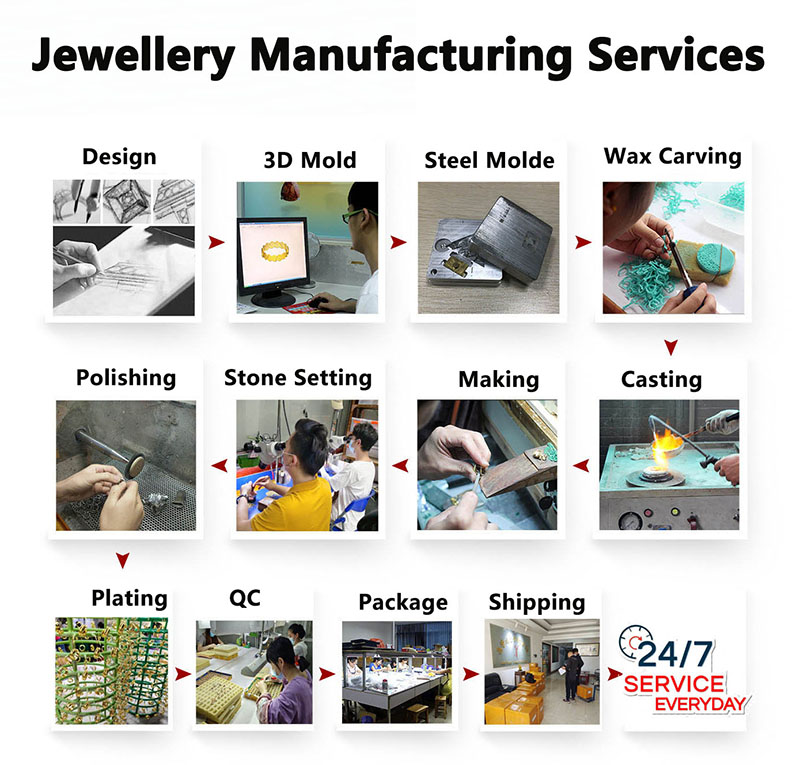
Once a design input is finalized and approved, it enters JINGYING’s meticulously orchestrated production workflow. This end-to-end process transforms digital concepts into physical jewelry through a series of carefully controlled stages .
4.1 Digital Prototyping and Design Validation
Before any physical production begins, the piece exists in a perfect digital universe. The 3D model—created from client sketches or optimized from provided files—is sent for final approval accompanied by high-resolution, photorealistic renderings .
These renders simulate different metal types (yellow gold, rose gold, white gold, platinum) and stone settings, allowing clients to see near-perfect representations of final products. Clients can assess how light plays across surfaces, evaluate overall aesthetics, and make last-minute adjustments with complete confidence. For rings and certain bracelets, JINGYING can integrate models into augmented reality platforms, enabling clients to “try on” digital prototypes using smartphone cameras—providing an unparalleled sense of scale and proportion .
4.2 Master Model Production: 3D Printing and Casting
With signed approval on the 3D model, JINGYING moves to creating the physical master. The company uses advanced Stereolithography (SLA) and Digital Light Processing (DLP) 3D printers that cure liquid photopolymer resin layer by layer, building models with exceptional detail and smoothness. The resolution is fine enough to capture textures as subtle as fingerprints or the veining of leaves .
This 3D-printed resin model then creates a mold for the casting process. Using the traditional lost-wax casting method—where the 3D-printed resin acts as modern “wax”—the model is encased in a plaster-like material called investment. The investment is heated in a kiln, which bakes the mold solid and burns out the resin, leaving a perfect, hollow cavity in the shape of the jewelry piece .
4.3 Metal Casting: The Birth of Form
The moment of transformation arrives when design becomes metal. The chosen material—most commonly 925 sterling silver for its ideal balance of beauty, durability, and value, but also 10K-18K gold, titanium, and stainless steel—is heated until molten. This liquid metal is then forced into the pre-heated investment mold using centrifugal force or vacuum pressure, filling the cavity and capturing every detail of the approved digital model .
Once the metal has cooled and solidified, the investment mold is broken away in a water bath, revealing the “casting tree”—a metal structure with the jewelry piece attached. Individual pieces are carefully cut from the tree, emerging raw with sprues attached and rough, matte surfaces .
4.4 Handcraftsmanship: Finishing and Assembly
This stage represents where machine precision meets the soul of the artisan. The raw casting now enters the hands of JINGYING’s skilled bench jewelers .
Pre-polishing and tumbling: Pieces are placed in tumbling machines with stainless steel shot and polishing compounds. This initial process smooths minor surface imperfections, removes the rough “casting skin,” and begins the polishing journey .
Hand-soldering and assembly: For designs with multiple parts—pendant bails soldered to pendants, links assembled into chains—master jewelers carefully solder components together. This requires immense skill to apply precise heat and solder without distorting delicate details .
Stone setting: This critical stage demands specialized expertise. JINGYING’s stone-setters, working under microscopes for precision, carefully place each stone using various techniques:
- Prong settings: Using tiny metal claws to hold stones
- Bezel settings: Encircling stones with custom-fitted metal collars for secure, modern looks
- Pavé settings: Placing many small stones close together to create “paved” surfaces of brilliance
- Channel settings: Positioning stones in rows between two metal walls
Final polishing and plating: Pieces undergo meticulous hand-polishing to achieve designated finishes: mirror shine, soft satin, hammered texture, or matte effects. For designs requiring gold plating, pieces enter electroplating baths where JINGYING specializes in heavy gold plating and vermeil (thick gold plating over sterling silver), ensuring longevity and rich, luxurious color .
4.5 Rigorous Quality Control
No piece leaves JINGYING’s facility without passing multi-point inspection. The company’s 7-point inspection system verifies:
- Metal weight verification against specifications
- Stone alignment check for precision placement
- Prong tightness test ensuring stone security
- Plating thickness measurement confirming durability
- Surface defect inspection for any imperfections
- Clasp function test verifying mechanisms work properly
- Final aesthetic review ensuring overall beauty
Additional tests include dimensional checks matching approved specifications, structural integrity verification, and stone security confirmation. Only after passing all checks is a piece professionally cleaned, packaged according to client instructions, and prepared for shipment . The company maintains a defect rate below 0.3% .
4.6 Lead Times and Delivery
Standard production timelines at JINGYING reflect the company’s commitment to efficiency without compromising quality:
- Sampling: 7-10 business days
- Production: 20-30 business days
- Rush orders: 15-18 business days (with surcharge)
- Reorders: 12-15 business days
Shipping options accommodate various client needs, from express delivery (3-5 days) to air freight (7-10 days) and sea freight (30-45 days) for larger orders .
5. The Low Minimum Order Quantity Advantage: Democratizing Jewelry Production
Perhaps JINGYING’s most significant innovation lies in its approach to minimum order quantities. While traditional manufacturers demand large production runs that exclude emerging designers and small businesses, JINGYING has championed a low-MOQ model that democratizes access to high-quality jewelry manufacturing .
5.1 Financial Accessibility and Risk Mitigation
The most significant advantage of low MOQs is financial prudence. Instead of committing tens of thousands of dollars to inventory for a single design, clients can order 50, 100, or 200 pieces. This dramatically lowers initial capital outlay, preserves cash flow, and allows investment in branding, marketing, and customer experience. It creates a test-and-learn approach: validate designs in the real market without the devastating risk of being stuck with unsold inventory .
For startups and independent designers, JINGYING offers full-service orders with minimum values as low as $1,500—a fraction of traditional manufacturing requirements .
5.2 Creative Freedom and Iterative Development
Low MOQs enable genuine creative freedom. Trends evolve rapidly, and customer feedback proves invaluable. A small initial batch allows designers to gauge market reception: Is the pendant size ideal? Does the gold finish meet expectations? Is the chain length perfect? With real sales data and customer reviews, designers can refine and improve before placing larger reorders .
This agile development cycle ensures collections evolve in direct response to audience preferences, leading to higher satisfaction and stronger brand loyalty. As one JINGYING client noted, the ability to iterate based on real-world feedback proved essential to building a loyal customer base .
5.3 Exclusivity and Brand Narrative
In a world of mass production, limited quantities become powerful marketing tools. “Small batch,” “limited run,” and “artisanal production” are compelling narratives that resonate with conscious consumers. They communicate care, quality, and exclusivity. Designers can create drops or collections that generate anticipation and urgency, fostering communities of customers who value uniqueness over ubiquity .
5.4 Scalability Without Friction
Perhaps most importantly, starting with low MOQs builds foundations of trust and streamlined communication. As brands grow, JINGYING grows with them. The company’s scalable production capacity—able to increase output by 40% within 30 days—ensures that successful brands never outgrow their manufacturing partner .
6. Material Excellence and Versatility
JINGYING’s material capabilities reflect the company’s commitment to offering clients comprehensive choice without compromising quality.
6.1 Precious Metals
Sterling silver (925): JINGYING’s primary medium, offering ideal balance of beauty, durability, and value. Sourced from certified, ethically managed mines and suppliers adhering to strict environmental and labor standards .
Gold: Available in 10K, 14K, and 18K variations across yellow, white, and rose gold. For gold-plated pieces, JINGYING offers vermeil finishes with thicknesses up to 3.0 microns—significantly more durable than standard plating .
Platinum: Available for legacy pieces requiring the pinnacle of luxury and durability .
6.2 Alternative Metals
For designers seeking different aesthetics or price points, JINGYING works with brass, copper, bronze, titanium, tungsten, and stainless steel. Surgical stainless steel proves particularly valuable for clients with nickel sensitivities or those creating body jewelry .
6.3 Gemstones and Embellishments
JINGYING offers extensive stone options:
- Diamonds: Available in traditional brilliant cuts, raw uncut diamonds for rustic aesthetics, and fancy colored diamonds in yellow, black, or chocolate for exclusive statements
- Lab-grown stones: Moissanite, created sapphires offering ethical alternatives with perfect clarity
- Natural gemstones: Sapphires, rubies, emeralds, and semi-precious stones including amethyst, turquoise, topaz, and moonstone
- Cubic zirconia: The best diamond simulant, offering exceptional brilliance at accessible costs
- Cultured pearls: For classic, elegant touches
- Enamel: For adding bold, colorful sections through techniques like Cloisonné
6.4 Material Integrity and Testing
JINGYING employs rigorous testing protocols to ensure material authenticity and quality:
- XRF testing for metal purity verification
- Spectrometer analysis for alloy composition
- UV/thermal testing for diamond verification
- Thickness testing for plating consistency
- Salt spray testing for corrosion resistance
- Adhesion testing for plating durability
7. Quality Assurance: The 7-Point Inspection System
Quality stands at the forefront of JINGYING’s operations. The company implements stringent quality control measures at every production stage, from design through final inspection .
7.1 Incoming Material Inspection
Before production begins, all raw materials undergo verification: certification checks for precious metals, purity verification through XRF testing, gemstone quality assessment, and dimensional checking of components .
7.2 In-Process Quality Checks
Throughout manufacturing, JINGYING monitors:
- Casting quality verification
- Stone setting precision
- Plating thickness monitoring
- Assembly accuracy
7.3 Final Inspection Protocol
Every piece undergoes 100% visual inspection, functional testing, packaging verification, and final approval before shipment. The 7-point checklist ensures:
- Metal weight matches specifications
- Stones align perfectly
- Prongs hold stones securely
- Plating meets thickness requirements
- Surfaces show no defects
- Clasps function properly
- Overall aesthetics satisfy standards
7.4 International Compliance
JINGYING maintains compliance with major international standards:
- ISO 9001:2015 Quality Management
- REACH Compliance (EU)
- CPSIA Compliance (US)
- Nickel Directive Compliance
8. Sustainability and Ethical Manufacturing
In an era of conscious consumerism, JINGYING demonstrates commitment to responsible production.
8.1 Ethical Sourcing
JINGYING sources sterling silver from certified, ethically managed mines and suppliers adhering to strict environmental and labor standards. The company maintains Responsible Jewellery Council membership and ensures all stones are conflict-free .
8.2 Green Manufacturing
Environmental initiatives include:
- Zero-waste manufacturing approaches recycling all silver dust and off-cuts
- Closed-loop water recycling systems
- Energy-efficient production equipment
- Biodegradable polishing compounds
- Eco-friendly packaging options from recycled and sustainable sources
8.3 Carbon Offset Program
JINGYING offers carbon-neutral shipping options for environmentally conscious clients, offsetting emissions from all shipments .
9. Client Partnership and Support Services
Beyond manufacturing excellence, JINGYING distinguishes itself through comprehensive client support.
9.1 Dedicated Project Management
From first inquiry, each client receives a dedicated project manager serving as single point of contact. This person guides clients through every step, translates technical jargon, provides regular updates, and ensures confidence throughout the process .
9.2 Design for Manufacturing Expertise
JINGYING’s engineers’ early intervention in design phases identifies potential problems that might otherwise result in broken products, failed stones, or unwearable pieces. This expertise saves clients from costly mistakes and ensures jewelry is not only beautiful but functional and durable .
9.3 Packaging and Branding Solutions
JINGYING offers comprehensive packaging options from basic anti-tarnish pouches and gift boxes to premium wooden boxes with silk lining and luxury leather cases with authenticity cards. Branding services include laser-engraved logos, custom UPC barcodes, and multi-language inserts .
9.4 Warranty and Support
All JINGYING pieces carry a one-year warranty against manufacturing defects, demonstrating confidence in production quality .
10. Case Studies: Success in Practice
10.1 Eco-Conscious Jewelry Brand
Challenge: A startup needed sustainable 18K gold vermeil line produced with ethical materials and biodegradable packaging.
Solution: JINGYING developed a comprehensive solution using recycled gold, implementing green manufacturing protocols, and sourcing sustainable packaging.
Result: The brand achieved 300% year-over-year growth after relaunch, with customers responding positively to the authentic sustainability narrative .
10.2 Celebrity Collaboration
Challenge: A designer needed 200-piece limited edition collection produced in 28 days for a celebrity launch.
Solution: JINGYING streamlined the CAD-to-finished-goods workflow, prioritizing the project while maintaining quality standards.
Result: The collection sold out within 72 hours, demonstrating the power of responsive, high-quality manufacturing .
10.3 Emerging Designer Scaling
Challenge: US-based emerging designer needed to scale production from 200 to 2,000 pieces monthly while maintaining quality and margins.
Solution: JINGYING implemented phased production scaling with enhanced quality control at each stage.
Result: Successful scaling achieved within 6 months while maintaining 40% gross margin .
11. Conclusion: The Future of Custom Jewelry Manufacturing
JINGYING represents the evolution of jewelry manufacturing—from simple production to comprehensive partnership. Through unwavering commitment to quality, continuous innovation, and genuine partnership approach, JINGYING has established itself as a trusted global manufacturing partner for brands ranging from emerging designers to established houses .
The company’s success stems from understanding that in today’s competitive market, manufacturing excellence requires more than technical capability. It demands cultural understanding, market awareness, and the ability to adapt to changing consumer preferences while maintaining uncompromising quality standards. JINGYING’s support for custom designs and made-to-order production eliminates the traditional headaches of jewelry production by providing a single partner through every stage from design to delivery .
For designers, entrepreneurs, and established brands seeking to transform creative visions into tangible reality, JINGYING offers not merely manufacturing capacity, but genuine partnership. Whether launching a boutique collection, scaling an established brand, or creating a single meaningful piece, JINGYING ensures design integrity preserved, technical excellence applied, and business efficiency achieved .
In a world increasingly hungry for meaning and authenticity in the objects we wear, JINGYING stands ready to help creators weave stories in metal and gemstone—one custom piece, one small batch, one dream at a time.