HOW TO PRODUCE OLIVE GREEN CHIP WITH ZIRCONIA EARRINGS AT JINGYING
Abstract
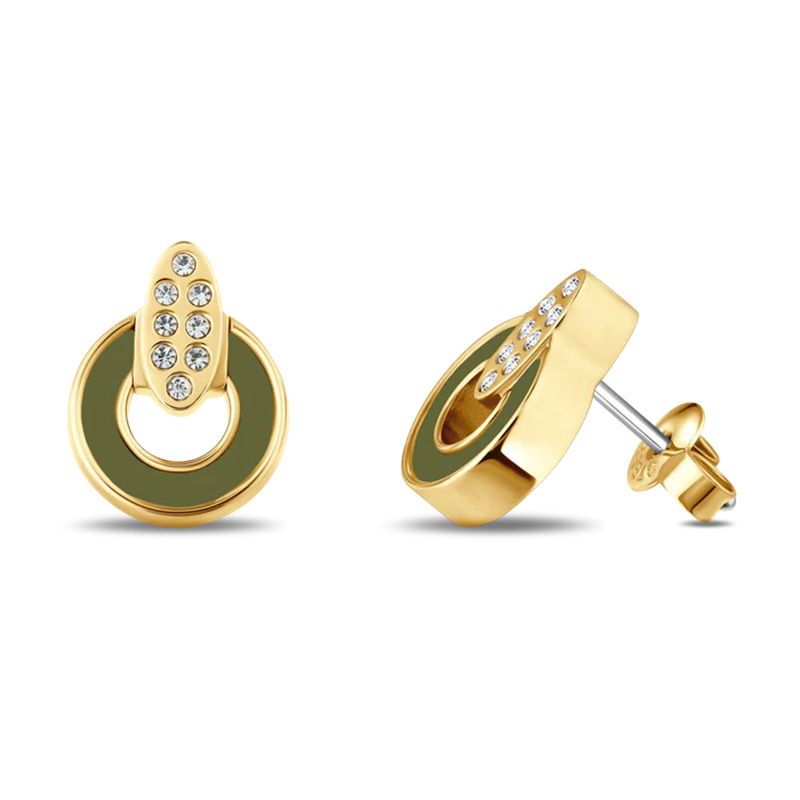
This technical paper presents a comprehensive methodology for producing olive green chip earrings with zirconia at JINGYING Jewelry Manufacturing. The process integrates advanced materials science—specifically the synthesis of (Cr,V)-ZrSiO₄ jewel green pigments—with JINGYING’s established 925 sterling silver jewelry production workflow. The olive green color is achieved through controlled chromium-vanadium co-doping in the zircon pigment, while the earring production follows a nine-stage manufacturing process including CAD design, casting, stone setting, and quality control. This paper details the complete production chain, from pigment synthesis to finished product, based on JINGYING’s 20+ years of jewelry manufacturing expertise and current ceramic pigment research.
1. Introduction
1.1 Background
The demand for colored zirconia jewelry has grown significantly in recent years, with olive green emerging as a sophisticated alternative to traditional clear cubic zirconia. JINGYING Jewelry, established in 1998 with a monthly production capacity of up to 100,000 pieces, specializes in custom 925 sterling silver jewelry manufacturing. The company’s expertise in integrating colored ceramic materials with precious metal settings positions it uniquely to produce olive green chip earrings.
1.2 The Olive Green Zirconia Challenge
Producing olive green zirconia requires precise control over pigment composition. Recent research has demonstrated that (Cr,V)-ZrSiO₄ jewel green pigments can be synthesized at temperatures as low as 900°C, with optimal color achieved at a Cr/Si mole ratio of 0.2. This pigment exhibits a jewel green color with chromatic values of L* = 56.69, a* = -18.52, and b* = -9.28, which can be adjusted toward olive tones through controlled doping.
2. Olive Green Zirconia Pigment Synthesis
2.1 Chemical Basis for Olive Green Coloration
The olive green color in zirconia-based ceramics is achieved through co-doping with chromium (Cr) and vanadium (V) ions in the ZrSiO₄ lattice. The mechanism involves:
- V⁴⁺ ions occupying interstitial sites (16g positions) within the zircon structure, producing a sky-blue baseline color
- Cr³⁺ ions substituting into the lattice, shifting the color toward green through band gap narrowing and electron transition ladder formation
- Cr-V synergistic effects promoting solid solution formation and reducing synthesis temperature
The color shifts from sky blue (no Cr) through jewel green (Cr/Si = 0.05–0.2) to dark green (Cr/Si = 0.4), with optimal olive green achieved at intermediate Cr/Si ratios.
2.2 Pigment Preparation Process
2.2.1 Precursor Preparation
- Zirconium hydroxide precursor slurry preparation: Mix 0.1–1.5M zirconium oxychloride with yttrium chloride solution. Add ammonia water (1–14 mol/L) to adjust pH to 8–10. Stir and age at 200 rpm for 0.5–6 hours.
- Filtration and washing: Pour the aged emulsion into a Buchner funnel for suction filtration. Wash with deionized water until the filtrate shows no turbidity when reacted with 0.1 mol/L silver nitrate solution.
- Slurry dispersion: Disperse the filter cake in water at 300 rpm to form a zirconium hydroxide precursor slurry (5–10 wt% zirconium hydroxide content).
2.2.2 Colorant Addition
Add the following metal salts to the precursor slurry:
- Ammonium metavanadate (5.22–11.6 mmol/L) as the vanadium source
- Cobalt nitrate or cobalt chloride (0.3–28.3 mmol/L)
- Aluminum nitrate or aluminum chloride (0.6–56.5 mmol/L)
The cobalt and aluminum salts serve as mineralizers and color modifiers, with cobalt aluminate (CoAl₂O₄) formation contributing to the final green hue.
2.2.3 Drying and Calcination
- Spray drying: Dry the slurry at 200–300°C inlet temperature to obtain zirconium hydroxide powder.
- Calcination: Calcine the powder at 800–1100°C for 1–4 hours to obtain zirconia powder containing the colorant. For the (Cr,V)-ZrSiO₄ system, 900°C is sufficient for phase formation.
2.3 Quality Control for Pigment
The synthesized pigment must meet specific criteria:
- Particle size: Ultrafine particles (<1 μm) for uniform dispersion in the zirconia matrix
- Phase purity: Primary crystalline phase must be ZrSiO₄, with no Cr₂O₃ heterophase (indicates excessive Cr doping)
- Color consistency: L, a, b* values within acceptable tolerances for olive green
3. JINGYING’s Earring Production Workflow
3.1 Design Phase
3.1.1 Client Consultation and Concept Development
The process begins when a client brings a design idea or sample. JINGYING’s design team transforms initial concepts into detailed sketches based on client requirements. For olive green chip earrings, the design must account for:
- The specific shade of olive green required
- The size and shape of the zirconia chips
- The setting style (prong, bezel, or pavé)
3.1.2 CAD Modeling
Sketch designs are converted into precise 3D digital models using Computer-Aided Design (CAD) software. This stage allows for:
- Visualization of proportions and stone placement
- Structural integrity verification
- Client review and revision before production
JINGYING’s engineering team typically identifies modifications needed for production viability, such as prong thickness adjustments (e.g., 0.3mm to 0.5mm for durability) and weight optimization.
3.2 Prototyping
For new or complex designs, rapid prototyping is employed:
- SLA 3D printing for form verification
- Lost-wax casting for metal samples
- Hand-fabricated samples for mechanism testing
3.3 Production Phase
3.3.1 Mold Creation
Using CNC machining, a metal master mold is carved to ensure:
- 100% quality replication
- Smooth surface finish equivalent to fine jewelry
- Secure stone retention
3.3.2 Casting
The casting process involves:
- Wax mold injection
- Plaster mold creation
- High-temperature heating to eliminate wax
- Molten 925 sterling silver injection into the plaster mold
JINGYING uses vacuum casting machines to achieve 92% material utilization rates.
3.3.3 Surface Preparation
Cast pieces undergo:
- Pre-polishing: Surface smoothing to prepare for plating and stone setting
- Robotic polishing arms to reduce hand-polishing time by 65% while maintaining consistency
3.3.4 Olive Green Zirconia Chip Preparation
The synthesized olive green zirconia pigment is processed into chip form:
- Powder pressing: The pigment powder is pressed into chip shapes using isostatic or biaxial pressing
- Sintering: The pressed chips are sintered at high temperature to achieve final hardness and color
- Cutting and faceting: Chips are precision-cut to maximize brilliance and color display
3.3.5 Stone Setting
JINGYING employs micro-inlaid machines imported from Japan for stone setting. For olive green zirconia chips:
- Prong setting: 4-6 prongs secure each stone while allowing maximum light exposure
- Bezel setting: A metal rim encircles the stone for superior security
- Laser setting: For precision placement with 0.1mm tolerance
The company’s wax setting technology achieves 99% stone retention rates.
3.3.6 Plating
JINGYING performs two-time plating for all sterling silver jewelry:
- Thick silver plating base layer: Ensures surface smoothness
- Final plating layer: Options include rhodium, gold, or other finishes
Plating thickness typically reaches 3 microns to ensure 1+ year durability, classified as vermeil quality.
3.4 Quality Control
Quality checking is the most critical process in JINGYING’s production line, managed by a 10-engineer QC team:
3.4.1 Stone Security Testing
- Individual stone testing: Professional steel needles test each stone individually
- Drop testing: Jewelry items are dropped from 3 meters to verify stones remain secure
3.4.2 Plating Quality Verification
- Machine thickness testing: Clients receive reports verifying plating meets specifications
- Manual rub testing: Professional tools rub metal surfaces for five minutes to ensure coating durability
3.4.3 Dimensional and Aesthetic Inspection
- Dimensional accuracy: ±0.15mm
- Stone tightness: 50g pull test
- Surface defects: <0.5% allowance
4. Materials Sourcing and Specifications
4.1 Silver Base Metal
JINGYING uses 925 sterling silver as the base metal for all earring production. Sterling silver offers:
- Excellent durability and malleability
- Hypoallergenic properties
- Lightweight yet sturdy construction
- Superior feel for premium jewelry
4.2 Olive Green Zirconia Chips
The olive green zirconia chips must meet JINGYING’s quality standards:
- Color: Consistent olive green throughout the stone, not just surface coating
- Cut: Precision faceting for optimal light performance
- Clarity: No visible inclusions or cloudiness
- Hardness: 8-8.5 on Mohs scale for daily wear durability
4.3 Plating Materials
JINGYING offers various plating options:
- Rhodium plating: Adds protection, enhances shine, resists tarnishing
- Gold plating: 18K or 14K options for warm finish
- Rose gold plating: Gold-copper alloy for distinctive pinkish hue
5. Production Planning and Capacity
5.1 Order Types
JINGYING handles both small-batch and large-scale production:
- Sample orders: 7-day turnaround for prototypes
- Mass production: 30-day turnaround for bulk orders
- Capacity: Up to 100,000 pieces per month
5.2 Quality Guarantee
JINGYING provides 3-6 months warranty for quality issues under non-human reasons, covering:
- Color fading
- Stone loss
- Plating deterioration
6. Conclusion
Producing olive green chip earrings at JINGYING requires integration of advanced ceramic pigment technology with established jewelry manufacturing processes. The key success factors are:
- Precise pigment synthesis: Controlled (Cr,V)-ZrSiO₄ formation at 900°C with optimal Cr/Si ratio of 0.2
- Dual-phase production: Combined pigment manufacturing and jewelry production workflows
- Advanced manufacturing: CAD design, CNC molding, laser stone setting, and robotic polishing
- Comprehensive QC: Multi-stage testing covering stone security, plating durability, and dimensional accuracy
- JINGYING’s 20-year expertise: Established quality systems and production capacity
The resulting product combines the durability of 925 sterling silver with the sophisticated color of olive green zirconia chips, meeting the growing demand for distinctive, high-quality fashion jewelry in global markets.