A Technical Guide to Mass Production of High-Fashion Geometric Hoops
1. Introduction: Deconstructing the “Kourtney” DNA
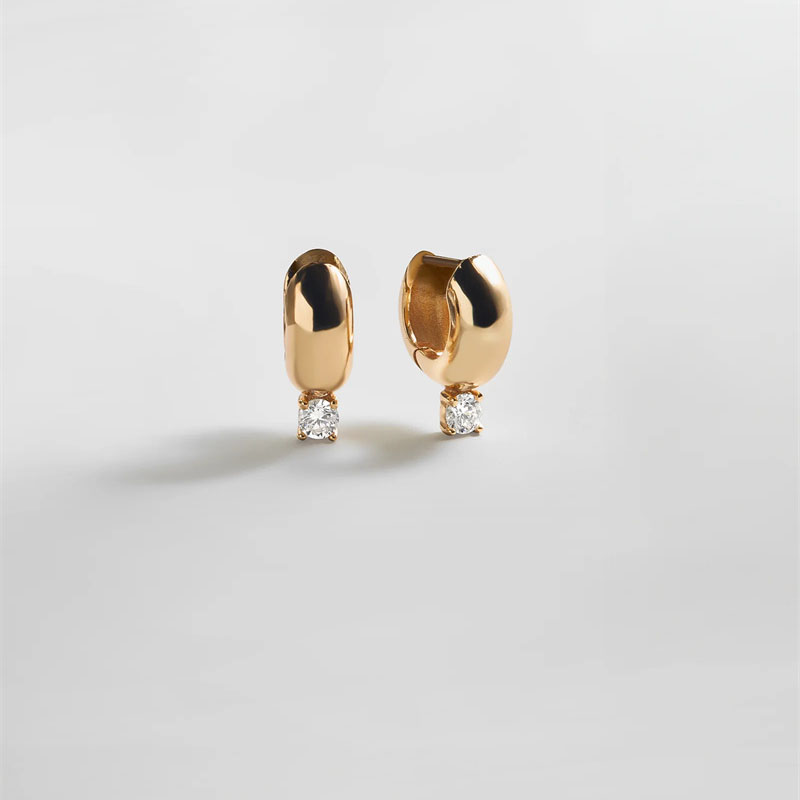
The “Kourtney Huggie Earring” represents a specific archetype in the fashion jewelry market: the geometric huggie. Unlike round huggies, the Kourtney style is defined by its angular or Shield/Cushion geometry, often featuring a chunky, glossy frame accented with a single prominent white stone (cubic zirconia). It is a unisex or feminine staple valued for being lightweight, waterproof, and hypoallergenic .
Target Specifications (Based on Market Analysis):
- Shape: Square, Cushion, or Shield (12mm x 12mm typical).
- Material: 316L Stainless Steel (High-end), 925 Sterling Silver (Mid-range), or Copper (Budget).
- Plating: 14K/18K Gold PVD or E-coating (3-micron thickness for durability).
- Stone: 5A or 8A Round Cubic Zirconia (CZ), 3mm-5mm.
- Closure: Push-back (friction post) with a hinge mechanism, or a snap-down click top.
2. Phase I: Technical Design & 3D Modeling (CAD)
Before any metal is cast, JINGYING’s engineering team converts the concept into a manufacturable file. Because this is a “Huggie,” the hinge mechanism is the most critical failure point.
The CAD Process at JINGYING:
- Sculpting: Using RhinoGold or MatrixGold, the designer builds the shield shape. The hollow back is designed to keep the piece lightweight .
- The Hinge Mechanism: Unlike cheap butterfly backs, the Kourtney huggie requires an invisible hinge (barrel hinge). The CAD must account for a 0.2mm tolerance between the post and the hinge tube to allow smooth movement without wobbling.
- Stone Setting Prongs/Bezel: The CAD includes a seat for the center stone. For a modern “Kourtney” look, a bezel setting (metal rim fully covering the stone’s edge) is often preferred over prongs for a sleek, glossy finish .
JINGYING Advantage: They utilize SLA/DLP 3D printers to create a resin prototype within 24-48 hours. You must approve this physical “feel” before steel mold cutting begins .
3. Phase II: Master Model & Mold Making (Tooling)
Once the CAD is approved, JINGYING moves to tooling. This is the highest initial investment but determines the consistency of 10,000+ units.
Steps:
- CNC Precision Milling: JINGYING uses CNC machines to cut a steel master model with 0.01mm precision . For the hinge area, this precision is vital.
- Rubber Mold Injection: The steel master is pressed into heated rubber to create a production mold. For the Kourtney huggie, a multi-piece mold is required because the hinge has undercuts.
4. Phase III: Wax Injection & Casting (The “Blank”)
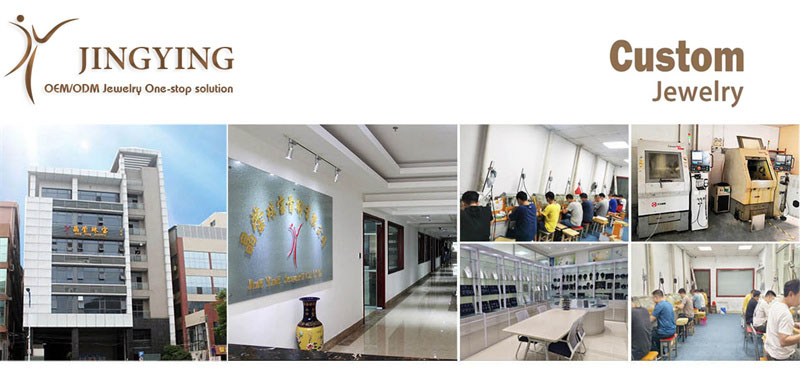
JINGYING operates a Lost-Wax Casting facility .
- Wax Injection: Liquid wax is injected into the rubber mold. Because the Kourtney has sharp 90-degree corners, the wax injection pressure must be high to prevent “short shots” (rounded corners).
- Tree Assembly: Hundreds of wax Kourtney models are attached to a wax “tree” for efficiency.
- Investment (Plaster): The wax tree is placed in a flask and covered with liquid plaster.
- Burnout: The flask is heated. Wax melts away (lost wax), leaving a Kourtney-shaped cavity.
- Casting: Molten metal (Steel, Silver, or Brass) is thrown into the cavity via centrifugal or vacuum casting.
Result: Raw metal “blanks” that look exactly like the earrings, but dull and metal-colored.
5. Phase IV: Surface Preparation & Polishing
The raw casting will have a slight “orange peel” texture or tree-attachment nubs. JINGYING’s workshops have a multi-step mechanical polishing line .
- Barrel Tumbling: Hundreds of earrings are placed in a rotating barrel with steel shot and soap. This cleans them and gives a preliminary shine.
- Buffing Wheels: Workers use cloth wheels with abrasive compound to polish the flat, angular surfaces of the shield. Note: JINGYING is known for robotic polishing systems for consistency, but final hand-finishing ensures the “mirror finish” expected of the Kourtney .
- Hinge Cleaning: Special attention is paid to blowing air through the hinge joint to remove polishing compound; otherwise, the earring will stick.
6. Phase V: Stone Setting (The White Center)
The defining feature of the Kourtney is the “white glass stone” or Cubic Zirconia. JINGYING uses a combination of automated and manual setting.
- Prong Opening (if applicable): If the design uses prongs, a pneumatic press slightly lifts the prongs.
- Stone Placement: A worker places the 5A CZ stone into the seat.
- Setting: Using a microscope and a Micro-Setting machine (often imported from Japan), the worker pushes the metal (gold-plated brass or silver) over the stone to secure it.
- For the Kourtney style: A Bezel setting is common. The metal rim is rolled over the CZ edge until it is flush and smooth . This protects the stone from falling out (a key JINGYING QC metric).
7. Phase VII: Electroplating (The Gold Bath)
To achieve the “14k Gold” or “White Rhodium” look of the Kourtney, plating is essential. JINGYING emphasizes Durability here .
The JINGYING Plating Line Process:
- Degreasing: The earrings are dipped in ultrasonic chemical baths to remove finger oils (oil prevents adhesion).
- Base Coat: Copper flash plating (for silver/steel) to ensure conductivity.
- Thick Palladium/Nickel: A barrier layer to prevent corrosion.
- Gold Plating (The Magic): The earrings are immersed in tanks containing gold potassium cyanide.
- Micro Porous Gold: JINGYING uses “E-coating” or PVD (Physical Vapor Deposition) for high-end Kourtney models.
- Thickness Standard: For the “Kourtney” to be waterproof and durable, they plate 3 microns of 14K or 18K gold. This is thicker than standard fashion jewelry (standard is 0.5-1 micron), ensuring it lasts for “1 year+ without fading” .
- Final Wash: Deionized water rinse to prevent water spots.
8. Phase VIII: Quality Control (QC)
JINGYING implements a rigorous 10-point inspection . For the Kourtney Huggie, specific tests include:
- The Pull Test: The hinge is opened and closed 50 times by a machine to ensure it doesn’t break.
- The Drop Test: The earring is dropped from 1.5 meters onto a steel plate to see if the CZ stone falls out. (JINGYING standard aims for 99% no-stone-loss) .
- Plating Thickness Test: An XRF gun is shot at the earring to read the micron level of the gold. If it reads below 3 microns, the batch is rejected.
- Nickel Test: A spot test ensures no nickel is leaching (critical for hypoallergenic claims) .
9. Phase IX: Private Label & Packaging (OEM)
Once produced, JINGYING offers fulfillment services.
- Stamping: The post is laser-engraved with your brand name or “14K GP” (Gold Plated) .
- Carding: The earrings are inserted into backing cards.
- Polybagging: Individual anti-tarnish bags.
- Shipping: From Guangzhou to global warehouses .
Conclusion: Why JINGYING for the Kourtney?
Producing the Kourtney Huggie requires a partner who can handle geometry (sharp corners), mechanics (the hinge), and chemistry (thick plating). JINGYING is specifically suited for this because:
- They specialize in mixed metals (Copper for weight, Steel for strength) .
- They possess the CNC precision required for the “Shield” shape .
- Their “3-micron plating” guarantee directly aligns with the market demand for waterproof, tarnish-free “Kourtney” hoops .
Production Timeline Summary:
- Week 1-2: CAD & 3D Wax Prototype.
- Week 3-4: Mold & Sample (Frozen).
- Week 5-8: Mass Production, Plating, Setting.
- Week 9: QC & Shipping.
By following this process, JINGYING transforms raw metal into the glossy, secure, and trendy Kourtney Huggie ready for retail at $48+ per unit
Over the last 23 years, JINGYING Jewelry has been providing a one-stop solution for brand jewelers in terms of OEM/ODM and customized work. We can create a great art jewelry collection in fine jewelry making using just your thoughts, photos, or CAD designs.
We provide ODM/OEM services for 100% real gold and 925 sterling silver rings, necklaces, pendants, earrings, bracelets, and pearl jewelry, including rings, sterling silver cross necklaces, heart necklaces, white gold earrings, and gold tennis bracelets, with personalized logos and packaging.