JINGYING : Custom Jewelry Manufacturing 18kt Gold Over Sterling and Sterling Silver Paper Clip Link Bead Station Necklace
JINGYING : Custom Jewelry Manufacturing 18kt Gold Over Sterling and Sterling Silver Paper Clip Link Bead Station Necklace
LET’S GET STARTED : mo@kingjy.com
JINGYING: Custom Jewelry Manufacturing and the 18kt Gold Over Sterling and Sterling Silver Paper Clip Link Bead Station Necklace
Introduction: A Manufacturer Built for the Modern Jewelry Brand
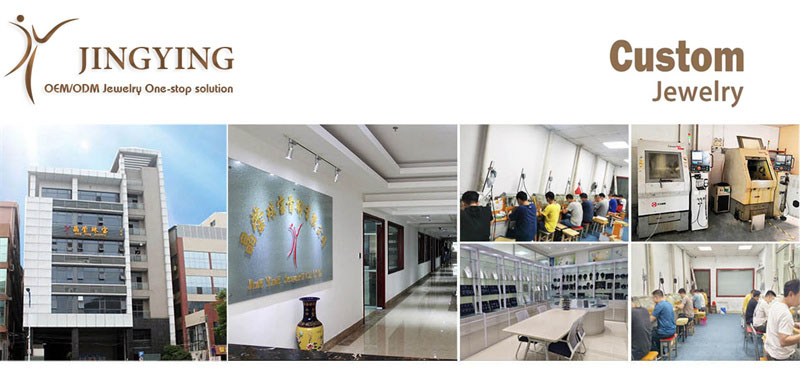
In an industry where speed, consistency, and design fidelity separate successful brands from the rest, JINGYING has spent more than two decades positioning itself as a manufacturing partner that understands what modern jewelry labels actually need. Established in 1998, JINGYING Jewelry has grown into a one-stop OEM/ODM solution for brand jewelers, handling everything from concept sketches to finished, packaged pieces. The company produces necklaces, pendants, bracelets, earrings, and rings across a range of materials: copper gold-plated, sterling silver with gold plating, and solid gold options. Its focus is not merely on output volume but on durability, long-lasting plating, and the kind of consistency that lets a brand scale without compromising its identity.
This article examines one specific product category within JINGYING’s manufacturing repertoire—the 18kt gold over sterling silver and sterling silver paper clip link bead station necklace—as a lens through which to understand the company’s approach to custom jewelry manufacturing. The piece itself is deceptively simple: a chain, some beads, two tones of metal. But the decisions embedded in its production—the thickness of the gold layer, the mechanical integrity of each link, the placement of every station—reveal the difference between a factory that fills orders and one that builds products.
The Product: A Study in Two-Tone Restraint
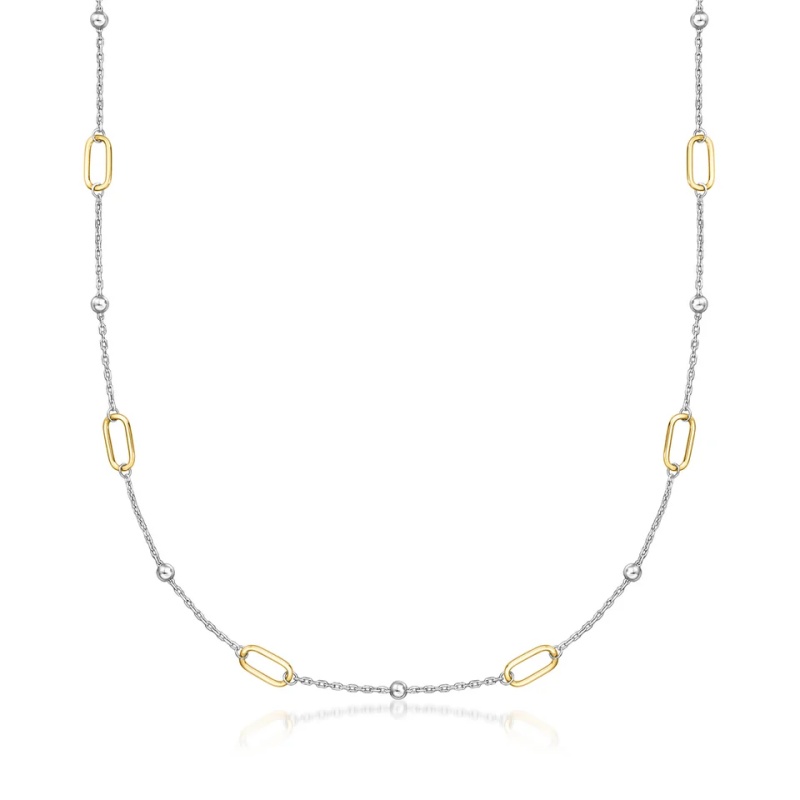
The 18kt gold over sterling and sterling silver paper clip link bead station necklace sits at the intersection of two persistent trends: the paper clip chain and the station design. The paper clip link, an elongated oval form that recalls office stationery but translates into something far more refined in metal, has moved from a niche street style detail to a staple of modern layering. Industry observers describe it as having “officially moved from a trend to a true staple,” with its popularity driven by a clean, architectural profile that works equally well in casual and business-casual contexts.
The station element—evenly spaced beads or accents punctuating a chain—adds rhythm without clutter. A typical iteration alternates bright sterling silver cable-link sections with elongated 18kt yellow gold over sterling silver paper clip links, punctuated by glossy beads that catch light at intervals. The resulting piece has a width of roughly 1/8 to 3/16 inches, a lightweight profile of around 3.4 grams, and a standard 2-inch extender for adjustable drape.
What makes this necklace commercially interesting for a custom jewelry manufacturer is its adaptability. The same structural template—paper clip links, bead stations, two-tone metal—can be scaled from a dainty 16-inch collar to a 30-inch layering chain. Bead materials can shift from plain metal to freshwater pearl, cubic zirconia, or gemstone. The gold-over-silver component can be adjusted from a light vermeil layer to a more substantial gold-filled specification. For a brand working with JINGYING, the necklace is not a fixed SKU but a starting point.
Manufacturing the Gold-Over-Silver Component
The phrase “18kt gold over sterling silver” carries specific technical weight. To qualify as gold vermeil—the industry term for gold over a precious metal base—the gold layer must be at least 2.5 microns thick, and the base must be sterling silver (92.5% silver). This is not merely a marketing distinction. Standard gold plating may carry as little as 0.1 to 0.5 microns of gold, a layer so thin that it wears away within weeks under normal contact. Vermeil’s 2.5-micron minimum, by contrast, produces a finish that with mindful wear and storage can maintain its appearance for 6 to 24 months or longer.
JINGYING’s plating process reflects this standard. For its 925 sterling silver jewelry, the factory performs a two-stage plating operation: first a thick silver plating as a base layer, applied to ensure a smooth surface, followed by the gold plating itself. The gold layer can be specified up to 3 microns in thickness, a specification the company markets as “vermeil” and positions as durable enough to withstand a year of regular wear. For the paper clip link bead station necklace, the gold-over-sterling components—the paper clip links themselves and any gold-toned bead stations—receive this treatment, while the cable chain and silver-toned stations remain pure sterling silver.
The quality control around this process is systematic rather than aspirational. JINGYING documents plating thickness through machine testing, providing clients with reports that verify the gold layer meets their specified standard. A manual rub test—five minutes of professional tool contact on the metal surface—serves as an additional check on coat adhesion and durability.
Link by Link: The Paper Clip Chain’s Mechanical Life
The paper clip link’s visual simplicity belies its mechanical demands. Each elongated oval link must be formed, soldered, and finished to a consistent dimension. The solder points are particularly critical: because the paper clip form relies on relatively open geometry, any weakness at the joint becomes a potential failure point under tension. The contemporary paper clip chain, as one industry analysis notes, “requires precise solder-point audits to ensure long-term mechanical stability”.
JINGYING’s production workflow addresses this through a staged manufacturing process that begins with original design and moves through 3D mold creation, CNC machining of the metal master, casting, molding and polishing, stone setting where applicable, plating, and final quality control. For a paper clip link necklace, the CNC-machined master ensures that every link in the production run shares the same dimensions, eliminating the slight irregularities that plague hand-formed chains at scale.
The bead stations introduce a second mechanical consideration. Each bead must be securely attached to the chain at its designated interval, whether through soldering, wire-wrapping, or a mechanical connection. JINGYING’s quality control for set components includes a three-meter drop test to verify that stones and beads remain in place, followed by individual inspection with a steel needle to confirm each element is fully secured. For a bead station necklace, this translates into confidence that the rhythm of the piece—the visual punctuation that defines its character—will not degrade with wear.
Customization: From Sketch to Shipment
The paper clip link bead station necklace is, in its stock form, a well-resolved design. But JINGYING’s value proposition for brand clients lies in what happens when a buyer wants something different. Perhaps the gold stations should be replaced with freshwater pearls. Perhaps the necklace should be 22 inches rather than 16. Perhaps the clasp should be a toggle rather than a lobster claw. Perhaps the entire piece needs to be rendered in a brand’s signature matte finish rather than a high polish.
JINGYING’s customization process begins with the client’s input—a sketch, a photograph, a CAD file, or even a verbal description—and moves through original design, 3D CAD modeling, and prototype approval before production begins. The company’s design team works with the client to translate an idea into a manufacturable specification, addressing questions of metal thickness, link dimensions, bead size, and clasp type before a single mold is cut.
The factory’s stated capabilities include working with 9K, 10K, 14K, and 18K gold alongside 925 sterling silver, with finishes ranging from polished to matte to two-tone. For the paper clip link bead station necklace, this means a client could specify 14K rose gold over sterling silver for the links, sterling silver for the cable sections, and black rhodium plating on the bead stations—a combination that moves the piece from classic two-tone into something more directional.
Perhaps most importantly for brand clients, JINGYING operates under non-disclosure agreements signed before manufacturing begins. In a market where design differentiation is the primary competitive asset, the assurance that a custom specification will not appear in another client’s catalog is not a courtesy but a baseline requirement.
The Market Context: Why This Necklace, Why Now
The commercial logic behind a paper clip link bead station necklace in gold-over-sterling is straightforward: it occupies a price point and a design language that appeal to the same consumer who is buying layered chains, sculptural chokers, and “stack-and-layer essentials”. The paper clip form has proven durable as a trend precisely because it is not maximalist. It reads as modern without being aggressive, and it layers cleanly with other chains of different weights and textures.
Gold prices have risen substantially, which makes gold-over-silver an increasingly attractive proposition for brands that want a gold aesthetic without a solid-gold cost structure. A vermeil paper clip chain delivers the visual warmth of 18K gold with the structural integrity and affordability of sterling silver. For a brand positioning itself in the accessible luxury space, this is a rational choice.
At the same time, the bead station element adds a touch of considered detail that distinguishes the piece from a plain paper clip chain. It signals that the necklace was designed rather than simply assembled—a distinction that matters to consumers who are increasingly literate about jewelry construction and materials.
Care, Durability, and the Honest Conversation
No discussion of gold-over-silver jewelry is complete without addressing durability honestly. Vermeil is not solid gold. With regular wear, the gold layer will eventually show signs of thinning, particularly at points of high contact such as the clasp area and the surfaces of links that rub against clothing or skin. The 6-to-24-month window for optimal appearance is a realistic range, not a guarantee.
JINGYING’s approach to this reality is to build the product with the thickest practical gold layer and to educate clients on care expectations. The company emphasizes that its sterling silver pieces are “highly waterproof and sweat proof” and that its gold plating is designed for “long-lasting” performance. For a brand, this means the conversation with the end consumer can be framed around mindful wear: remove the necklace before swimming, avoid direct contact with perfume and lotions, store it in a dry pouch when not in use. These are not limitations unique to vermeil; they are the standard care instructions for any plated precious metal jewelry.
The sterling silver components, meanwhile, offer their own durability profile. Sterling silver is softer than gold alloys—typically 75 to 100 Vickers hardness compared to 120 to 150 for 9K gold—which means silver elements in direct mechanical contact with gold may exhibit surface wear more quickly. In a two-tone paper clip link necklace, this is a design consideration as much as a material one: the alternating structure of the chain can be arranged so that gold and silver components do not continuously abrade one another at the same points.
Conclusion: Manufacturing as a Partnership
The 18kt gold over sterling silver and sterling silver paper clip link bead station necklace is, on one level, a single product among thousands that a factory like JINGYING might produce in a given year. But it also serves as a compact case study in what modern custom jewelry manufacturing actually involves. The piece requires precise control over plating thickness, link geometry, bead attachment, and two-tone finishing. It demands a production workflow that can move from sketch to 3D model to casting to plating without losing fidelity at any stage. And it asks the manufacturer to understand not just how to make the necklace, but why a brand would want to sell it.
JINGYING’s answer to that question is rooted in capability: 23 years of OEM/ODM experience, a full range of precious metal options, a documented quality control process, and a customization service that treats a brand’s design brief as the starting point rather than a constraint. For jewelry labels looking to build a layered, modern assortment without taking on the capital burden of an in-house production floor, that combination—technical precision, material flexibility, and a partnership-oriented approach—is the real product. The necklace is simply what it looks like when all of that works.