Custom Green Enamel Rhombus Earrings in Gold Jewelry Manufacturers China
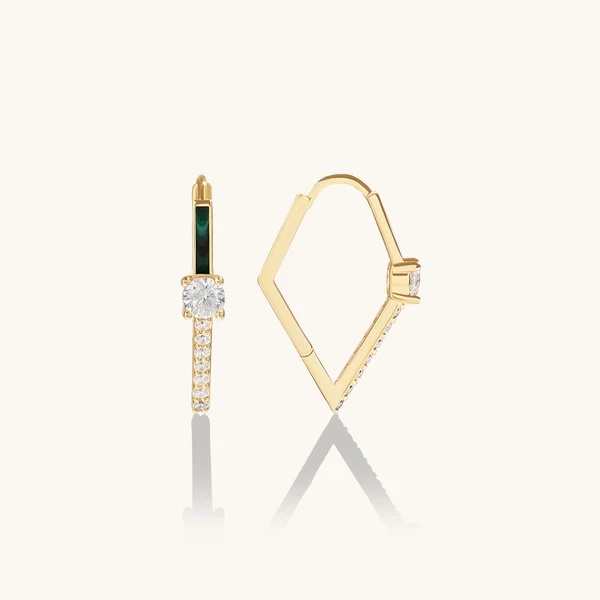
Custom Green Enamel Rhombus Earrings in Gold Jewelry Manufacturers China
LET’S GET STARTED : mo@kingjy.com
How to Custom Green Enamel Rhombus Earrings in Gold Jewelry at JINGYING
Introduction
In the world of fine jewelry, customization has become the ultimate expression of personal style and brand identity. Among the myriad of design possibilities, green enamel rhombus earrings in gold settings stand out as a sophisticated choice that combines geometric precision with vibrant color. JINGYING Jewelry, a leading OEM/ODM manufacturer with over two decades of experience, offers comprehensive custom jewelry solutions that bring such visions to life . This guide explores the complete process of customizing green enamel rhombus earrings at JINGYING, from initial concept to finished product, with particular attention to quality standards and craftsmanship that define the manufacturer’s reputation.
Understanding JINGYING’s Capabilities
JINGYING operates as a full-service jewelry manufacturer specializing in 925 sterling silver and 9K, 10K, 14K, and 18K gold jewelry . The company provides extensive OEM/ODM services for earrings, necklaces, pendants, bracelets, and rings, making it an ideal partner for custom jewelry projects . What sets JINGYING apart is its commitment to quality control, employing a dedicated 10-engineer team to oversee every stage of production . For custom green enamel rhombus earrings, this expertise ensures that each piece meets exact specifications while maintaining durability and aesthetic excellence.
The manufacturer’s material options are particularly relevant for this project. Clients can choose between copper gold-plated, sterling silver gold-plated (vermeil), or solid gold options in various karats . For those seeking the optimal balance of luxury and value, JINGYING’s gold vermeil—featuring a minimum 2.5-micron gold layer over 925 sterling silver—represents an excellent choice, with the company often exceeding industry standards by applying 3.0 microns of 14K or 18K gold .
The Design Phase: Conceptualizing the Rhombus Form
The journey begins with design conceptualization. JINGYING’s experts work closely with clients to translate ideas into manufacturable designs, whether starting from sketches, photographs, or digital files . For rhombus-shaped earrings, precise geometric considerations are paramount. The rhombus, or diamond-shaped form, requires careful attention to angle symmetry and proportion to achieve visual balance.
During this phase, clients collaborate with JINGYING’s design team to determine specific dimensions, the exact shade of green enamel (from deep emerald to vibrant lime), and the gold finish (polished, matte, or textured). The manufacturer’s expertise in adapting designs for enamel application is particularly valuable, as the intricate process of enameling demands specific structural considerations . The metal framework must be designed with proper channels or recesses to securely hold the enamel while maintaining the clean lines characteristic of rhombus geometry.
Material Selection: Choosing the Right Gold and Enamel
Material selection significantly impacts both aesthetics and durability. For green enamel rhombus earrings, clients must decide between several gold options:
Solid Gold (9K, 10K, 14K, 18K) : The most premium option, offering intrinsic value and permanence. Higher karat gold provides richer color but is softer, requiring careful design considerations .
Gold Vermeil : Sterling silver base with a thick gold layer (minimum 2.5 microns). JINGYING’s vermeil exceeds legal standards, often reaching 3.0 microns, providing durability comparable to solid gold at a more accessible price point .
Gold-Plated : Copper base with gold plating, the most economical option suitable for fashion jewelry collections .
For the green enamel, JINGYING employs vitreous enamel—glass fused to metal at high temperatures. This material offers exceptional durability, color stability, and the luminous quality that makes enamel jewelry distinctive. The specific shade of green can be precisely matched to brand colors or personal preferences, with options ranging from transparent to opaque finishes . The enamel application process, known as firing, requires exceptional skill to achieve uniform color and flawless surface finish.
The Manufacturing Process: From CAD to Casting
CAD Modeling and 3D Printing
The production process at JINGYING begins with advanced CAD modeling. Using software such as Rhino or Matrix, designers create detailed 3D models with specific tolerances for shrinkage . This is particularly critical for rhombus shapes, where precise angles must be maintained. The CAD file accounts for the fact that different metals shrink differently during casting—gold vermeil, for instance, shrinks at a different rate than solid gold. JINGYING’s engineers adjust the file by approximately 2-3% to ensure the final dimensions match the design specifications .
Following CAD approval, high-resolution 3D wax printers (LCD 4K with 25-micron resolution) create a wax tree containing multiple rhombus earring models . This wax tree serves as the pattern for investment casting.
Investment Casting
The wax tree is encased in heat-resistant plaster (investment material) and heated to approximately 750°C, burning out the wax and leaving a perfect negative cavity in the plaster . Molten gold or silver is then centrifugally cast into this cavity, creating the metal framework for the earrings. This process ensures that each rhombus earring is identical, with sharp, precise edges essential for geometric designs.
Enamel Application: The Art of Color
Enameling is among the most challenging techniques in jewelry making, requiring exceptional patience and skill . For rhombus earrings, the process begins with preparing the metal surface—cleaning and applying a base layer called “flux,” a whitish enamel that promotes adhesion . This foundational layer is applied to the recessed areas of the rhombus design and fired at high temperatures.
The green enamel is then applied in layers. Artisans dust or paint the powdered glass enamel into the designated areas, carefully controlling the thickness for even color . Each layer undergoes firing in a kiln at temperatures high enough to fuse the glass to the metal without damaging the gold setting. Multiple firings may be necessary to achieve the desired depth and saturation of color. The translucent quality of enamel requires precise temperature control—too much heat causes discoloration, while too little results in uneven fusion .
For rhombus designs, the challenge lies in the geometric precision required. Enamel must fill the shape completely without overflowing onto the gold edges, which would mar the clean lines. JINGYING’s master enamellers have developed techniques to achieve this precision through careful application and multiple firing cycles .
Quality Control and Finishing
Quality control is the most critical process in JINGYING’s production line . Each pair of green enamel rhombus earrings undergoes rigorous inspection at multiple stages:
Enamel Integrity: Each enameled surface is checked for bubbles, cracks, or uneven color. The company employs tests to ensure enamel adhesion, including drop tests from heights of up to 3 meters to confirm that the enamel remains intact and secure .
Gold Plating Verification: For vermeil and gold-plated pieces, JINGYING uses machine testing to verify plating thickness meets client specifications. Additionally, technicians manually rub metal surfaces for five minutes to ensure the gold coating can withstand normal wear without deterioration .
Stone and Component Security: If the rhombus design includes additional elements like gemstone accents, each stone is individually checked using steel needles to ensure secure settings .
The final finishing process includes polishing to achieve the desired gold surface finish, whether high-polish for maximum shine or brushed for a contemporary matte look.
Customization Options and Branding
Beyond the core design, JINGYING offers extensive customization options for branding. Clients can add logos, signatures, or unique hallmarks to their custom green enamel rhombus earrings. For businesses, the company provides private labeling services with personalized logos and packaging . Importantly, JINGYING signs non-disclosure agreements (NDAs) with clients, ensuring that proprietary designs remain confidential . This commitment to intellectual property protection makes JINGYING a trusted partner for established jewelry brands and emerging designers alike.
Production Timeline and Order Process
The custom jewelry process at JINGYING follows a structured timeline:
- Design Consultation: Initial discussions to finalize design specifications (1-2 weeks)
- CAD Development: 3D modeling and client approval (1-2 weeks)
- Sample Production: Creation of prototype for client approval (2-3 weeks)
- Mass Production: Full production run (3-6 weeks, depending on quantity)
- Quality Control and Shipping: Final inspection and delivery (1-2 weeks)
Clients can initiate the process by contacting JINGYING’s sales team, who will guide them through material selection, design refinement, and production scheduling .
Conclusion
Customizing green enamel rhombus earrings in gold jewelry at JINGYING represents a journey from concept to creation, supported by advanced manufacturing technology and centuries-old craft techniques. The manufacturer’s expertise in CAD modeling, investment casting, enameling, and rigorous quality control ensures that each piece meets the highest standards of durability and aesthetic excellence. Whether for a personal statement piece or a commercial jewelry collection, the combination of geometric rhombus design, vibrant green enamel, and precious gold creates a distinctive accessory that exemplifies contemporary fine jewelry craftsmanship. With its comprehensive OEM/ODM capabilities, material options spanning gold vermeil to solid 18K gold, and commitment to quality, JINGYING provides the ideal platform for bringing such sophisticated designs to life.