In the dynamic and ever-evolving world of jewelry, the desire for individuality and personal expression has never been stronger. Mass-produced pieces, while accessible, often lack the soul, story, and unique character that modern consumers increasingly seek. This has propelled the custom jewelry sector to the forefront of the industry, where the collaboration between client vision and manufacturing expertise brings forth heirlooms of the future. At the heart of this transformative process stands the manufacturer—the crucial partner that translates dreams into tangible, wearable art. This article delves into the world of JINGYING, a paradigm of excellence in the custom silver and gold jewelry manufacturing landscape. We will explore the comprehensive journey from initial concept to final masterpiece, examining the intricate processes, advanced technologies, stringent quality controls, and the profound client partnership that defines the JINGYING standard. This in-depth analysis positions JINGYING not merely as a factory, but as an atelier and strategic ally for designers, brands, and individuals seeking to materialize their most ambitious jewelry visions.
I. Introduction: The Renaissance of Custom Jewelry and the Manufacturer’s Role
The 21st-century consumer is a paradox: globally connected yet fiercely individualistic. In fashion and personal adornment, this translates to a move away from homogenized luxury and towards pieces that tell a personal narrative, embody cultural significance, or simply reflect a unique aesthetic. Custom jewelry is the ultimate expression of this trend. It is no longer confined to engagement rings and family crests; it encompasses everything from a small, symbolic charm to a high-fashion statement collection.
Within this burgeoning market, the role of the manufacturer has fundamentally shifted. In the past, a manufacturer was often a distant, anonymous entity. Today, for a brand to succeed, its manufacturing partner must be a co-creator, a technical consultant, and a guarantor of quality. This is the ecosystem in which a company like JINGYING thrives. Specializing in both sterling silver and karat gold—from 9K to 24K—JINGYING has positioned itself as a bridge between creative aspiration and commercial reality. Their name, which in Chinese (精英) translates to “elite” or “essence,” reflects their core philosophy: to provide an elite level of craftsmanship and to extract the essential beauty from every raw material and design sketch.
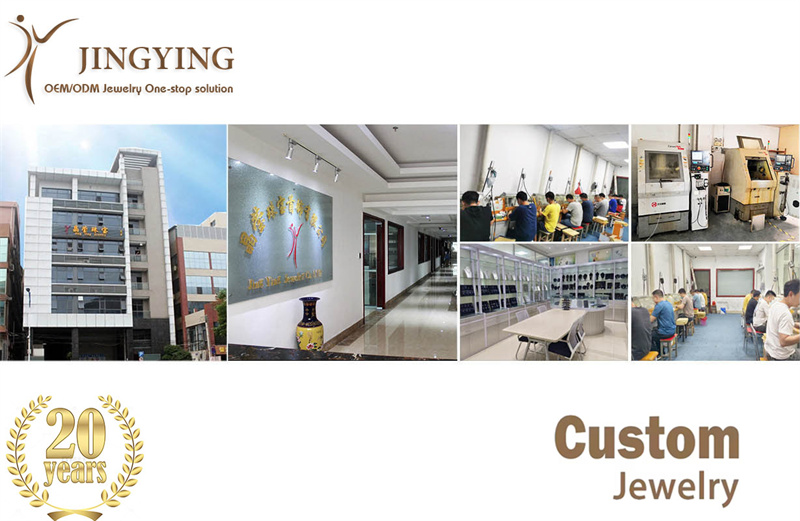
This article will dissect the pillars of JINGYING’s operation, providing a virtual tour of their capabilities and demonstrating why they are a benchmark for custom jewelry manufacturing.
II. The Foundation: Pre-Production Excellence
The success of any custom piece is determined long before the first gram of metal is cast. JINGYING’s pre-production process is a meticulous stage dedicated to alignment, feasibility, and planning, ensuring a smooth and predictable journey from concept to completion.
A. The Collaborative Consultation
Every project at JINGYING begins with a dialogue. This initial consultation is not a simple order-taking exercise; it is a deep dive into the client’s world. Whether the client is an independent designer with a detailed CAD file, a nascent brand with mood boards, or an individual with a cherished heirloom and a rough sketch, JINGYING’s team of project managers and technical experts engages as creative problem-solvers.
Key discussion points include:
- Design Intent: Understanding the story, emotion, and aesthetic behind the piece.
- Target Audience/Market: Is the piece for a high-end boutique, a mass-market e-commerce site, or a one-of-a-kind personal commission? This influences material choices and construction methods.
- Budgetary Parameters: Providing transparent guidance on how material choices, complexity, and quantity impact cost.
- Timeline: Establishing clear milestones and delivery expectations.
B. Technical Design and 3D Modeling
Once the creative vision is crystal clear, it is translated into a precise technical language. JINGYING’s in-house team of skilled 3D modelers uses state-of-the-art Computer-Aided Design (CAD) software to create a digital prototype of the jewelry.
This stage is critical for several reasons:
- Visualization: The client receives photorealistic renderings of the piece from multiple angles. This allows them to “see” the finished product in a virtual space, understanding its proportions and form before any metal is committed.
- Engineering and Feasibility: The modeler doesn’t just create a shape; they engineer a piece of jewelry. They ensure that prongs are structurally sound, that moving parts like hinges and clasps function correctly, that the piece is comfortable to wear, and that it can be successfully cast and finished. For example, they will address potential issues like “metal porosity” in thick sections or “undercuts” that could prevent a mold from being made.
- Iteration and Refinement: The CAD model is easily adjustable. Based on client feedback, dimensions can be tweaked, details can be added or subtracted, and the design can be perfected until it receives the client’s final approval.
C. Material Selection and Sourcing
With an approved 3D model, the focus shifts to materials. JINGYING’s expertise in both silver and gold is a significant advantage.
- Sterling Silver: JINGYING uses premium 925 sterling silver, known for its brilliant white luster and excellent workability. They understand its tendencies (like tarnishing) and can advise on finishes that enhance its durability.
- Karat Gold: The choice of gold is a profound aesthetic and practical decision. JINGYING works with all karats:
- 9K & 10K: Higher alloy content, making it very strong, durable, and more affordable. Ideal for everyday wear and pieces with delicate details.
- 14K: The perfect balance of richness, color, and strength. It is the most popular choice for fine jewelry in many Western markets.
- 18K & 22K: Softer and richer in color, with a higher gold content. 18K is prized for its luxury and deep hue, while 22K and 24K are used for pieces where a deep, warm yellow color and high value are paramount, though their malleability requires specific design considerations.
JINGYING also guides clients on gold colors—yellow, white, and rose—explaining the alloy compositions (e.g., white gold is alloyed with nickel or palladium and often requires rhodium plating for a bright white finish).
All precious metals and gemstones are sourced from reputable, LBMA (London Bullion Market Association) compliant suppliers, ensuring ethical provenance and guaranteed purity.
D. Prototyping: The Wax Model
For many clients, especially those commissioning a single, high-value piece, seeing a physical prototype is an essential step. JINGYING uses high-resolution 3D printing to create a precise wax or resin model from the approved CAD file. This “rapid prototyping” allows the client to hold the design in their hand, assess its size, weight, and ergonomics on the body, and give a final, confident sign-off before the costly casting process begins. This step is a hallmark of a manufacturer committed to client satisfaction and risk mitigation.
III. The Artisan’s Journey: Core Manufacturing Processes
With a signed-off prototype and selected materials, the piece enters the manufacturing phase. This is where JINGYING’s blend of traditional artistry and modern technology truly shines.
A. Mold Making and Casting
The primary method for transforming a model into metal is casting, specifically the lost-wax casting technique, a process perfected over millennia but now enhanced by technology.
- Tree Assembly: The approved wax model is attached to a central “sprue” along with many other wax models to form a “tree.” This allows for the simultaneous casting of multiple pieces, optimizing material use and efficiency.
- Investing: The tree is placed inside a steel flask and immersed in a liquid plaster-like substance called “investment.” The flask is then placed in a vacuum chamber to remove any air bubbles, ensuring a perfectly detailed impression.
- Burnout: The flask is transferred to a high-temperature oven. The heat does two things: it bakes the investment into a hard, ceramic shell, and it melts (“burns out”) the wax, leaving a hollow, negative cavity of the jewelry piece inside the shell.
- Casting: The flask, now hot, is placed in a casting machine. Precisely measured amounts of molten silver or gold are forced into the flask by centrifugal force or vacuum pressure, filling the cavities left by the wax.
- Devesting and Quenching: Once the metal has cooled and solidified, the investment flask is plunged into water. The ceramic shell cracks and dissolves away, revealing the raw metal “tree” of jewelry pieces, now known as “castings.”
B. The First Quality Check
At this stage, the raw castings undergo their first rigorous inspection. Technicians examine each piece for casting defects such as bubbles (porosity), incomplete sections, or distortions. Pieces that pass this check are then carefully cut from the central sprue using lasers or precision saws.
C. Assembly and Fabrication
Not all jewelry is cast as a single piece. Complex designs often require the fabrication and assembly of multiple components.
- Soldering: Highly skilled artisans using micro-torches solder elements together—for instance, attaching a setting to a band, or connecting chain links. This requires a deep understanding of metallurgy and the different melting points of various solders to avoid damaging the main piece.
- Stone Setting: This is one of the most critical and specialized skills in jewelry making. JINGYING’s master setters are proficient in all setting styles:
- Prong Setting: Using tiny metal claws to hold a gemstone, allowing maximum light exposure.
- Bezel Setting: Encircling a stone with a custom-fitted metal rim for a secure, modern, and protective hold.
- Pave Setting: Setting small stones closely together, covering the surface like a “paved” road, creating a continuous sparkle.
- Channel Setting: Placing stones securely between two parallel metal walls, often used in eternity bands.
- Invisible Setting: A complex technique where stones are set into a grid with no visible metal from the top, creating a seamless surface of gems.
- Chain Making and Mechanism Installation: For pieces like necklaces and bracelets, JINGYING can hand-assemble chains or integrate precision mechanisms like spring rings, lobster clasps, or custom-designed box clasps, ensuring both security and ease of use.
IV. The Soul of the Piece: Finishing and Polishing
If casting gives a piece its body, then finishing gives it its soul. This multi-stage process transforms a rough, matte-finished casting into a brilliant, refined work of art. JINGYING offers a vast array of finishes to meet any design requirement.
A. Pre-Polishing and Surface Refinement
The process begins with the removal of excess metal and surface imperfections.
- Tumbling: Pieces are placed in a rotating drum with an abrasive media and water. This “vibratory tumbling” smooths out rough edges and begins the polishing process in a uniform way.
- Hand Filing and Sanding: Artisans meticulously file down solder joints and any remaining sprues, then use progressively finer grades of sandpaper and abrasive wheels to erase scratches and create a perfectly smooth surface.
B. The Art of Polishing
Polishing brings out the metal’s inherent luster.
- High Polishing/Mirror Finish: Using motorized wheels with polishing compounds (like rouge), the polisher buffs the metal to a brilliant, reflective shine. This is the most common finish, designed to maximize light reflection and sparkle.
- Satin/Brush Finish: Created by brushing the metal with fine wire brushes or abrasive pads, this finish produces soft, linear, non-reflective lines, giving the piece a contemporary, matte texture.
- Matte/Sandblasted Finish: By blasting the surface with fine particles (like glass beads or sand), a uniform, pebbled, non-reflective surface is achieved. This finish is excellent for highlighting textures and providing a modern, understated look.
C. Specialized Finishes and Embellishments
JINGYING’s capabilities extend to more artistic and technical finishes:
- Oxidation and Antiquing: Applying a chemical solution to silver or lower-karat gold to darken the recessed areas of the design. When followed by a light polish on the high points, this technique creates dramatic contrast, making intricate patterns and carvings “pop.”
- Engraving: Both hand-engraving, using specialized tools to create unique, organic script and patterns, and laser-engraving, for perfect precision and reproducibility of logos, serial numbers, or intricate designs.
- Texture Creation: Using tools, rolling mills, or chemicals to impart textures like hammered, Florentine (cross-hatched), or wood-grain effects onto the metal.
- Plating: JINGYING offers plating services such as rhodium plating (for a bright, white, and tarnish-resistant finish on white gold or silver), gold plating, and rose gold plating over sterling silver to create two-tone effects or enhance color consistency.
V. The Uncompromising Standard: Quality Assurance and Control
A manufacturer’s reputation is built on the consistency and quality of its output. JINGYING has institutionalized a multi-layered QC protocol that scrutinizes every piece at multiple stages.
- In-Process QC: Checks during casting, assembly, and setting to catch issues early.
- Pre-Final QC: A comprehensive inspection of the finished piece before it is cleaned and packaged. This includes:
- Dimensional Check: Verifying the piece matches the CAD specifications.
- Stone Check: Ensuring all stones are secure, undamaged, and properly aligned.
- Clasp and Mechanism Functionality: Testing all moving parts.
- Surface Perfection: Examining under magnification for any polishing marks, scratches, or finishing flaws.
- Final QC and Hallmarking: Every piece that passes inspection is meticulously cleaned in an ultrasonic cleaner and steam dryer to remove any polishing compound or residue. It is then hallmarked. For gold pieces, this involves laser-engraving the karat stamp (e.g., 14K, 18K). For sterling silver, the “925″ stamp is applied. Client-specific logos or maker’s marks can also be added at this stage.
VI. Beyond Manufacturing: Value-Added Services
JINGYING’s role as a partner extends beyond production. They offer a suite of value-added services that support their clients’ entire business cycle.
- Packaging and Branding: They can provide custom packaging solutions, from branded ring boxes and pouches to sophisticated display-ready cases, ensuring the unboxing experience aligns with the client’s brand image.
- Inventory Management and Drop-Shipping: For e-commerce brands, JINGYING can hold inventory and fulfill orders directly to the end-customer, streamlining the supply chain.
- Photography and Marketing Support: High-quality product photography is essential for sales. JINGYING can provide professional studio images of the finished pieces for use in client catalogs and online stores.
- Design Collaboration for Production Optimization: For clients with a design idea but no technical background, JINGYING’s team can co-create the design, suggesting modifications that enhance wearability, reduce cost, or improve manufacturability without compromising the artistic vision.
VII. Conclusion: Partnering with the Future of Jewelry
The landscape of jewelry is one of constant change, driven by consumer demand for sustainability, personalization, and authentic storytelling. In this environment, the choice of a manufacturing partner is one of the most strategic decisions a designer or brand can make.
JINGYING represents the new archetype of the manufacturer: a hybrid entity that is part master artisan, part cutting-edge engineer, and part business consultant. Their mastery over materials like silver and gold, their seamless integration of CAD/CAM technology with handcrafted finishing, and their unwavering commitment to quality and client collaboration make them more than a supplier; they are an enabler of creativity.
For anyone looking to bring a jewelry concept to life—be it a single, sentiment-laden pendant or a full commercial collection—the journey with a partner like JINGYING is one of shared vision and meticulous execution. It is a process that ensures the final piece is not just an accessory, but a perfect fusion of art, emotion, and impeccable craftsmanship, destined to be cherished for generations. In the world of custom jewelry, JINGYING is not just a name; it is a standard of excellence.