JINGYING: The Quiet Architecture of Accessible Luxury in Custom Brass Jewelry
The global jewelry market is undergoing a structural realignment. As gold and silver prices remain at historically elevated levels, a quiet migration is underway—away from precious-metal orthodoxy and toward materials that can deliver the visual and tactile language of luxury without the prohibitive cost structure. Customs data from the first three quarters of 2026 shows China’s precious-metal jewelry exports surpassing $10.2 billion, up 17.55% year-on-year, but the more telling figure lies beneath the aggregate: one trading company reported that 60% of its clients have shifted from silver to copper-based jewelry this year alone, with brass order volumes rising 50% year-on-year. Brass, once relegated to the margins of costume jewelry, has become the industry’s pragmatic answer to a simple question: how do you make a piece that looks and feels like gold, performs reliably on the skin, and still leaves room for a brand to breathe?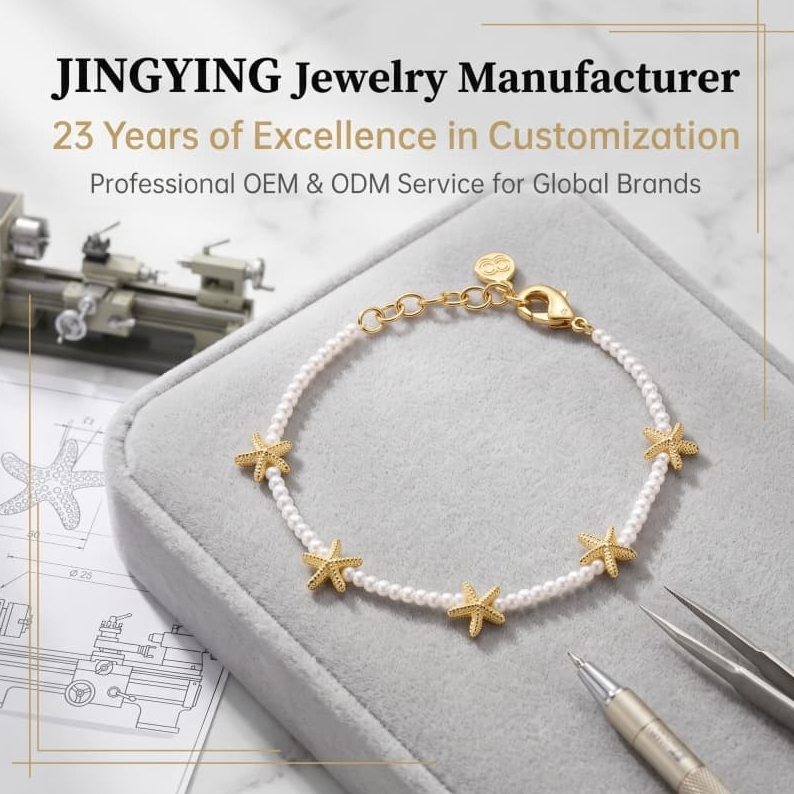
JINGYING, a Guangzhou-based OEM/ODM manufacturer established in 1998, has spent over two decades answering that question through a specific and deliberately narrow proposition: custom brass designs finished with 18K gold plating and a satin touch. The combination is not accidental. It reflects a manufacturing philosophy that treats surface and substrate as a single system, where the warmth of the gold layer and the softness of the satin finish are calibrated together from the first CAD file to the final quality-control inspection.
Why Brass Became the Material of the Moment
The case for brass is rarely made in aesthetic terms, though it could be. Brass—an alloy of copper and zinc—accepts plating and coloring exceptionally well, holds intricate three-dimensional detail through lost-wax casting, and carries a heft that reads as substantial in the hand. In manufacturing terms, its malleability allows factories to use rubber or wax molds rather than expensive CNC tooling, which lowers mold costs, accelerates sampling, and gives designers far greater freedom with organic shapes, hollow structures, and vintage-inspired detailing. For a brand iterating on trend cycles, that flexibility is not a minor advantage; it is the difference between testing a new silhouette in weeks rather than months.
But the brass that reaches JINGYING’s production floor is not generic hardware-store alloy. The factory specifies high-purity, environmentally friendly brass with controlled lead and nickel content, compliant with REACH and RoHS directives. The distinction matters because brass has earned a reputation problem in some corners of the market—green skin, tarnishing, allergic reactions—that is almost always a story about poor manufacturing rather than the metal itself. When brass is produced with thin flash plating or unverified alloys, problems are inevitable. When it is produced with adequate plating thickness, barrier layers, and post-plating protection, it becomes one of the most reliable and margin-efficient materials available to fashion jewelry brands.
JINGYING’s answer to the brass reputation problem is architectural. The plating stack is built in layers: a base preparation, a nickel-free barrier layer (typically palladium or a skin-safe alternative), the 18K gold layer itself, and a final anti-tarnish sealant. This multi-layer approach prevents the copper and zinc in the brass from migrating upward into the gold and oxidizing—a known failure mode when gold is plated directly onto brass without a diffusion barrier. The result is a piece that maintains its warm, radiant hue through daily wear rather than surrendering to discoloration within months.
18K Gold Plating: The Difference Between Decoration and Durability
Not all 18K plating is the same, and the gap between a decorative flash coat and a functional demi-fine finish is measured in microns. Industry standards for fashion jewelry plating typically range from 0.5 to 2.5 microns; JINGYING’s process is calibrated to deliver 2 to 5 microns of 18K gold, with micron-precise control over uniformity and adhesion. That thickness is not an arbitrary specification. Thicker plating resists scratches, tarnishing, and fading far better than thin decorative coatings, and with reasonable care, a well-plated brass piece can maintain its brilliance for years rather than seasons.
The choice of 18K rather than 24K is equally deliberate. Eighteen-karat gold comprises 75% pure gold alloyed with other metals for stability and hardness; it offers a warmer, more nuanced color than the pale yellow of higher-karat plating, and it wears more gracefully because the alloy is less soft than pure gold. For brands positioning between fashion jewelry and fine jewelry—the so-called demi-fine space—18K gold-plated brass hits a commercial and aesthetic sweet spot: the visual authority of gold without the working-capital burden of solid precious metal.
The finishing sequence does not end with plating. JINGYING applies anti-tarnish post-plating treatments, often an electrophoretic coating, that seal the gold layer and isolate the brass from moisture, sweat, and air. This is particularly consequential for brass, which is more susceptible to oxidation than precious metals. The combination of adequate plating thickness and protective e-coating creates a finish that is effectively waterproof and tarnish-resistant under normal wear conditions—a specification that matters most for pieces in direct, prolonged skin contact, such as earrings and bracelets.
The Satin Finish: A Tactile Counterpoint to the Gold
If 18K plating supplies the visual warmth, the satin finish supplies the piece’s quiet character. A satin finish is created by dulling the metal surface through brushing, sandblasting, or chemical treatment, producing a soft, pearl-like luster rather than a mirror reflection. Light does not bounce off the surface in sharp, controlled highlights; it spreads gently, creating subtle elegance, softer visual contrast, and a more understated appearance. The result is jewelry that reads as considered rather than flashy—a quality that has become increasingly valuable as luxury aesthetics move toward restraint.
Satin is often described as the middle ground between high polish and matte, but its practical advantages extend beyond aesthetics. A satin surface hides fingerprints and minor scratches far better than a mirror polish, which makes it a pragmatic choice for everyday pieces, unisex lines, and minimalist collections that are worn rather than displayed. In JINGYING’s production, the satin effect is achieved through controlled mechanical brushing or a fine frosting wheel, with the grain scale adjusted according to the design language of the piece. Because the word “satin” can denote different textures across manufacturers—one supplier’s satin may be finer or coarser than another’s—JINGYING treats finish approval as a physical reference process: clients approve a sample under consistent lighting before mass production begins, ensuring that the visual and tactile outcome remains repeatable across production runs.
The satin finish also interacts with the gold plating in a way that amplifies both. A high-polish gold surface reflects surrounding colors strongly and can appear almost brassy under certain lighting; a satin gold surface diffuses light more evenly, which makes the 18K color read as softer and more integrated into the metal rather than sitting on top of it. The combination is not merely decorative. It is a design decision that changes how the piece is perceived in the hand and on the skin: less like a coated object, more like a material with its own character.
The Custom Architecture: From Sketch to Sealed Box
JINGYING’s custom workflow is structured around the principle that a finish is only as good as the substrate beneath it and the geometry it must cover. The process begins with design evaluation and requirement lock-in: the client shares references, technical drawings, or simply a sketch, and the engineering team assesses feasibility, finalizes specifications, and confirms the production timeline. From there, high-resolution 3D CAD models and realistic renderings are produced, allowing the client to review proportions, textures, and focal points before any metal is cut.
Prototyping is treated as a moment of truth rather than a formality. A first metal sample is produced, and the client checks dimensions, fit, weight, and overall quality in hand. JINGYING accepts small-batch trial orders alongside large wholesale runs precisely because sampling confidence is essential for brands testing a new design or entering a new market. Once the sample is approved, mass production for brass pieces typically proceeds through lost-wax casting to capture fine textures, followed by assembly, laser welding for structural durability, and stone setting where required. The finishing stage—where the satin brushing and 18K plating are applied—is sequenced with care: the surface texture is established before plating, and the plating thickness is controlled to preserve the satin grain rather than filling it in.
Quality control operates as a multi-stage system rather than a final checkpoint. X-ray fluorescence inspection verifies plating thickness and metal purity; salt-spray testing assesses corrosion resistance; wear simulation approximates the conditions of daily use; and nickel-release testing confirms compliance with EU REACH and EN1811 standards. For earrings, the posts—which endure prolonged direct skin contact—are held to the same nickel-free standard as the decorative components, and finished goods undergo inspection for plating quality, structural stability, and ear-post safety before packaging. The factory retains design files for effortless reordering, and an after-sales quality warranty covers manufacturing defects including plating and structural issues.
The Strategic Position: Demi-Fine Manufacturing at Fashion-Jewelry Speed
JINGYING’s competitive position is not built on being the cheapest brass plater or the fastest sampler in Guangzhou. It is built on a narrower and more defensible claim: the ability to produce custom brass pieces with an 18K gold finish and satin surface that behave like demi-fine jewelry while moving at the pace of fashion jewelry manufacturing. The factory’s pricing is reportedly 30–50% below US and EU manufacturers, with minimum order quantities starting at 50 pieces per design and standard lead times of 15–20 days. For a emerging brand, that combination lowers the cost of experimentation without lowering the standard of execution.
The market context reinforces the logic. The shift from silver to brass is not a temporary reaction to metal prices; it reflects a broader consumer willingness to accept plated brass as a legitimate material for everyday luxury, provided the plating is thick enough and the finish is considered enough. JINGYING’s 23 years of OEM/ODM experience—serving over 200 brands across 35 countries from a 15,000-square-meter facility—has given it a granular understanding of what that acceptance requires in practice: nickel-free construction that passes European and American regulations, plating that survives the wear patterns of earrings and bracelets, and a satin finish that feels intentional rather than unfinished.
In the end, the value of a manufacturer like JINGYING lies in the coherence of its material choices. Brass provides the design freedom and cost structure. 18K gold plating provides the visual and emotional register of gold. The satin finish provides the tactile restraint that makes the piece feel modern rather than imitative. And the multi-layer plating architecture, nickel-free barrier, and anti-tarnish sealant provide the durability that turns a promising sample into a repeatable product. Accessible luxury is often described as a price point. In JINGYING’s workshop, it is better understood as a manufacturing discipline—one measured in microns, calibrated by hand, and finished with a softness that does not announce itself but is immediately felt.