JINGYING: Custom 925 Sterling Silver Jewelry OEM Manufacturing Service
The global silver jewelry market, valued at approximately $31.4 billion, is in the midst of a structural realignment. Silver prices surged from roughly ¥7 per gram in early 2025 to nearly ¥20 per gram by early 2026, a tripling of raw material costs in under a year. Established players have responded by re-engineering sterling silver into ultra-lightweight architectures or shifting mid-tier assortments toward plated base metals. For emerging and independent brands, however, this volatility has created a narrow but durable opening: a well-executed 925 sterling silver collection, developed with a manufacturing partner capable of controlling cost, quality, and intellectual property, can signal permanence and material integrity in a market increasingly crowded with disposable fashion jewelry.
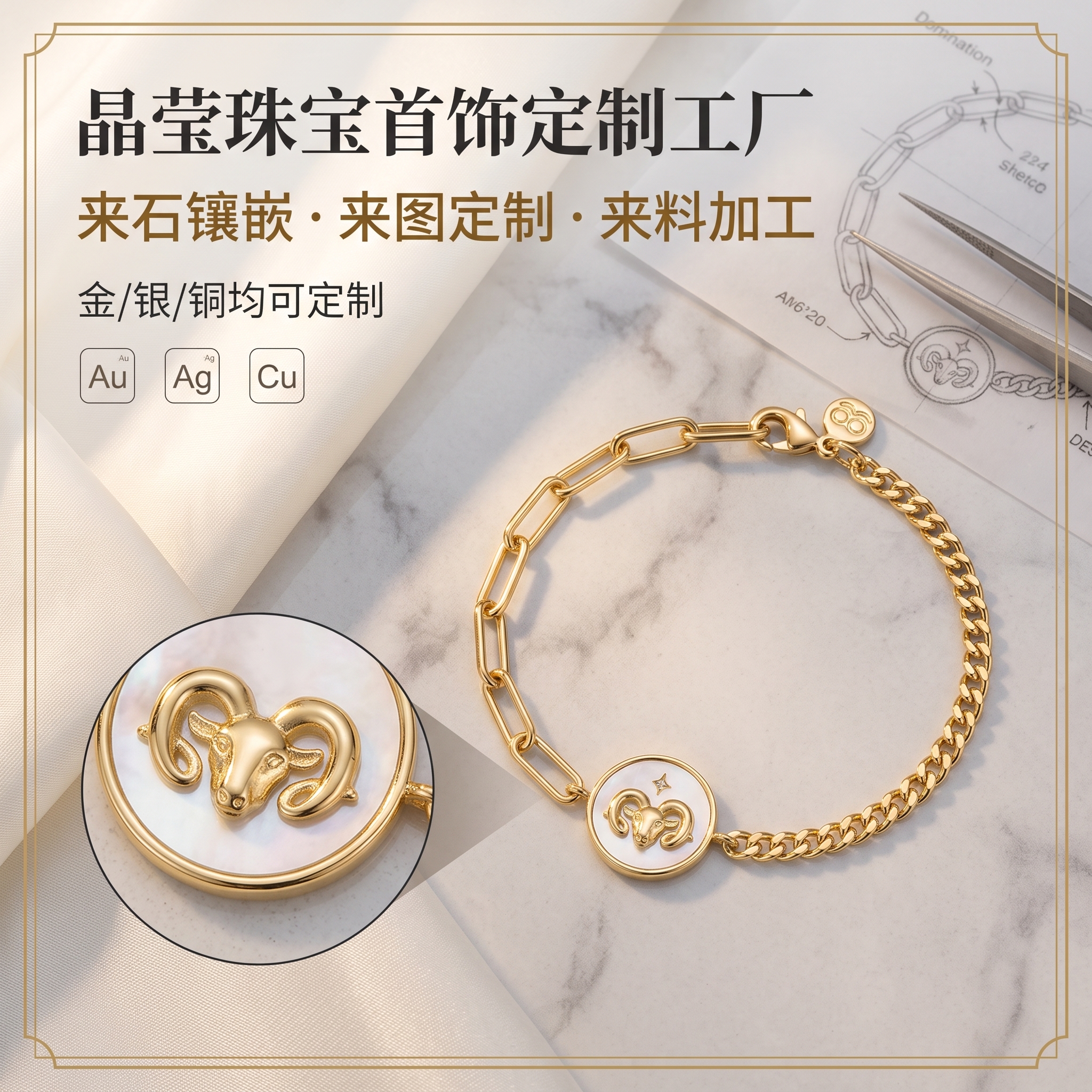
This is the context in which JINGYING operates. Founded in 1998 and headquartered in Guangzhou, JINGYING has spent more than two decades evolving from a modest workshop into a vertically integrated OEM and ODM manufacturer specializing in 925 sterling silver and copper with genuine gold plating. With a monthly production capacity exceeding 100,000 pieces, the company serves brand jewelers, retailers, and wholesalers worldwide, offering a one-stop solution that spans design, prototyping, casting, finishing, quality control, and private-label packaging. For a brand seeking a custom 925 sterling silver OEM partner, JINGYING represents a specific proposition: industrial scale without the loss of craft-level control, and confidentiality treated not as an afterthought but as the first operational step.
From CAD File to Casting: The Engineering Backbone
The manufacturing journey at JINGYING begins with design and prototype development. Clients may submit a finished CAD file, a reference photograph, or a rough concept; the company’s in-house design team can also develop the idea collaboratively. CAD/CAM modeling translates the concept into a precise three-dimensional prototype, with tolerances maintained within ±0.1 mm—a level of precision that becomes critical when a design must remain consistent across thousands of units. This engineering-first approach ensures that the designer’s vision is faithfully captured before mass production begins, rather than discovered to be unworkable after tooling has already been committed.
The casting stage relies on lost-wax casting, a technique that has remained fundamentally unchanged for centuries yet benefits enormously from modern precision. Molten 925 sterling silver—heated to its melting point of approximately 961°C—is poured into precision molds, capturing every curve, filigree detail, and surface texture of the original design. For copper-based pieces intended for gold plating, a parallel process is used: the brass substrate is formed through high-resolution wax printing and plaster mold casting, then cleaned, polished, and prepared for electroplating. The choice between silver and copper substrates is not a matter of one being superior; it is a material strategy that allows a brand to serve different price points and emotional registers with a single manufacturing partner.
The Craft Layer: Filing, Polishing, and Finishing
Raw castings at JINGYING are not simply tumbled and shipped. Each piece undergoes meticulous hand-filing, where artisans refine edges and surfaces using files of varying grain. This is where human skill complements machine precision: the artisan’s trained eye verifies that the form is true, that no casting defects escape detection, and that the surface is perfectly prepared for subsequent finishing. Polishing then transforms a functional casting into a piece of jewelry. The company employs multi-stage polishing, progressing from coarse abrasive wheels to fine cotton cloth wheels coated with polishing wax, producing a mirror-finish surface. For pieces requiring a matte or satin finish, sanding and sandblasting techniques create controlled surface textures rather than a uniform reflective sheen.
Electroplating is where JINGYING’s technical capabilities become most tangible for brands selling into demanding retail environments. For 925 sterling silver pieces, rhodium plating is applied to enhance luster and provide tarnish resistance—a critical factor for maintaining product appeal during extended shelf life. For copper-based pieces, genuine gold plating follows a multi-layer process: the brass substrate first receives a nickel or alloy barrier layer to ensure adhesion and corrosion resistance, after which the gold layer is electrodeposited to the specified thickness. The company adheres to national standards for gold plating, ensuring that coating thickness meets or exceeds the 0.5 μm minimum required by QB/T 1131-2005, with thicker layers available for premium applications where durability and color depth are paramount. An optional anti-tarnish e-coat—a micro-thin electrophoretic lacquer—seals the jewelry against oxidation and humidity, providing an additional layer of protection for pieces destined for humid climates or extended storage.
Quality Control as a Stage-by-Stage Discipline
Capacity means little without consistency, and JINGYING’s quality framework is built around inspection at every production phase rather than a single final check. The process begins with incoming material verification: XRF testing of silver and brass alloys to confirm composition and purity before any metal enters production. Wax injection and casting are inspected for dimensional accuracy and surface quality at the mold and casting stages. After polishing, finish uniformity and the absence of surface defects are verified. Electroplating inspection tests coating thickness, adhesion, and color consistency. The final product inspection applies 100% quality control covering dimensions, performance, and visual appearance.
Material integrity is documented rather than assumed. All 925 sterling silver pieces produced by JINGYING are stamped with the “S925” hallmark, the universally recognized indicator of silver purity, and third-party assay reports from accredited laboratories such as SGS or Bureau Veritas can be provided upon request for large initial orders. For copper-based pieces with gold plating, nickel release levels are controlled to comply with REACH and RoHS standards, a requirement that is non-negotiable for brands selling skin-contact items such as earrings and rings into European and North American markets. Plating durability is also subjected to testing that extends beyond visual inspection, giving brands empirical data to support claims about wear resistance and longevity.
Confidentiality as a Manufacturing Discipline
For brands operating in competitive markets, the protection of design intellectual property is not a peripheral concern. JINGYING’s cooperation process is structured accordingly: it does not begin with a quotation but with a legally binding Non-Disclosure Agreement. Before any design files, sketches, or CAD drawings are shared, both parties sign an NDA that establishes clear confidentiality obligations and creates legal consequences for breach. Internal protocols further restrict access to client design files, storing digital assets on secure servers with limited permissions.
For clients requiring maximum separation, JINGYING can establish independent production lines dedicated to specific OEM projects, ensuring that a brand’s designs never appear on the same production floor as competing products. The company also maintains a strict policy against replicating or reselling brand-exclusive designs: once a design is developed for a client, it remains that client’s intellectual property, and JINGYING does not manufacture competing products based on proprietary designs or sell such designs to third parties. This combination of contractual, physical, and policy safeguards addresses the most common anxiety brands bring to an OEM relationship—that their differentiation will be diluted by the very partner entrusted with producing it.
Beyond the Metal: Customization, Packaging, and Order Flexibility
A JINGYING OEM engagement is not limited to the metal itself. The company provides ODM and OEM services across rings, necklaces, pendants, earrings, bracelets, and pearl jewelry, with customization extending to personalized logos, stone settings, and packaging. Clients can specify a range of finishes, plating colors, and surface treatments, and the company’s engineers can adapt the manufacturing process to accommodate unique mechanical components, novel materials, or a brand’s distinctive matte or satin aesthetic. For brands launching a first collection or testing a new silhouette, JINGYING’s production system is designed to accommodate both bulk orders for established brands and smaller batch runs for emerging designers or seasonal collections. This flexibility matters in a market where a brand may need thousands of units for a core collection and only hundreds for a limited edition, without moving to a different supplier for each order size.
Why JINGYING, and Why Now
The case for JINGYING as a custom 925 sterling silver OEM partner rests on a specific alignment of capabilities. The company offers vertical integration that encompasses wax modeling, lost-wax casting, laser engraving, electroplating, and final assembly under one roof, minimizing outsourcing delays and reducing the quality inconsistencies that arise when production is fragmented across multiple vendors. It combines industrial capacity—over 100,000 pieces per month—with a hand-filing and multi-stage polishing regime that preserves the craft signature of each design. Its quality system is documented and testable, from XRF incoming inspection to SGS-verifiable silver content and REACH-compliant nickel release. And its NDA-first, independent-line approach to confidentiality gives brands a partner that treats design protection as a precondition of collaboration rather than a clause in a purchase order.
In a silver jewelry market defined by price volatility and shifting material strategies, the brands that build durable positions are those that treat 925 sterling silver not as a commodity input but as a material signature requiring disciplined manufacturing. JINGYING’s role is to make that discipline accessible: to translate a CAD file, a sketch, or a brand concept into a repeatable, inspectable, and protectable product at a scale that supports both emerging collections and established volume programs. For brands seeking a custom 925 sterling silver OEM manufacturer with the experience, infrastructure, and confidentiality framework to move from concept to shelf-ready jewelry, JINGYING offers a vertically integrated answer—one that has been refined across 23 years of production for the global market.