JINGYING: A Reliable Supplier to Manufacture Gold-Filled Cuban-Link Bracelets and Chains
The Cuban-link bracelet occupies a rare position in the jewelry market: it is simultaneously a classic and a current staple. Its interlocking, tightly fitted links project weight and intention, and it has proven durable enough to survive shifts in taste that have retired countless other chain styles. For brands and buyers seeking to source this category, however, the choice of material and manufacturer matters as much as the design itself. Gold-filled construction offers a middle path between the disposability of gold plating and the capital intensity of solid gold, and the supplier capable of executing it to specification becomes a strategic asset rather than a transactional vendor. JINGYING, a Guangzhou-based jewelry manufacturer operating since 1998, presents itself as precisely such a supplier for gold-filled Cuban-link bracelets and chains. Whether that claim holds depends on how one reads the evidence: the material standards the factory claims to meet, the operational history it brings to the category, and the verifiable markers a buyer should demand before committing to production.
What “Gold-Filled” Actually Requires—and Why the Distinction Matters
The reliability of any gold-filled supplier begins with a precise definition of the material. Gold-filled is not a marketing synonym for gold-plated. Under the United States Federal Trade Commission’s Jewelry Guides, an item may be described as “Gold Filled” only when a layer of gold alloy of not less than 10 karat fineness has been affixed to a base metal by soldering, brazing, welding, or other mechanical means, with a minimum thickness throughout of 170 millionths of an inch—approximately 4.3 microns—and when that plating constitutes at least one-twentieth of the total metal weight of the article. This is a mechanically bonded layer, not an electrodeposited film. The distinction is not semantic. Standard gold plating is typically less than 0.5 microns thick and wears away under friction, moisture, and the ordinary chemistry of daily wear; gold-filled material carries a gold layer five to ten times thicker than plated jewelry and is correspondingly resistant to tarnishing, peeling, and fading. A 14/20 gold-filled piece—the most common industry standard, denoting 14-karat gold at one-twentieth of total weight—can remain serviceable for years of regular wear, whereas a plated piece may show visible degradation within months.
For a Cuban-link bracelet, this material distinction has structural consequences. The form depends on solid, closely fitted links that can bear handling without deforming or shedding their finish. Gold-filled wire, sheet, and tubing begin as bonded material that is then formed into links and clasps, which gives authentic gold-filled chains their characteristic durability. A supplier that treats “gold-filled” as a label rather than a process will produce bracelets that look correct at dispatch and fail in the customer’s hands. The first test of any supplier, therefore, is whether it can articulate and document the karat, the weight fraction, and the minimum thickness of the gold layer it applies—not merely assert that the product is “gold-filled.”
JINGYING’s Operational Profile: Scale, Materials, and Service Model
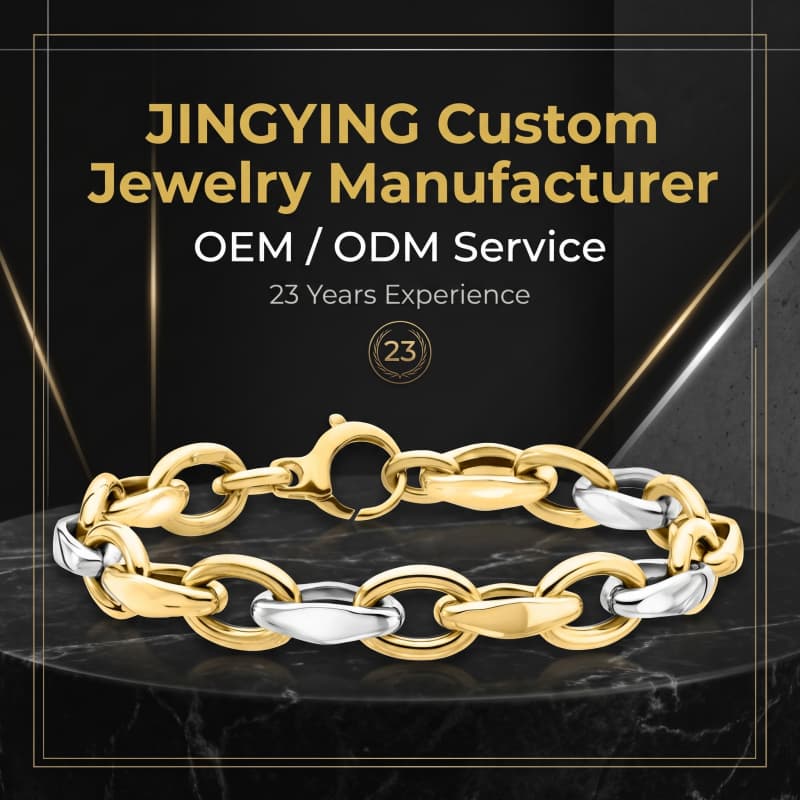
JINGYING’s public materials describe a manufacturer established in 1998, with a monthly production capacity of up to 50,000 pieces of silver jewelry and a client base spanning supermarkets, jewelry chains, wholesalers, traders, and brand companies. Its stated material capabilities include gold-plated copper, gold-plated 925 sterling silver, and gold-filled and vermeil constructions, with a strong emphasis on quality, durability, and long-lasting plating. The factory also offers full OEM and ODM services: customers can supply sketches, photographs, or CAD designs, and the manufacturing process proceeds through 3D modeling, CNC machining for metal masters, casting, finishing, and hand-setting where applicable. For gold-filled Cuban-link production specifically, the relevant capability is not simply casting a link shape but working with bonded gold-filled stock and assembling links, clasps, and end-pieces in a way that preserves the integrity of the gold layer at every joint and solder point. JINGYING’s site lists Cuban chain and bracelet formats among its product offerings and positions gold-filled work as part of a broader private-label and OEM service. The factory also states that it will sign a non-disclosure agreement before manufacturing begins, a detail that matters to brands protecting original link profiles or clasp designs.
On paper, then, JINGYING presents the profile of a supplier that understands both the material and the service layer of the business. But in the gold-filled category, paper claims are insufficient. The market contains a documented problem: gold-plated chains are routinely offered as gold-filled on sourcing platforms, sometimes through deliberate misrepresentation and sometimes through a seller’s own confusion about what the term requires. Reliability, in this context, is not a matter of reputation alone; it is a matter of verifiable process.
The Verification Framework: What a Reliable Gold-Filled Supplier Must Prove
A credible buyer does not ask whether a supplier is “trustworthy” in the abstract. The useful question is whether the supplier can satisfy a set of specific, documented criteria before bulk production begins. The jewelry sourcing literature converges on three non-negotiable checks: a written alloy specification, product-type-consistent export or documentation history, and sample-to-batch consistency.
The written alloy specification is the first filter. For a gold-filled Cuban-link bracelet, that specification should state the karat of the gold layer, the weight fraction (for example, 1/20), the base-metal core, and the minimum thickness in microns. A supplier that responds with “high-quality gold” or “18K gold filled” without numeric specification is not providing enough information to distinguish bonded gold-filled material from a thicker-than-average plating. JINGYING’s materials claim gold-filled and vermeil capabilities alongside plated and solid-gold options, which is a plausible range for a factory serving multiple price tiers, but the buyer’s task is to require that the specification for any given order be fixed in writing before sampling.
The second check is documentation consistency. A factory that genuinely manufactures gold-filled jewelry for export should be able to produce paperwork consistent with that product type: export declarations under the correct HS code for gold jewelry, assay or material certifications where available, and a sample-to-batch trail that allows the buyer to compare the production run against the approved sample. JINGYING’s longevity—more than two decades in the Guangzhou jewelry manufacturing ecosystem—is a meaningful first-pass credibility signal, but age alone does not resolve the material question. The documentation trail is what converts longevity into reliability for a specific order.
The third check is sample-to-batch consistency, and it is especially consequential for Cuban links. A gold-filled bracelet has multiple potential failure points: the solder joints between links, the clasp mechanism, and the surface integrity of the gold layer after forming and finishing. A supplier that can produce a flawless sample but allows variability in the bulk run is not reliable for this category. JINGYING’s stated quality process includes a ten-engineer inspection team assigned to each production stage, which, if accurately described, is the kind of internal control that supports batch consistency. The buyer’s protection lies in treating that claim as a hypothesis to be tested through pre-production samples, in-process checks, and a final inspection protocol that includes wear simulation and clasp-cycle testing.
Material Integrity and the Economics of Gold-Filled Cuban Links
The commercial logic of gold-filled Cuban-link bracelets rests on a trade-off: the buyer pays more than for plating but far less than for solid gold, and in return receives a piece that can be marketed as durable, wearable, and materially honest. This trade-off only holds if the gold layer is genuinely thick enough to survive. Gold-filled material is available in 14-karat and, less commonly, 12-karat constructions, with 14/20 being the dominant standard in the established supply market. A manufacturer that substitutes a thinner bonded layer or a lower-karat gold for the specified material undermines the entire value proposition, even if the piece looks identical at the point of sale.
JINGYING’s stated focus on “long-lasting coating” and its ability to work across plated, vermeil, and gold-filled constructions suggest that the factory is positioned to serve buyers at different price points. That versatility is useful, but it also means the buyer must be explicit about which construction is being ordered and must require that the invoice, the product label, and the physical sample all describe the same material. The term “gold-filled” carries legal weight in the United States and reputational weight everywhere; a supplier that treats it loosely exposes the buyer to both regulatory risk and customer dissatisfaction.
What Reliability Means in Practice
Reliability in the gold-filled Cuban-link category is not a single attribute. It is the conjunction of material honesty, process control, and commercial transparency. JINGYING brings to this conjunction a long operating history, a broad material range, an OEM/ODM service model, and a stated quality-inspection structure. Those are the raw materials of a reliable supplier. But the buyer who treats them as sufficient without verification is not exercising diligence; they are extending trust where verification is possible.
The practical path forward is straightforward. Request a written alloy specification for the specific gold-filled Cuban-link construction under consideration, including karat, weight fraction, and minimum gold thickness in microns. Order a sample and subject it to the kind of handling a finished bracelet will encounter—clasp cycles, flex at the links, exposure to moisture and skin chemistry. Compare the production batch against that sample with a documented inspection protocol. Ask for export or assay documentation consistent with gold jewelry, not imitation jewelry. If JINGYING can satisfy those conditions, it moves from a plausible supplier to a verified one. If it cannot, the buyer has learned something valuable before committing capital.
The Cuban link is not a trend that rewards shortcuts. Its visual authority depends on the weight and finish of every individual link, and its commercial value depends on the buyer’s ability to stand behind the material claim. A supplier that can manufacture gold-filled Cuban-link bracelets to specification, document the material honestly, and reproduce the sample in bulk is a genuine asset. JINGYING’s profile suggests it is capable of being that supplier. The evidence required to confirm it is available to any buyer willing to ask for it.