The Art of Monochrome Mastery: Jingying’s 23-Year Odyssey in OEM Jewelry Manufacturing of Black and White Chip Bangles
Introduction: The Silent Language of Contrast
In the vast, glittering ecosystem of global jewelry manufacturing, where trends shift with the speed of a social media scroll, there exists a niche that has remained perpetually in vogue: the monochrome aesthetic. Black and white, the yin and yang of the color spectrum, hold a unique power. They are not merely colors; they are the absence and presence of light, the ultimate statements of minimalist luxury and geometric precision. For twenty-three years, Jingying has not just participated in this market; it has defined the standards of Original Equipment Manufacturing (OEM) for black and white chip bangles.
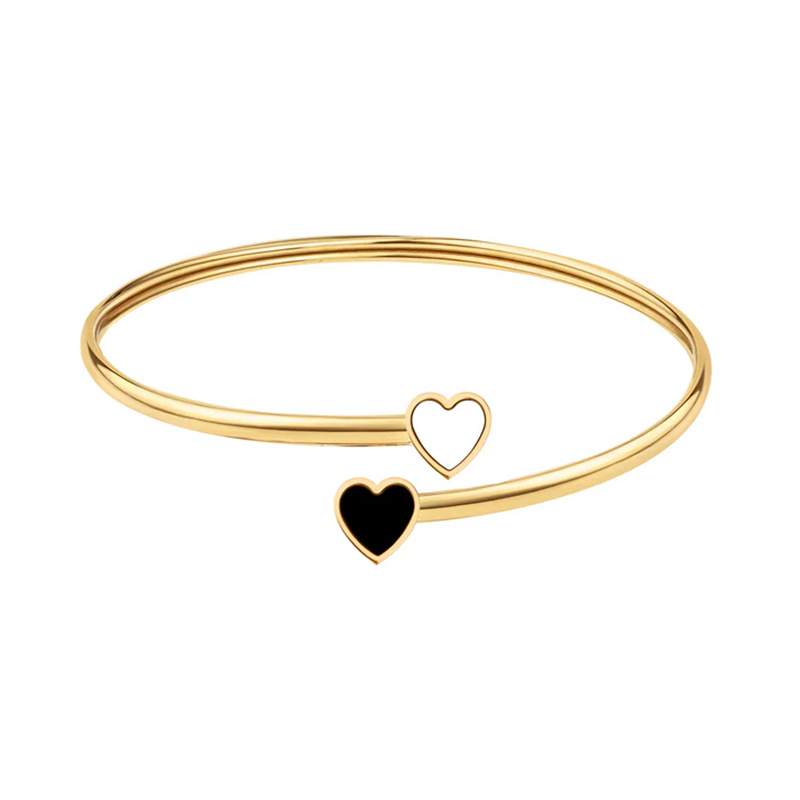
To understand Jingying’s endurance and success is to understand the intricate marriage of material science, artisan craftsmanship, and supply chain logistics. This article delves into the technical mastery, the evolution of manufacturing processes, and the business philosophy that has allowed Jingying to become a silent giant in the jewelry industry, supplying high-end retailers and fashion houses with bangles that are as durable as they are beautiful.
Chapter 1: The Genesis of a Vision (2003–2010)
Founded in the early 2000s, a period characterized by the globalization of fashion and the rise of “fast fashion” accessories, Jingying entered the market with a distinct focus. While many manufacturers chased the kaleidoscope of colored gemstones and gold plating, Jingying’s founders recognized a timeless truth: high-quality monochrome pieces transcend seasonal fads.
The initial years were dedicated to research and development, specifically regarding the “chip” – the inlay material used in the bangles. The term “chip” in jewelry manufacturing refers to the sliced, cut, or polished stone or synthetic material set into the metal framework. Jingying’s early challenge was sourcing black and white materials that were not only visually striking but also structurally robust. Early experiments with natural onyx and white agate presented issues with fragility and color inconsistency.
By 2006, Jingying had pivoted toward advanced ceramic composites and high-grade resin-stabilized natural stones. This period marked the company’s first major breakthrough: the development of a proprietary stabilization process that allowed black chips to maintain a deep, velvety luster without fading due to UV exposure, and white chips to retain a porcelain-like clarity without yellowing. This “Jingying Standard” became the blueprint for their future quality control protocols.
Chapter 2: Material Science – The Heart of the Bangle
The true differentiator in OEM manufacturing is not the design alone, but the material integrity. Jingying operates one of the most sophisticated material testing laboratories in the Guangdong province, where the majority of China’s jewelry manufacturing is concentrated.
The Black Chip:
Jingying utilizes two primary sources for black chips: heat-treated natural obsidian and advanced high-density zirconia ceramic. The ceramic option is particularly popular for high-end exports due to its scratch resistance (ranking 8.5 on the Mohs scale) and its hypoallergenic properties. The challenge in manufacturing lies in the sintering process. If the temperature deviates by even a fraction of a degree, the black color can shift to a grayish hue. Jingying’s proprietary kilns, operated by technicians with an average of 15 years of experience, ensure a calibrated reduction environment that guarantees a “Vantablack” finish—an intense, non-reflective black that absorbs light, making the metalwork around it pop.
The White Chip:
The white chips are equally complex. Jingying primarily uses high-quality white agate and a custom-engineered white marble composite. Unlike the black ceramic, white materials are unforgiving in their impurity. A single fleck of iron oxide or a microscopic air bubble can render a batch defective. To counteract this, Jingying employs a multi-spectral imaging system that scans each chip before it is set into the bangle. This system detects imperfections invisible to the naked eye, ensuring that the final product possesses a pristine, creamy translucency.
Chapter 3: The Bangle Architecture – Crafting the Framework
The bangle is not merely a stone ring; it is a structural marriage between the metal alloy and the chip insert. Jingying specializes in the “sandwich” style and the “channel set” style of bangle manufacturing.
- The Sandwich Method: This involves the chip being layered between two strips of metal—usually brass or stainless steel, plated with 14K, 18K gold, or palladium. The precision here is mechanical. The metal casing must exert equal pressure on the chip to hold it secure without fracturing the material. Jingying’s precision CNC (Computer Numerical Control) machines cut the metal frame to tolerances of ±0.01mm. This micron-level precision is crucial; if the casing is too tight, the stress will cause the chip to crack during temperature changes; if too loose, the chip will rattle.
- The Channel Setting: For more contemporary designs, the chip is inserted into a groove that runs along the outer circumference of the bangle. This requires the chip to be curved to match the bangle’s diameter. Jingying developed a unique bending process that heats the chip material uniformly, allowing it to take the curved shape without losing its structural integrity—a process that took nearly two years to perfect in the early 2010s.
Chapter 4: The Operational Excellence of OEM
Being a successful OEM manufacturer is about more than just making the product; it is about adapting to the client’s identity. Jingying’s portfolio includes clients ranging from independent Parisian designers to large-scale American department store brands. This variety requires a flexible manufacturing strategy known as “Mass Customization.”
The Low Minimum Order Quantity (MOQ) Advantage:
One of Jingying’s competitive edges is the ability to offer low MOQs for high-quality products. While most high-end factories require orders of 1,000 pieces to make a production run cost-effective, Jingying’s modular production system allows them to start at 300 pieces. This is achieved through a flexible assembly line where workers are cross-trained in multiple stages of production. A worker who sets chips can also do the final polishing, allowing the factory to scale up or down efficiently.
Lead Time Management:
In the post-pandemic era, supply chain reliability is the ultimate currency. Jingying has maintained a strict 45-day lead time for custom orders, a figure that has remained consistent for the last decade. This consistency is maintained through a dual-supplier strategy for raw materials—if one agate supplier in Brazil faces a shipment delay, Jingying’s backup supplier in Madagascar immediately fills the gap. For the metal alloys, Jingying maintains a three-month rolling stock of raw brass and stainless steel, hedging against market price fluctuations.
Chapter 5: The Finishing Process – Where Art Meets Engineering
The journey of the bangle is not complete until it has passed through the polishing and plating rooms. For black and white bangles, the finishing is particularly critical because the stark contrast amplifies any imperfection.
- Pre-Polishing: A robotic arm with a soft bristle brush removes the micro-burrs left by the CNC cutting.
- Plating: The bangles are electroplated. For the white chips, a rhodium plating is often used to keep the metal silver-bright and tarnish-free. For the black chips, a black rhodium or a deep palladium plating creates a gothic, industrial edge.
- Hand Finishing: Despite the automation, the final touch is always human. Jingying employs a team of “finishers” who inspect each bangle under a 10x loupe. They are tasked with ensuring that the glue line (if used) is invisible and that the transition from metal to stone is seamless.
A notable quality check is the “Clash Test.” Every bangle is struck gently against a wooden block to test for resonance. A dull sound indicates a hairline fracture within the chip that the visual inspection missed; a clear, ringing sound indicates a perfect structure.
Chapter 6: Sustainability and Ethical Manufacturing
The modern jewelry consumer is increasingly conscious of the origin of their products. Jingying has adapted to this shift by achieving RJC (Responsible Jewellery Council) certification and ensuring that all raw materials are conflict-free.
The factory operates on a “zero waste” water recycling system for the polishing processes, and the dust from cutting the chips is collected and repurposed for industrial abrasives. Furthermore, Jingying is experimenting with “regenerated” metal—using recycled brass and silver alloys to create bangle cores, reducing the need for newly mined materials. This move has significantly appealed to European and North American buyers who prioritize environmental, social, and governance (ESG) criteria.
Chapter 7: The Future – Smart Bangles and Hyper-Personalization
As Jingying enters its 24th year, the company is looking toward the future. The next frontier is the “Smart Bangle” – integrating the monochrome aesthetic with wearable technology. Unlike the clunky plastic of standard fitness trackers, Jingying is developing a prototype that houses a thin, flexible biosensor within the chip cavity. The chip remains black or white on the exterior, but the interior is hollowed out to fit a heart rate monitor. This requires a re-engineering of the bangle’s thickness, increasing it from 8mm to 12mm while maintaining the elegance of the design.
Additionally, Artificial Intelligence is being integrated into the quality control process. Jingying is currently piloting an AI vision system that uses neural networks to detect color gradient anomalies in the chips—differences that the human eye cannot see—ensuring that the “black” in batch #203 matches exactly the “black” in batch #400, even if manufactured six months apart.
Conclusion: A Legacy Carved in Monochrome
Twenty-three years is a long time in the volatile world of jewelry manufacturing. Many factories have risen and fallen, often chasing the “trend of the moment.” Jingying’s longevity is a testament to its focus on the fundamentals: material purity, manufacturing precision, and an unwavering commitment to the OEM partnership model.
The black and white chip bangle, seemingly simple, is actually a complex testament to human ingenuity. It requires the heat of a kiln, the cold precision of a CNC lathe, and the warmth of a craftsman’s hand to inspect the final piece. Jingying has mastered this balance. As the company looks forward, it does so with the confidence that comes from two decades of experience—a belief that in a world of constant change, the striking simplicity of black and white will remain the gold standard of sophistication.
For brands looking to make a statement, Jingying offers not just a product, but a narrative of excellence. It provides the canvas; it is up to the designer to paint the story of luxury, one bangle at a time. The 23-year journey is not merely a history of manufacturing; it is a history of building trust, ensuring that every wrist that wears a Jingying-produced bangle wears a piece of silent, enduring art.