The Art and Science of Manufacturing an 18K Japan Gold Big Monaca/Roll Chain Bracelet at JINGYING
Introduction
In the world of fine jewelry, few items command the respect and admiration of a meticulously crafted gold chain bracelet. Among the most revered styles is the Japanese Big Monaca, also known as the Roll Chain—a design characterized by its distinctive hollow, rounded links that create a fluid, elegant movement on the wrist. At JINGYING, Japan’s leading OEM manufacturer of precious metal jewelry, this ancient craft meets modern precision engineering. With over two decades of experience, state-of-the-art facilities, and a commitment to Japanese standards of excellence, JINGYING has perfected the manufacturing process for 18K gold chain bracelets, transforming raw gold alloys into wearable works of art . This article provides a comprehensive, step-by-step exploration of how JINGYING manufactures its 18K Japan Gold Big Monaca/Roll Chain Bracelets.
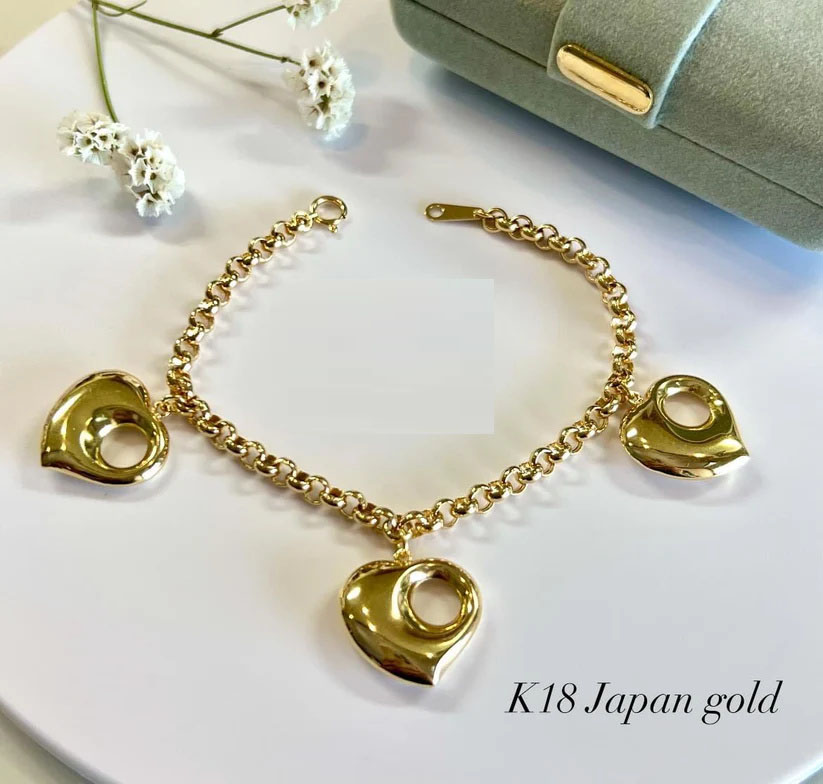
Step 1: Alloy Preparation and the Science of 18K Gold
The journey of an 18K gold bracelet begins not with a design, but with chemistry. At JINGYING, the manufacturing process starts with the careful formulation of the 18K gold alloy. Pure 24K gold (99.9% purity) is too soft and malleable for the intricate shaping and daily wear that a chain bracelet endures. To achieve the perfect balance of hardness, durability, and that signature rich color, JINGYING’s metallurgists create a precise alloy.
The standard composition for 18K gold is 75% pure gold, with the remaining 25% composed of other metals . For yellow gold—the classic choice for the Japanese Big Monaca—this typically includes a blend of silver, copper, and zinc. For example, a common formula at the heart of many high-quality 18K yellow gold products uses 75.2% gold, 13.69% copper, 7.44% nickel, and 3.66% zinc, though specific formulas are refined based on the desired shade and mechanical properties . This specific alloying process is critical: the copper provides a warm hue and strength, while the zinc and silver contribute to the alloy’s workability and resistance to tarnishing.
The raw metals are smelted under the protection of an inert gas, such as argon or nitrogen, to prevent oxidation during melting. This ensures a pure, homogenous mixture free from impurities that could weaken the final product . The molten 18K gold is then cast into ingots, which are subsequently rolled and drawn through a series of increasingly smaller dies to create the precise thickness and shape of wire needed for the bracelet’s links.
Step 2: Wire Drawing and the Precision of Japanese Engineering
The Big Monaca chain is defined by its large, rounded links, which require wire of exceptional uniformity. JINGYING employs a precise wire-drawing process to transform the gold ingot into a long, continuous wire of a specific diameter. Using computer-controlled drawing machines, the gold is pulled through a series of tungsten carbide or diamond dies, each with a progressively smaller hole. This process, common in jewelry manufacturing, reduces the wire’s diameter while increasing its length and strength . Tolerances are held to within 0.01mm, a standard of Japanese precision engineering that ensures every link in the chain will be identical in thickness and weight . For a Big Monaca bracelet, the wire must be perfectly round and of the exact gauge to create the substantial, yet lightweight, hollow links characteristic of the style.
Step 3: Link Formation and the “Big Monaca” Architecture
The “Big Monaca” name refers to the large, rounded, tube-like links that form the chain’s structure. Unlike a simple cable chain, the Monaca link is more complex and typically requires a two-part construction process often involving a temporary core.
The Seaming and Coating Technique
To achieve the large, hollow look of the Big Monaca without using an exorbitant amount of solid gold, JINGYING may employ a technique related to the creation of “filled” or tubular gold wire. This involves forming a compound wire, a process detailed in patents for jewelry manufacturing . A support core, often made of a base metal like iron or aluminum, is shaped into a wire. An external layer of the 18K gold tape is then seamed onto this core. The gold is not merely plated; it is mechanically bonded to the core . The compound wire is then drawn down to the final, precise diameter. For a “Big Monaca” style, this tubular gold layer will form the walls of the large links.
Winding and Shaping
The next phase involves shaping the wire into the chain’s signature rounded links. The gold-coated wire is fed into an automatic link-making machine. The machine cuts the wire into precise lengths, forms them into a loop, and seamlessly welds the ends together using laser welding technology . In the case of the Big Monaca, the links are larger and more rounded. After welding, the links may be twisted slightly to create the distinctive roll chain pattern, where each link lies flat against the next, creating a smooth, fluid texture . The interlocking process is also automated: each newly formed link is passed through one or more of the previous links before being closed, ensuring a strong and uniform chain .
Core Removal (If Applicable)
If a temporary base metal core was used to create the tubular gold structure, the chain must undergo a careful emptying process. The chain is submerged in a controlled acid bath—such as hydrochloric acid for iron cores—which dissolves the inner core without damaging the 18K gold exterior . This leaves behind a hollow, lightweight chain link. This step is crucial to the “Big Monaca” aesthetic, as it allows for oversized links that are still comfortable and light to wear. The chain is then thoroughly washed in pure water to neutralize any residual acid .
Step 4: Diamond-Pattern Engraving: Achieving the “Roll” Brilliance
The characteristic “roll” chain is not just about shape; it is defined by its brilliant sparkle. To achieve this, the chain undergoes a critical process known as diamond-pattern engraving. While traditional methods might require engraving before link formation, JINGYING utilizes an advanced process that ensures maximum brilliance.
According to industry-leading methods, the diamond-pattern engraving is ideally performed after the wire has been coated and formed, but before the final link shaping, or in a way that preserves the integrity of the engraved pattern . The surface of the gold wire is engraved with a series of shallow, intersecting diagonal lines, creating a faceted, diamond-like pattern. The angles of these incisions are precisely calculated to reflect light and create a stunning, multi-faceted sparkle .
However, shaping the wire into a chain link can stretch and distort these delicate engravings, reducing their brilliance. JINGYING overcomes this by either performing the engraving after the link has been fully formed or by employing the novel technique described in patents where the engraving is done on a coated wire, and the subsequent shaping of the link is designed to minimally deform the engraved outer layer . The result is a bracelet with superior, long-lasting brightness.
Step 5: Finishing and Quality Control
Once the chain has been assembled and the desired surface pattern applied, the bracelet enters the final finishing stage. The chain is tumbled with steel shot and polishing compounds to smooth the surface and bring out the rich color of the 18K gold . This process removes any microscopic burrs and enhances the material’s natural luster. For a Big Monaca bracelet, special attention is given to the edges of the links to ensure they are smooth and comfortable against the skin.
Quality control at JINGYING is exceptionally rigorous, adhering to Japanese Industrial Standards (JIS). The chain undergoes a 12-point inspection process . This includes:
- Visual Inspection: Every link is checked for uniformity in shape, size, and color.
- Weight and Measurement: The length and weight of the bracelet are verified to meet the client’s exact specifications.
- Soldering Check: The integrity of each welded link is tested to ensure durability.
- Surface Quality: The diamond engraving and overall polish are examined under high magnification to ensure there are no scratches or imperfections.
Step 6: The Finishing Touch: Clasp Assembly and Packaging
The final step in manufacturing the Big Monaca chain bracelet is the assembly of the clasp and any additional findings. JINGYING uses precise laser welding to attach a premium spring ring or lobster clasp, ensuring it is perfectly aligned and securely fastened. The clasp is also made from 18K gold to maintain the bracelet’s integrity and value.
Finally, the completed bracelet is branded according to the client’s specifications, polished one last time, and carefully packaged. JINGYING’s packaging is designed to protect the delicate chain during transit and present it as the luxury item it is.
Conclusion
Manufacturing an 18K Japan Gold Big Monaca/Roll Chain Bracelet at JINGYING is a symphony of advanced technology and time-honored craftsmanship. From the careful alloying of the 18K gold to the precision wire drawing, the complex formation of the hollow links, and the meticulous surface engraving, every step is executed with a commitment to Japanese precision. JINGYING’s ability to combine metallurgical science, automated manufacturing, and rigorous quality control allows it to produce a chain bracelet that is not only a beautiful piece of jewelry but also a testament to the manufacturer’s dedication to excellence . The result is a bracelet that boasts the substantial presence of the Big Monaca style with the fluid elegance and brilliant sparkle of a perfect roll chain, a true heirloom for the modern wearer.