Introduction: The Golden Opportunity
The global jewelry market is a behemoth, valued at over $300 billion. For the modern entrepreneur, the barriers to entry have never been lower. You do not need to be a silversmith or a gemologist to launch a brand. You just need a vision and a reliable factory.
However, the gap between a design on paper and a physical product on a customer’s neck is where most startups fail. Finding a jewelry manufacturing partner is a high-stakes game of trust, logistics, and financial risk. This guide serves as your encyclopedia for sourcing factories and understanding the “common sense” mechanics of the jewelry trade.
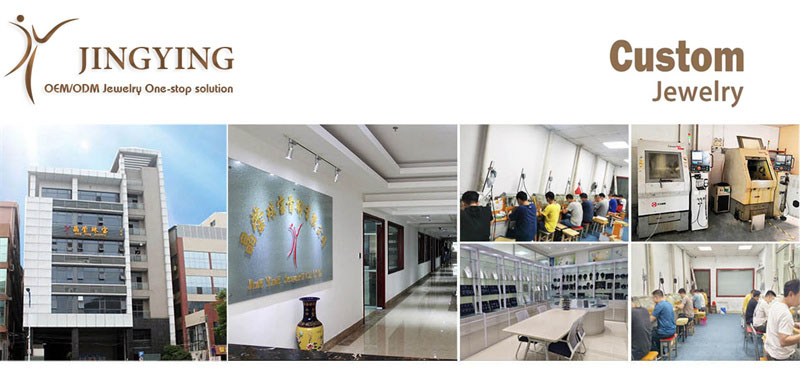
Before searching for a factory, you must understand who you are looking for. Factories are not one-size-fits-all.
1. OEM vs. ODM vs. CMF
- OEM (Original Equipment Manufacturer): You have the design, the CAD (Computer-Aided Design) file, and the specs. The factory just casts, polishes, and sets stones. Best for: Established designers.
- ODM (Original Design Manufacturer): The factory has existing “white label” molds. You pick a ring from their catalog, tweak the finish, and put your logo on it. Best for: Beginners testing the market.
- CMF (Design, Manufacturing, and Finishing): A full-service partner handling design, prototyping, mass production, and packaging. *Best for: Brands scaling to 500+ units.*
2. Global Hubs: Where to look?
- Shenzhen, China (Yiwu/Shuibei): The “Jewelry Silicon Valley.” High tech, low cost, incredibly fast speed. Best for volume production (50+ pieces) of gold, silver, and fashion jewelry.
- Thailand (Bangkok): The world leader in gemstone setting and high-end craftsmanship. Slightly higher labor costs than China but better for intricate, hand-made details.
- Italy (Arezzo/Vicenza): The pinnacle of luxury gold and high-fashion design. Extremely high MOQs (Minimum Order Quantities). Only for high-ticket brands.
- India (Mumbai/Jaipur): King of diamonds and silver. Very low labor costs, but quality control and communication can be inconsistent.
- USA/EU: Great for rapid prototyping and ethical manufacturing, but pricing is 5x to 10x higher than Asia.
Entrepreneur’s Verdict: If you are reading this guide as a startup, 90% of you should be sourcing from Shenzhen, China (for volume/fashion) or Bangkok, Thailand (for quality/gems).
Part 2: The Search Strategy (How to find the needle in the haystack)
You cannot just Google “Jewelry factory” and email the first result. Most top-tier factories have zero online presence. You must use B2B platforms and trade shows.
Step 1: Digital Reconnaissance (Online Platforms)
- Alibaba (Gold Supplier vs. Assessed Supplier): Filter by “Trade Assurance.” Look for factories that have been on the platform for at least 3 years. Warning: Alibaba is full of traders (middlemen) posing as factories. A trader will quote you 5x the price.
- 1688.com (The Chinese Domestic Secret): This is the Chinese Amazon for wholesale. Prices here are the real factory prices (often 50% cheaper than Alibaba). You need a Chinese speaker or a sourcing agent to navigate it.
- Global Sources: More rigorous vetting than Alibaba. Higher quality suppliers, fewer scams.
- ThomasNet (USA): For finding domestic manufacturers, but limited for jewelry.
Step 2: Physical Verification (Trade Shows)
- Canton Fair (Guangzhou, April/Oct): The largest trade fair globally. Halls 10-12 are jewelry. You can shake hands with 100 factory owners in a day.
- HK Jewellery & Gem Fair (September): The gold standard. Every major manufacturer attends.
- JCK Las Vegas (June): Best for connecting with Western suppliers and finding finishing specialists.
Step 3: The Agent Approach
If you are intimidated by language barriers or logistics, hire a Sourcing Agent. They charge 10-15% commission but handle QC (Quality Control), translation, and shipping. For jewelry, a good agent saves you from “silver plated” being swapped for “brass” without your knowledge.
Part 3: Red Flags & Green Lights (Due Diligence)
You have a shortlist of 10 factories. How do you vet them?
The “Green Light” Checklist:
- Video Call Factory Tour: Ask for a live video walkthrough. You want to see the casting machines, the polishing wheels, and the stone-setting benches. If they refuse, move on.
- Specialization: Ask, “Do you do lost-wax casting or die striking?” A good factory will tell you what they can’t do. A bad factory says “Yes” to everything and fails later.
- MOQ Flexibility: A startup-friendly factory will accept MOQs of 20-50 pieces per design. Factories demanding 500+ pieces per design are for big retailers only.
- Material Sourcing Certificates: They should be able to provide invoices for their raw metal suppliers (showing they buy legit 925 silver or 14k gold).
The Red Flags (Run away):
- No address or “PO Box” location.
- Requires 100% upfront payment before sending a sample. (Standard is 30-50% deposit, balance before shipment).
- The sample is perfect, but the mass production is trash. (This is the most common scam. Solution: Pay for a “Pre-Production Sample” from the actual mass production line.)
- They claim to be in Hong Kong but the bank account is in Mainland China. (Not always a scam, but often a trader).
Part 4: The Production Process (What you are actually paying for)
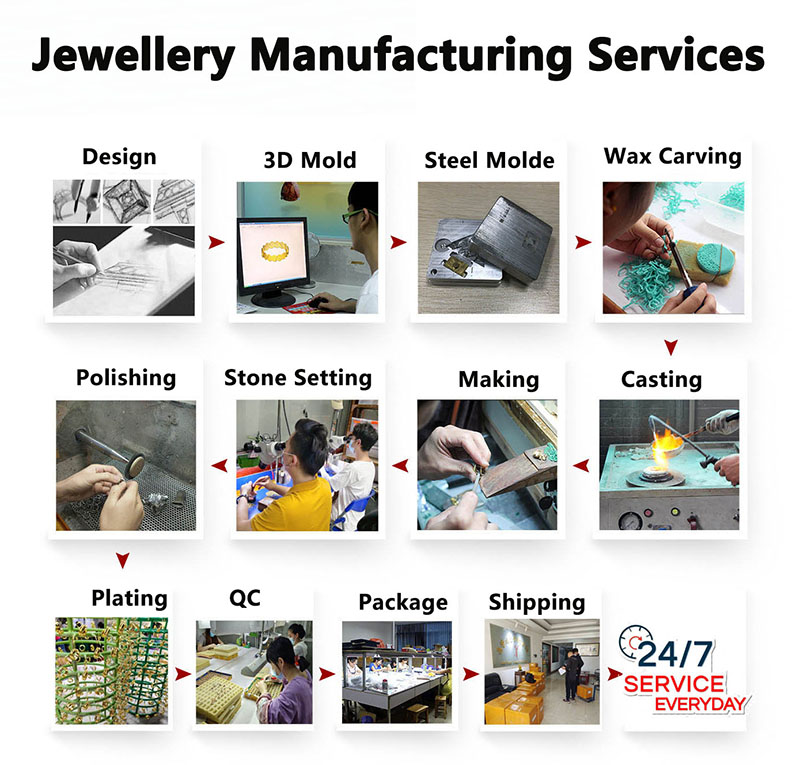
To negotiate with a factory, you must speak their language. Here is the standard workflow:
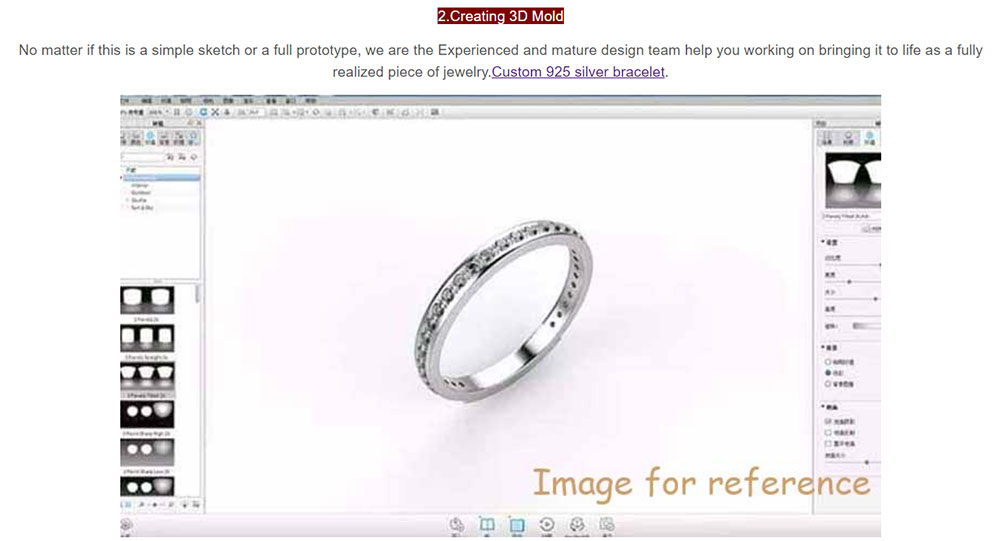
1. CAD (Computer-Aided Design) & Rendering
The factory converts your sketch into a 3D digital file. Cost: $15–$50 per design.
Pro tip: Ask for an STL file. If you own the STL, you can take it to another factory.
2. 3D Printing & Casting (The “Tree”)
The design is printed in wax, attached to a “tree,” covered in plaster (investment), and then burned out. Molten metal is shot into the vacuum.
Cost driver: Metal weight. A 10g ring in silver vs. 10g in 14k gold is a $400 difference.
3. Assembly & Polishing
The raw casting is ugly (matte grey). Polishers grind, sand, and buff it to a mirror shine. This is labor intensive. Cheap factories skip steps here.
4. Stone Setting
Pave, bezel, prong, or channel setting. Never trust a generalist factory to do pave setting. Ask for photos of their “micro-pave” work under a microscope.
5. Plating & Finishing
Rhodium plating (for white gold look), gold plating (usually 0.1 to 1 micron thickness), or anti-tarnish coating.
6. Quality Control (QC)
The factory should weigh every piece, check stone security, and test metal purity (XRF gun test).
Part 5: The Essential “Common Sense” of Jewelry Startups
This section separates the hobbyist from the business owner.
1. The Metal Math (Don’t get scammed on weight)
Factories charge by metal weight + making charge.
- The Scam: Factory quotes $20 for a ring. You think it’s cheap. They deliver a hollow, thin ring that bends when you sneeze.
- The Fix: Ask for the “finished weight in grams” and the “wall thickness” (min 0.8mm for silver, 0.5mm for gold).
- Purity: Always request a “Spectrometer Report” for every batch. Silver should be 92.5% pure. Gold should be stamped 585 (14k) or 750 (18k).
2. Plating is not forever (Manage expectations)
If you are selling gold-plated sterling silver, the customer needs to know it will tarnish and fade in 6–12 months. That is physics, not a defect.
- Thickness matters: Standard plating is 0.1 microns. “Heavy gold plate” is 1-2.5 microns. “Vermeil” (required in the US) is 2.5 microns of gold on sterling silver.
3. The MOQ Trap
A factory says, “No MOQ!” Great. But if you order 10 rings, the per-unit cost will be $50. If you order 200 rings, the cost drops to $12.
- Strategy: Design a “Hero Product” (one best-seller). Put all your money into an MOQ of 200 for that one SKU. Do not make 10 different designs at 10 pieces each.
4. Lead Times & The Slow Boat
- Sample: 7–14 days.
- Production (50 pieces): 15–25 days.
- Shipping (Sea freight): 30–45 days to USA/EU.
- Total: Expect 2–3 months from payment to your door. Do not launch a Christmas collection in November.
5. Intellectual Property (IP) is mostly dead in Asia
You send a factory a unique design. They produce it for you. Next week, they sell the exact same design to your competitor.
- Reality: Unless you have a registered Chinese design patent (costly and slow), you cannot stop this.
- The solution: Work with factories that have an “Exclusivity Agreement” (they promise not to sell your design for 12 months). Or, use a “Disassembly” strategy—send the CAD to Factory A for casting, send the castings to Factory B for polishing. No one factory has the full puzzle.
Part 6: Sampling – The Most Critical Phase
Never skip sampling. Never.
The Three Types of Samples:
- Proto Sample: Just to see if the geometry works. Often in brass or copper (cheaper).
- First Sample: In your actual metal (Silver or Gold). You check fit, finish, and stone placement.
- Pre-Production (PP) Sample: The factory runs a small batch (5-10 units) on the actual production line using the actual workers. This is the most important sample. If the PP sample is good, the bulk run will be good. If the PP sample is bad, cancel the order.
The Sample Fee Trap:
- Scam: Factory charges $200 for a silver sample. You pay. They send you a photo of a similar ring. You never get the physical ring.
- Legit: Factory charges $50–$100 for the CAD, $30 for the wax print, and $50 for the metal. They should deduct the sample fee from your bulk order (usually).
Part 7: Pricing Breakdown (What should it cost?)
You need to reverse-engineer retail prices.
Example: A Sterling Silver Cubic Zirconia Ring
| Cost Component | Amount (USD) | Percentage of Cost |
|---|---|---|
| Silver weight (5g @ $0.80/g) | $4.00 | 30% |
| Making charge (labor/polish) | $3.00 | 23% |
| Stone setting & CZ stones | $1.50 | 12% |
| Plating & Packaging | $0.50 | 4% |
| Ex-Works Factory Price | $9.00 | 69% |
| Freight/Customs | $2.00 | 15% |
| Landed Cost (Your door) | $11.00 | 84% |
| Your Wholesale Price (x2) | $22.00 | - |
| Your Retail Price (x2.5) | $55.00 | - |
Note: If a factory quotes you $1.50 for a silver ring, it is either brass or the workers are slaves. Do not buy it.
Part 8: Logistics & Payment Terms
Payment Structures:
- Standard: 30% deposit to start work. 70% balance before shipping.
- Negotiated: 50% deposit. 50% after your QC inspection at their warehouse.
- Never pay 100% upfront. If you must, use a Letter of Credit (L/C) or PayPal Goods & Services (not Friends & Family).
Shipping (Incoterms explained for dummies):
- EXW (Ex Works): You handle everything. Factory just hands you the box.
- FOB (Free on Board – Shenzhen): Factory puts the goods on the boat. You pay for the sea freight and insurance. This is the sweet spot for startups.
- DDP (Delivered Duty Paid): Factory handles shipping, customs, and taxes. Most expensive, but zero headaches.
Customs & Duties (USA/Canada/EU):
- HS Code: 7113 (Jewelry). Duty rates vary (0-8%).
- Documentation: The factory must provide a Commercial Invoice and Packing List. Do not let them mark the value as $0 (that is smuggling and gets your goods seized).
- Pro tip: If your jewelry is made in China but contains Italian leather or Australian opal, you might qualify for lower duties under “partial origin” rules.
Part 9: Quality Control (QC) – Your Bible
You cannot trust the factory to QC itself. You need a system.
The 5-point QC Checklist (Before shipping):
- Weight tolerance: ±5% of the agreed weight. If it’s lighter, they cut corners.
- Porosity: Look for tiny pinholes in the metal (caused by bad casting). Fail any piece with visible pits.
- Stone Security: Can you wiggle the stone with a toothpick? If yes, the customer will lose the stone in a week.
- Plating adhesion: Scratch the inside of the ring gently with a sharp blade. Does the plating peel? If yes, they skipped the ultrasonic cleaning step.
- Polishing lines: Are there visible sanding scratches under bright light? A good finish has a flawless mirror.
Doing QC Remotely:
- Hire a third-party inspector in the factory’s city (e.g., AsiaInspection or V-Trust). They charge $200–$500 per day.
- Ask for 4K video of the “sorting table” – all pieces laid out.
Part 10: The First Order – A Step-by-Step Script
Here is how a successful first order looks:
Week 1: You send a sketch and a “tech pack” (a PDF with dimensions, metal type, stone type, and photos of similar finishes).
Week 2: Factory sends CAD drawing. You approve or revise (max 2 revisions free).
Week 3: Factory sends physical silver sample. You wear it for 3 days. Does it snag on clothes? Does it turn your finger green? (It shouldn’t, it’s silver).
Week 4: You approve the sample. You send 30% deposit ($1,500 on a $5,000 order).
Week 5-7: Factory produces 200 units.
Week 8: Factory sends Pre-Production sample from the line. You approve. You send 40% balance ($2,000).
Week 9: You hire a local QC agent in China to inspect the 200 units. They reject 20 units for porosity. Factory re-makes 20 units (free of charge).
Week 10: You pay final 30% balance ($1,500). Factory ships via Air freight (if you need it fast) or Sea (if you are patient).
Week 12: Goods arrive. You open the box. 198 perfect units. 2 minor defects (you sell those as “sample sale”).
Part 11: Common Mistakes That Kill Jewelry Brands
- Not wearing the sample. Designers look at a ring on a table. Customers wear it. A ring that spins on the finger, has sharp edges under the shank, or catches on hair is a return waiting to happen.
- Ignoring nickel. Many cheap silver alloys contain nickel. In the EU, nickel is banned for skin contact (Nickel Directive). You must specify “Nickel-free” or buy 925 silver with copper alloy only.
- Underestimating packaging. The factory sends you loose jewelry in a plastic bag. You need anti-tarnish strips, branded boxes, and a polishing cloth. A $10 ring in a $1 box feels like a $50 ring.
- Scaling too fast. You sell 100 units. You order 1,000. The factory changes the casting method from hand-cast to machine-cast to save time. The 1,000 units are hollow and break. Always order a PP sample for every new batch, even if it’s the same design.
Part 12: The Future – Sustainability & Ethics
Modern consumers care about origin. You should too.
- Recycled Metals: Ask if the factory uses “recycled sterling silver” or “recycled 14k gold.” The price is usually the same, but the marketing value is huge.
- Lab-Grown vs. Mined: Factories can source both. Lab-grown diamonds (LGD) are chemically identical and 70% cheaper. For startups, LGDs are a no-brainer.
- Factory Audits: Can the factory prove they don’t use child labor or unsafe chemical waste? (Look for RJC – Responsible Jewellery Council certification, though rare in small factories).
Conclusion: The Long Game
Finding a jewelry factory is like dating. The first three you talk to will be wrong. The fourth might be “okay.” The fifth, if you do your homework, becomes a business partner for a decade.
Do not optimize for the cheapest price. Optimize for transparency. A factory that sends you a video of a rejected batch (“Sorry, these 10 pieces had bubbles, we are redoing them”) is worth their weight in gold. A factory that never admits fault will bankrupt you in return shipping fees.