How to Get Your 925 Silver Jewelry Designs Manufactured at JINGYING
Bringing a 925 sterling silver jewelry collection to market requires more than a beautiful sketch; it demands a manufacturing partner capable of translating design intent into consistent, sale-ready pieces at scale. For independent designers, emerging brands, and established retailers alike, the gap between concept and finished product is where most projects succeed or fail. JINGYING, a Guangzhou-based OEM/ODM manufacturer founded in 1998, has built its reputation on closing that gap for over two decades. This article provides a practical roadmap for navigating the JINGYING manufacturing process—from the first CAD file to the final quality inspection—so you can approach the partnership with clarity and confidence.
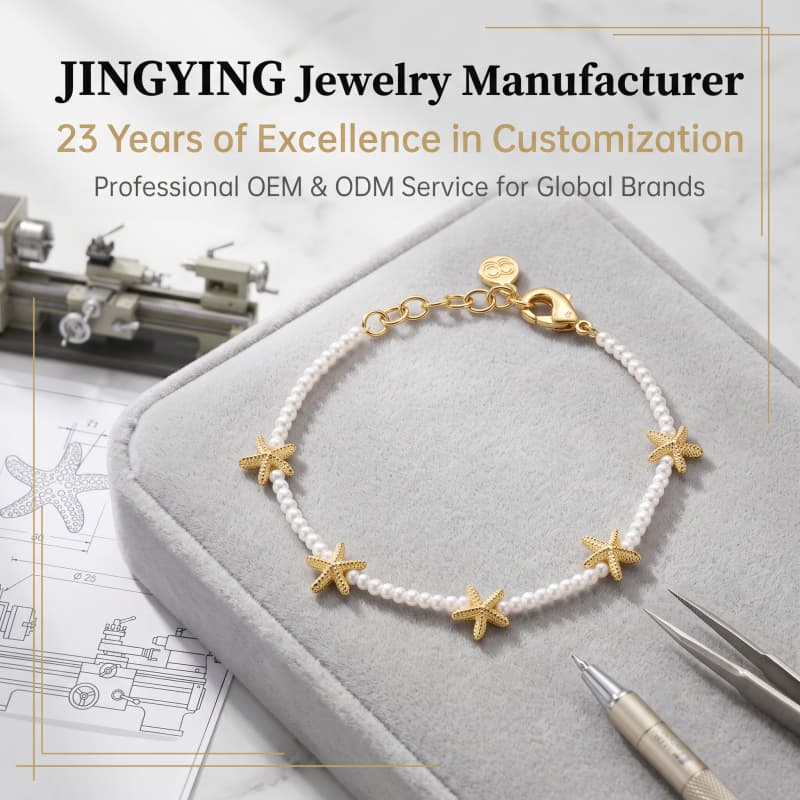
Why JINGYING: Scale, Integration, and Material Focus
JINGYING operates as a vertically integrated manufacturer specializing in 925 sterling silver and copper with genuine gold plating. With a monthly production capacity exceeding 100,000 pieces, the company serves brand jewelers, retailers, and wholesalers worldwide through a one-stop solution that spans design, prototyping, casting, finishing, quality control, and private-label packaging. This scale is supported by multiple specialized facilities and a workforce of skilled technicians, allowing JINGYING to accommodate both bulk orders for established brands and smaller batch runs for emerging designers.
The strategic focus on 925 silver is significant. Sterling silver—an alloy of 92.5% pure silver and 7.5% other metals, usually copper—offers a hypoallergenic, durable, and accessible luxury material. JINGYING’s craftsmen have developed deep mastery of the processes required to work with it, from lost-wax casting to rhodium plating and stone setting. For brands entering the silver category, this specialization translates into fewer production surprises and more predictable outcomes.
Step 1: Design Handoff and CAD Development
The manufacturing journey begins with design and prototype development. Clients can submit a finished CAD file, a reference photograph, or a rough concept; JINGYING’s in-house design team can also develop ideas collaboratively. The company uses CAD/CAM modeling to translate concepts into precise three-dimensional prototypes, maintaining tolerances within ±0.1 mm—a level of precision that becomes critical when a design must remain consistent across thousands of units.
For clients providing existing CAD files, JINGYING’s technical team may spend significant time optimizing the design for manufacturing—adjusting wall thickness, reinforcing stress points, and running mold flow simulations. This engineering-first approach ensures that the designer’s vision is faithfully captured before mass production begins, rather than discovered to be unworkable after tooling has already been committed. For simpler pieces, CAD development can be completed within three to seven business days; complex designs may require multiple revision cycles, and design approval is often the single most common bottleneck in the entire timeline.
Step 2: Prototyping and Mold Creation
Once the CAD model is approved, JINGYING uses SLA/DLP 3D printers to create a resin prototype within 24 to 48 hours, depending on the size and complexity of the piece. This physical prototype allows the client to assess the “feel” and proportions of the design before committing to steel mold cutting. The client must approve this prototype before tooling begins.
Mold making is the stage that determines the consistency of every subsequent unit. JINGYING uses CNC precision milling to cut a steel master model with 0.01 mm precision, followed by rubber mold injection to create the production mold. For pieces with complex geometry—such as hinged earrings or multi-component designs—a multi-piece mold may be required. The complexity of the mold directly affects both the time required and the tooling cost. For designs selected from an existing catalog, no mold fee is charged; custom designs typically require a mold fee ranging from US$35 to US$50 per design.
Step 3: Lost-Wax Casting
Casting is the backbone of silver jewelry manufacturing. JINGYING employs lost-wax casting, a technique that has remained fundamentally unchanged for centuries yet benefits enormously from modern precision. Molten 925 sterling silver—heated to its melting point of approximately 961°C—is poured into precision molds, capturing every curve, filigree detail, and surface texture of the original design. For copper-based pieces intended for gold plating, a parallel process is used: the brass substrate is formed through high-resolution wax printing and plaster mold casting, then cleaned, polished, and prepared for electroplating.
For small-batch orders, the casting cycle can be completed in one to three days. For large-volume orders, casting may be staggered across multiple batches to maintain quality and throughput. The choice between silver and copper substrates is not a matter of one being superior; it is a material strategy that allows a brand to serve different price points and emotional registers with a single manufacturing partner.
Step 4: Hand-Filing, Polishing, and Surface Refinement
Raw castings at JINGYING are not simply tumbled and shipped. Each piece undergoes meticulous hand-filing, where artisans refine edges and surfaces using files of varying grain. This is where human skill complements machine precision: the artisan’s trained eye verifies that the form is true, that no casting defects escape detection, and that the surface is perfectly prepared for subsequent finishing.
Polishing then transforms a functional casting into a piece of jewelry. The company employs multi-stage polishing, progressing from coarse abrasive wheels to fine cotton cloth wheels coated with polishing wax, producing a mirror-finish surface. For pieces requiring a matte or satin finish, sanding and sandblasting techniques create controlled surface textures rather than a uniform reflective sheen. This finishing stage is where the tactile quality of a collection is established—the detail that separates a piece that feels “premium” from one that does not.
Step 5: Electroplating and Anti-Tarnish Protection
Electroplating is where JINGYING’s technical capabilities become most tangible for brands selling into demanding retail environments. For 925 sterling silver pieces, rhodium plating is applied to enhance luster and provide tarnish resistance—a critical factor for maintaining product appeal during extended retail shelf life. Silver’s tendency to oxidize is the material’s greatest weakness, and a well-executed plating strategy is essential for any commercial silver collection.
JINGYING operates its own in-house electroplating plant, a vertical integration that eliminates the delays, quality fluctuations, and communication gaps that arise when a factory sends products to a third-party plating shop. Every order is plated under direct supervision, with consistent bath control, stable thickness, and uniform color across the entire batch. The plant is equipped to handle a full spectrum of finishes: 18K gold plating, rose gold plating, rhodium plating, platinum imitation plating, silver plating, gun-black coating, antique and oxidation finishes, and a variety of trendy color platings.
For copper-based pieces, genuine gold plating follows a multi-layer process: the brass substrate first receives a nickel or alloy barrier layer to ensure adhesion and corrosion resistance, after which the gold layer is electrodeposited to the specified thickness. The company adheres to national standards for gold plating, ensuring that coating thickness meets or exceeds the 0.5 μm minimum required by QB/T 1131-2005, with thicker layers available for premium applications. An optional anti-tarnish e-coat—a micro-thin electrophoretic lacquer—seals the jewelry against oxidation and humidity, providing an additional layer of protection for pieces destined for humid climates or extended storage.
Step 6: Stone Setting and Value-Added Customization
If your designs include gemstones, cubic zirconia, or other stone settings, JINGYING offers hand-setting using micro-inlay machines imported from Japan, which the company states achieves a 99% no-lost-stone rate for 5A cubic zirconia stones. Stone setting alone can add 20% to 50% to a piece’s base metal cost, depending on whether the stones are machine-set or hand-set; micro-pavé settings and wax settings are more labor-intensive and therefore more expensive than simple prong settings.
Beyond stone setting, JINGYING supports engraving, enamel filling, and three-dimensional relief work. Logo engraving—essential for building brand recognition—typically costs an additional US$0.16 per piece for orders of 100 pieces or more, with laser engraving available for greater precision and durability. Custom packaging is also supported, with branded boxes, pouches, and cards starting at around US$0.65 to US$0.85 per piece for orders of 100–200 pieces.
Understanding Costs, MOQ, and Lead Times
One of JINGYING’s most notable advantages for emerging brands is its low minimum order quantity. The factory offers small-batch customization starting at just 50 pieces per design for 925 silver, making it accessible for startups and small brands. For copper items, the MOQ can go as low as 30 pieces for simple designs. This flexibility is a significant advantage compared to many manufacturers that require hundreds or even thousands of pieces per order.
Costs break down across several categories. Design and development fees may apply if the factory is creating an original design, typically ranging from US$50 to US$200 per design. Mold fees for custom designs generally range from US$35 to US$50 per design. Sample fees range from approximately US$40 to US$110, depending on complexity, and these fees are often refundable upon placing a bulk order. Raw material costs for 925 silver fluctuate with market prices; the primary material cost is the silver itself, with a typical 45 cm necklace chain weighing between 8 and 10 grams. Labor and manufacturing fees for a basic 925 silver necklace typically result in a factory-gate price of ¥85 to ¥130 per piece for unbranded, basic designs without additional design value.
Lead times depend on the stage at which they are measured. Sample development takes approximately 7 to 10 days, and mass production takes approximately 20 to 30 days. From the moment a design is finalized and a deposit is paid, a client can typically expect to receive finished goods within four to six weeks, excluding shipping transit time. However, total project time—including design iteration, CAD revisions, sample approval rounds, and client decision-making—typically spans six to twelve weeks. The discrepancy reflects the difference between production time and total project time: production begins after the design is locked, while total time includes the often-unpredictable back-and-forth of creative development.
Quality Control: Inspection at Every Stage
Capacity means little without consistency, and JINGYING’s quality framework is built around inspection at every production phase rather than a single final check. The process begins with incoming material verification: XRF testing of silver and brass alloys to confirm composition and purity before any metal enters production. Wax injection and casting are inspected for dimensional accuracy and surface quality. After polishing, finish uniformity and the absence of surface defects are verified. Electroplating inspection tests coating thickness, adhesion, and color consistency. Final product inspection applies 100% quality control covering dimensions, performance, and visual appearance.
Material integrity is documented rather than assumed. All 925 sterling silver pieces produced by JINGYING are stamped with the “S925” hallmark, the universally recognized indicator of silver purity, and third-party assay reports from accredited laboratories such as SGS or Bureau Veritas can be provided upon request for large initial orders. For copper-based pieces with gold plating, nickel release levels are controlled to comply with REACH and RoHS standards, a requirement that is non-negotiable for brands selling skin-contact items into European and North American markets. For stone-set pieces, every item is checked individually with a steel needle to ensure stone security, and finished pieces are drop-tested from three meters to verify that stones do not fall out.
Intellectual Property Protection: NDA-First and No Replication
For brands operating in competitive markets, the protection of design intellectual property is not a peripheral concern. JINGYING’s cooperation process is structured accordingly: it does not begin with a quotation but with a legally binding Non-Disclosure Agreement. Before any design files, sketches, or CAD drawings are shared, both parties sign an NDA that establishes clear confidentiality obligations and creates legal consequences for breach.
Internal protocols further restrict access to client design files, storing digital assets on secure servers with limited permissions. For clients requiring maximum separation, JINGYING can establish independent production lines dedicated to specific OEM projects, ensuring that a brand’s designs never appear on the same production floor as competing products. The company also maintains a strict policy against replicating or reselling brand-exclusive designs: once a design is developed for a client, it remains that client’s intellectual property, and JINGYING does not manufacture competing products based on proprietary designs or sell such designs to third parties. This combination of contractual, physical, and policy safeguards addresses the most common anxiety brands bring to an OEM relationship—that their differentiation will be diluted by the very partner entrusted with producing it.
Conclusion: A Manufacturing Partnership Built for Silver
Getting your 925 silver jewelry designs manufactured at JINGYING is not a transactional exchange but a structured partnership with clear stages, documented handoffs, and multiple quality gates. The process rewards preparation: having a clear design brief, realistic volume expectations, and an understanding of where costs accumulate will make every conversation more productive. JINGYING’s vertical integration—from in-house casting and electroplating to final assembly and packaging—reduces the coordination burden on the brand and compresses the distance between concept and shelf. For designers and brands serious about building a silver collection with material integrity and manufacturing consistency, JINGYING offers a pathway that is industrial in scale yet craft-level in control. The first step is simple: initiate contact, sign the NDA, and share your vision. The rest is a process that twenty-three years of silver manufacturing experience has refined into a repeatable system.