How to Customize 925 Sterling Silver Gold-Plated Jewelry at JINGYING
Custom jewelry has moved far beyond a simple monogram or a choice between two chain lengths. For brands, designers, and independent creators, it is now a strategic tool—a way to translate a distinct aesthetic into a tangible product that feels personal, intentional, and unmistakably one’s own. Yet the path from an idea to a finished piece of gold-plated sterling silver jewelry is rarely straightforward. It requires a manufacturer that understands both the creative language of design and the metallurgical realities of plating, casting, and finishing. JINGYING has spent more than two decades positioning itself at exactly that intersection.
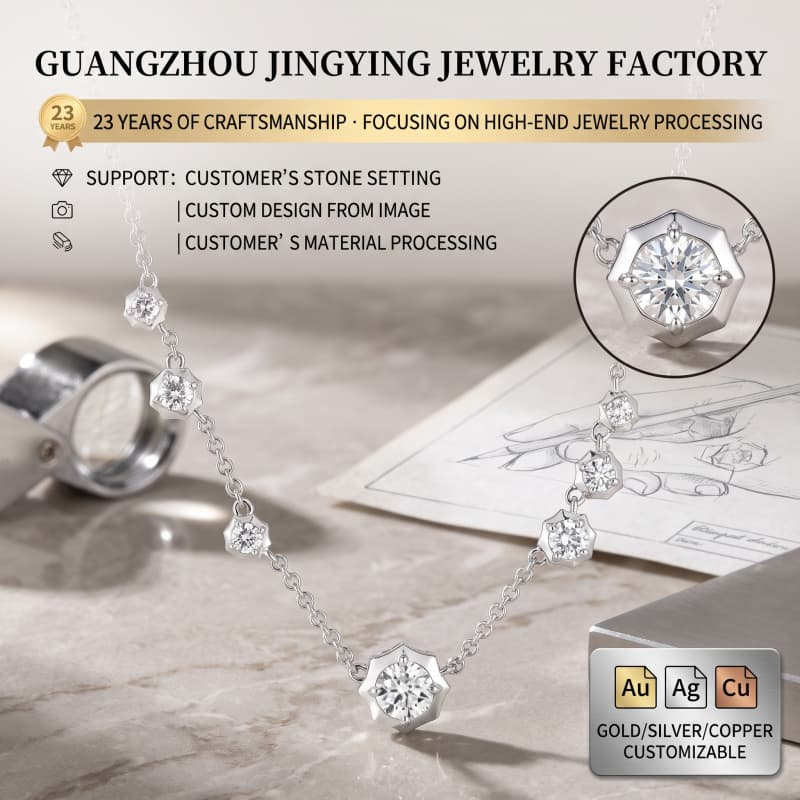
Founded in 1998, Guangzhou JINGYING Jewelry Co., Ltd. has built its reputation as a one-stop OEM/ODM partner for brands worldwide, specializing in 925 sterling silver and gold-plated silver jewelry. The company produces rings, necklaces, pendants, earrings, bracelets, and pearl jewelry, offering customization that extends from the first sketch to the final packaged piece. Understanding how customization works at JINGYING is, in effect, understanding how a modern jewelry manufacturing partnership operates—where design intent, material science, and production discipline converge.
Why 925 Sterling Silver Forms the Foundation
The starting point for any gold-plated JINGYING project is almost always 925 sterling silver. The “925” designation is not decorative; it means the alloy contains 92.5% pure silver and 7.5% other metals, typically copper, to give the metal the strength and workability required for jewelry. This composition makes sterling silver hypoallergenic and suitable for sensitive skin, a critical consideration for brands selling into markets where nickel-free and skin-friendly claims carry real weight.
JINGYING’s sterling silver is also treated as a performance material, not just a precious one. The company emphasizes that its sterling silver jewelry is waterproof, sweat-proof, and designed not to turn skin green—a common failure point in lower-quality silver alloys. For gold-plated pieces, this matters even more. The silver base must be smooth, dense, and chemically stable so that the gold layer adheres evenly and resists wear. A flawed or porous silver surface will telegraph through even the thickest gold plating, leading to premature dulling, flaking, or discoloration.
The Gold-Plating Difference: Vermeil, Microns, and Color
Gold-plated sterling silver is not a single category. The difference between a thin, decorative flash of gold and a durable, luxury-grade finish lies in the plating process and the thickness of the gold layer. JINGYING approaches gold plating with a two-step method that is central to its quality positioning. First, a thick layer of silver is applied as a base plating to smooth the surface and ensure a uniform foundation. Only then is the real gold plating applied, with thickness reaching up to 3 microns. This two-stage process is what the company refers to as vermeil—a term that, in the strictest sense, requires a sterling silver base and a gold layer of at least 2.5 microns, though JINGYING’s 3-micron capability places it comfortably within that standard.
The thickness matters because gold plating on jewelry is subject to abrasion, perspiration, and repeated contact with skin and clothing. A plating layer measured in fractions of a micron will wear away quickly, exposing the silver beneath and altering the piece’s appearance. JINGYING’s plating standards are calibrated to the wear profile of each item. For high-contact pieces such as rings and bracelets, the company mandates a minimum gold thickness of 0.25 to 0.5 microns, while earrings and pendants, which experience less friction, are held to 0.125 to 0.25 microns. These thresholds are not arbitrary; they reflect an understanding that different jewelry categories fail in different ways and at different rates.
Color is another customization axis. JINGYING offers yellow gold, rose gold, and white gold plating finishes, allowing a brand to align its silver collection with its existing gold or fashion jewelry lines. The company also works with 9K, 10K, 14K, and 18K gold plating, as well as rhodium plating for a bright, scratch-resistant white finish. Rhodium plating is particularly relevant for white-gold-look pieces, adding a hard, reflective surface that resists tarnishing and scratches. For brands that want the visual warmth of gold without the cost of solid gold, 18K gold plating over 925 sterling silver has become a signature offering, combining a luxurious appearance with a nickel-free underlayer.
The Customization Process: From Mood Board to Mass Production
JINGYING’s customization service does not begin with a product catalog. It begins with the client’s most personal material—a mood board, a rough sketch, a 3D model, or even a detailed written description. This is a deliberate philosophy. Rather than forcing a client’s idea into an existing mold, the design team treats the initial input as a visual and emotional vocabulary, interpreting recurring motifs, textures, and aesthetic preferences before any technical decision is made.
Once the design intent is clear, the process moves into digital engineering. JINGYING’s designers use advanced software such as Rhino and JewelCAD to translate the concept into detailed 3D renderings and technical drawings for client approval. When a client supplies a 3D file, the first step is a comprehensive Design for Manufacturing (DFM) analysis, which examines whether the geometry can be cast, set, and finished efficiently without compromising the design’s integrity. This stage is where creative ambition meets production reality, and it is handled collaboratively rather than prescriptively.
Prototyping follows. JINGYING uses CNC machining and high-temperature casting to produce precise prototypes that match the approved design. Samples are typically completed within about ten days, allowing clients to evaluate scale, proportion, surface finish, and stone placement before committing to mass production. For custom jewelry, this sample stage is indispensable. It is one thing to see a design on a screen; it is another to hold it in hand, feel its weight, and observe how the gold plating catches light at different angles.
After approval, manufacturing begins. JINGYING’s monthly production capacity reaches up to 100,000 pieces, supported by in-house casting departments, plating facilities, and quality control teams. The company’s factory is organized around a one-stop model, meaning that design, prototyping, casting, stone setting, polishing, plating, and final inspection are not outsourced to separate vendors but coordinated under one roof. This vertical integration reduces communication friction and gives the manufacturer greater control over lead times and consistency.
Stone Setting, Engraving, and the Details That Define a Piece
Gold plating is often the most visible customization decision, but it is rarely the only one. JINGYING offers a range of finishing and detailing services that allow a piece to carry more than a metal color. Stone setting is a core capability, with options including prong, bezel, pavé, and channel settings. The company uses advanced micro-setting equipment, including Japanese micro-inlay machines, to achieve precision and minimize the risk of stone loss. For clients incorporating birthstones, accent diamonds, or colored gemstones, the setting method becomes part of the design language—a bezel setting for a clean, modern look, or pavé for a continuous surface of sparkle.
Engraving is another customization layer. JINGYING offers hand engraving and personalized engraving, enabling names, dates, symbolic marks, or short messages to be integrated into the metal surface. Engraving can be combined with stone placement; for example, birthstones arranged around an engraved message can turn a pendant or ring into a narrative object rather than a purely decorative one. The company also provides oxidation and polishing finishes, allowing a piece to shift between high-gloss brightness and a darker, more vintage or architectural character.
Logo and packaging customization complete the branding picture. JINGYING offers personalized logos and packaging options, which means a custom piece can arrive not just as a finished product but as a coherent brand asset—ready for retail, gifting, or direct-to-consumer fulfillment.
Quality Control and Intellectual Property Protection
Customization is only valuable if the final product matches the approved prototype and performs as expected. JINGYING operates a multi-point quality inspection system that covers casting, plating, stone setting, and final finishing. The company’s quality framework is not limited to visual inspection; it includes adhesion and wear considerations appropriate to gold-plated silver, ensuring that the plating thickness and surface preparation are consistent with the intended use of the piece.
Equally important for brands and independent designers is confidentiality. JINGYING signs non-disclosure agreements before the manufacturing process begins and treats client designs as protected intellectual property. The company states that it does not reveal client identities or operational information and that unique designs are never shared with other clients. For creators who are building a differentiated brand on original designs, this is a non-negotiable condition of partnership, and JINGYING has built its OEM/ODM workflow around it.
How to Begin a Custom Project at JINGYING
Starting a custom 925 sterling silver gold-plated jewelry project at JINGYING follows a relatively straightforward sequence. The first step is to contact the team with the design concept, reference images, sketches, mood boards, or 3D files. JINGYING’s design team then works with the client to refine the idea into a manufacturable design, providing 3D renderings and technical drawings for approval. A prototype or sample is produced, usually within ten days, and once approved, mass production proceeds according to the agreed specifications, plating thickness, stone setting requirements, and finishing details.
For brands that are new to custom manufacturing, the most effective approach is to arrive with clarity about three things: the intended wear context (daily wear versus occasional), the desired gold color and plating durability level, and the target price point. These three variables shape nearly every subsequent decision, from the thickness of the gold layer to the complexity of the stone setting and the type of packaging. JINGYING’s role is to translate those variables into a production plan that preserves the design’s visual intent while meeting the practical demands of the market.
Conclusion
Customizing 925 sterling silver gold-plated jewelry at JINGYING is not a matter of choosing from a menu. It is a structured collaboration that moves from mood board to CAD model, from prototype to plated and set finished piece. The company’s two-decade-plus experience in sterling silver manufacturing, its two-step plating process with gold thickness up to 3 microns, and its in-house design, casting, setting, and finishing capabilities make it a viable partner for brands seeking both creative flexibility and production reliability. For those who want to turn an idea into a wearable, brandable object in gold-plated sterling silver, JINGYING offers a pathway that treats customization as a dialogue—between design and engineering, between aesthetic intention and material behavior, and between a client’s vision and a manufacturer’s craft.