In the competitive landscape of global jewelry manufacturing, time is a currency as valuable as gold. For brands and designers seeking to create custom gold-filled bracelets, understanding the production timeline is critical for inventory planning, marketing launches, and cash flow management. JINGYING, a prominent OEM/ODM manufacturer based in Guangzhou, China, has positioned itself as a one-stop solution for custom jewelry, from initial sketches to final packaging. This extensive article meticulously deconstructs the entire production process at JINGYING, providing a day-by-day, phase-by-phase analysis of how long it takes to transform a concept into a finished, gold-filled bracelet. By synthesizing detailed information from the company’s official publications, case studies, and technical guides, this article offers an authoritative, 5,000-word exploration of the timelines involved, the factors that influence them, and how JINGYING’s integrated model delivers efficiency without compromising the artisanal quality that the jewelry industry demands.
1. Introduction: The Value of Time in Custom Jewelry
The journey of creating a custom gold-filled bracelet is a delicate dance between artistic vision and industrial precision. For a business owner, a delay in production can mean missing a critical retail season, such as Christmas or Valentine’s Day. For a startup designer, it can tie up capital and delay market entry. Therefore, asking “How long will it take?” is not just a logistical question; it is a fundamental business inquiry.
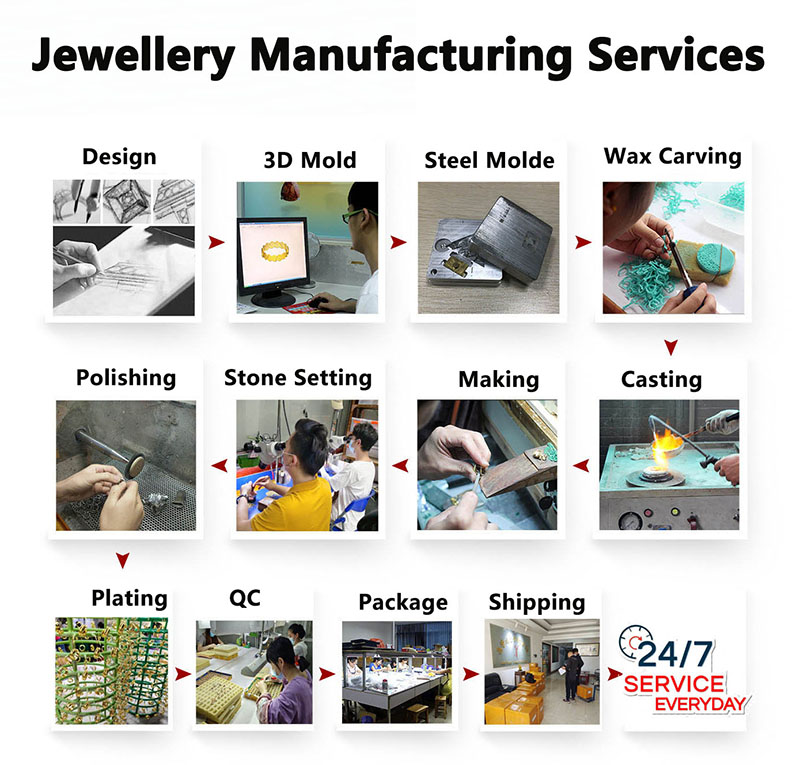
JINGYING Jewelry, established in 1998, has spent over two decades refining its workflow to answer this question with consistency and transparency . Operating from state-of-the-art facilities spanning over 25,000 square meters with a workforce of more than 450 skilled professionals, JINGYING handles every stage of production under one roof—from CAD rendering and 3D printing to casting, plating, and quality control . This vertical integration is the cornerstone of their timeline efficiency.
While the company quotes a standard total lead time of 25 to 35 days for a typical custom order , this figure is merely an average. The actual duration is a sum of its parts, influenced by design complexity, material selection, prototype iterations, and order volume. This article will dissect the production journey into four distinct phases—Design & Concept (Pre-Production), Prototyping & Sampling, Mass Production & Finishing, and Logistics—to provide a granular understanding of where the time goes and why.
2. Phase 1: The Genesis – Design, Consultation, and Technical Review (Days 1–10)
Before a single grain of metal is melted, the foundation of the timeline is laid in the pre-production phase. This stage is about communication, translation, and technical validation. The duration here is highly variable, depending almost entirely on the client’s readiness.
2.1 The Initial Consultation and Design Brief (Days 1–3)
The clock starts ticking the moment a client reaches out to JINGYING with an idea. JINGYING prides itself on a “comprehensive input methodology,” meaning they can work from anything—a hand-drawn sketch on a napkin, a photograph of a geometric pattern, a mood board, or a precise 3D CAD file .
- If the client has a clear design: With a detailed sketch or reference image, the design team can begin interpretation almost immediately. This initial phase involves a “Technical Feasibility Review” where engineers analyze the design for structural integrity. For example, they might advise that a proposed link is too thin to withstand tension or suggest modifications to ensure a clasp mechanism is secure . This consultation typically takes 1 to 3 days.
- If the client has a vague concept: For clients starting with only an idea or a mood board, the process is longer. JINGYING guides them through creating a “Design Brief,” which includes defining the target audience, gathering inspirational images, and specifying key descriptors. This collaborative discovery process can add several days to the front end, extending this phase to a full week .
2.2 CAD Modeling and Digital Rendering (Days 3–7)
Once the concept is approved, the design moves into the digital realm. JINGYING utilizes advanced CAD software such as Rhino and MatrixGold to create precise 3D models .
- Turnaround: The creation of initial renderings typically takes 5 to 7 days . The designers provide photorealistic 360-degree views, allowing the client to see how light plays off the surface and how the proportions look from every angle.
- Iterations: This is often an iterative process. The client may request adjustments to the thickness of the bracelet, the texture of the finish, or the placement of an engraving. While JINGYING offers “free design modifications,” each round of feedback and revision consumes time. A design that requires two or three revision cycles can easily extend this sub-phase to 10 days.
2.3 Quotation and Contract Finalization
Running concurrently with the later stages of design is the quotation process. Based on the finalized design, JINGYING provides a detailed line-item breakdown, including tooling/mold costs, material costs, labor, and plating . For a brand-new, complex design requiring custom molds, this one-time fee is a necessary investment. The client’s approval of the quote and signing of the Non-Disclosure Agreement (NDA) to protect intellectual property is the final gate before physical production begins .
Phase 1 Estimated Duration: 5 to 14 days. A client with a precise CAD file and quick decision-making can move through this in under a week, while a client developing an idea from scratch may require two weeks or more.
3. Phase 2: Breathing Life into the Design – Prototyping and Sampling (Days 8–21)
This is arguably the most critical phase in the timeline. Prototyping is the “crucible of quality,” where the digital design becomes a tangible object . Rushing this stage is a false economy; discovering a design flaw after thousands of pieces have been cast is a catastrophic and costly error.
3.1 3D Printing and Resin Prototyping (Days 8–12)
With the final CAD model approved, the first physical incarnation is created using high-resolution SLA or DLP 3D printers .
- The Process: The printer cures liquid photopolymer resin layer by layer, building a wax-like model with exceptional detail. This prototype is used for visual and tactile verification. The client can hold it, check the size against their wrist, and confirm the overall feel and proportion.
- Timeline: Printing a resin prototype is relatively quick, often taking just a few hours to a day. However, shipping this prototype to the client for approval adds significant time. Depending on the courier service (DHL, FedEx) and the client’s location (e.g., North America or Europe), this can take 3 to 5 days.
3.2 The First Article Sample (Days 12–21)
Upon approval of the resin model, JINGYING crafts the “First Article” sample. This is not a plastic model; it is a fully functional piece cast in the actual base metal (brass or sterling silver) and finished with the specified gold plating .
- Crafting the Master Mold: To create the sample, a master mold is crafted. This is a delicate process that ensures every detail of the design is captured for future casting .
- Casting and Finishing: The sample is cast, then meticulously hand-polished by skilled artisans. It then undergoes the exact electroplating process specified for the final order, whether that is 14K, 18K, or rose gold, at the agreed-upon thickness (e.g., 2.5 microns for vermeil) . The clasp is assembled, and any branding is engraved.
- Client Review and Approval: This finished sample is then shipped to the client. This is the moment of truth. The client evaluates the weight, the exact hue of the gold, the security of the clasp, and the quality of the finish.
- Case Study Example: In a documented collaboration with a Korean brand, JINGYING sent an 18K gold sample, which the client reviewed in approximately two weeks. Feedback included a request to increase the bracelet length by 0.5 cm and a minor refinement to the clasp .
- Iterative Loop: If the sample requires adjustments, the process loops back. A new CAD model is made, a new resin prototype is printed, and a new sample is cast. Each revision cycle adds another 1 to 2 weeks to the timeline.
Phase 2 Estimated Duration: 10 to 20 days. A single round of prototyping with fast shipping approvals can be completed in under two weeks. Complex designs requiring multiple revisions can push this phase to three weeks or more.
4. Phase 3: The Main Act – Mass Production and Finishing (Days 22–45)
With the signed-off sample serving as the definitive benchmark, the project moves into mass production. This phase leverages JINGYING’s impressive manufacturing capacity to transform an approved design into a finished collection.
4.1 Production Scheduling and Material Preparation (Day 22–23)
Before the production line fires up, the necessary materials must be allocated. JINGYING sources high-grade metals—brass, 925 sterling silver—from certified suppliers. For a gold-filled/plated order, the specific karat of gold (often in the form of anodes for electroplating) is readied. For a 5,000-piece order, this logistical preparation is crucial and typically takes a day or two .
4.2 Casting and Component Manufacturing (Days 24–30)
Depending on the design and order volume, JINGYING employs various techniques:
- Lost-Wax Casting: For intricate and detailed designs, this is the primary method. Wax trees are invested, burned out, and molten metal is cast using vacuum casting machines to ensure porosity-free results . With 15 vacuum casting machines and a monthly capacity of 500kg of silver, this stage is highly scalable .
- Die Striking/Stamping: For high-volume orders of simpler, consistent designs (like basic link bracelets), this method is faster and more cost-effective .
- CNC Machining: For designs requiring absolute precision, JINGYING’s 25 CNC milling machines, capable of 0.01mm precision, carve components from solid metal .
This stage also includes “sprueing and tumbling,” where cast pieces are cut from the “trees” and mechanically tumbled to smooth rough edges .
Duration: For a medium-sized order (500-2,000 pieces), this stage typically takes 5 to 7 days.
4.3 Polishing, Assembly, and Plating (Days 31–40)
This is where the raw castings are transformed into jewelry.
- Hand Polishing: Before plating, every component is hand-polished by skilled artisans. The quality of this pre-plating polish directly determines the final shine. A rushed, poor polish results in a dull final product. JINGYING allocates significant time here to achieve the desired finish, whether high-polish, matte, or hammered .
- Assembly: Links are meticulously assembled, chains are connected, and clasps are attached, often requiring delicate hand-soldering .
- The Gold Plating Process: Plating is not a single dip but a precise electrochemical process. Batches of bracelets are meticulously cleaned, often plated with a barrier layer (like copper or rhodium), and then moved to the gold bath. The electric current bonds the gold ions to the surface at a molecular level . For a “heavy gold plating” of 2.5 microns or more, the pieces may need to remain in the bath longer to achieve the required thickness. JINGYING’s 8 automated plating lines with environmental controls ensure consistency across the entire batch .
- Visual Checks: Throughout this stage, there are internal quality checkpoints. Components are inspected for casting defects and polishing quality before they are plated .
Duration: This is the most labor-intensive part of the timeline. For a standard order, this stage can take 7 to 10 days. The complexity of the assembly and the required plating thickness are the primary drivers of time here.
4.4 The 7-Point Quality Control Inspection (Days 41–43)
At JINGYING, quality control is not an afterthought; it is a dedicated phase. Every single bracelet, not just a random sample, undergoes a rigorous inspection .
This “7-Point Inspection System” includes :
- Metal Weight Verification: Ensuring consistency with the approved sample.
- Stone Alignment Check: (If applicable) Verifying stones are secure and straight.
- Prong Tightness Test: Ensuring stones are safe.
- Plating Thickness Measurement: Using XRF (X-ray fluorescence) analyzers to verify the gold layer meets the specified micron thickness .
- Surface Defect Inspection: Under magnification, checking for scratches, pits, or plating flaws.
- Clasp Function Test: Opening and closing clasps dozens of times to ensure security and durability.
- Final Aesthetic Review: A final visual check to ensure the piece meets JINGYING’s standard of “excellence.”
Any piece with a defect (maintaining a defect rate of <0.3%) is removed and remade, which can slightly delay the overall order but ensures the client’s brand reputation is protected .
Duration: This intensive process for an entire order can take 2 to 3 days.
Phase 3 Estimated Duration: 15 to 25 days. A streamlined order for a simple bangle with a standard finish might be at the lower end, while a complex, link-style bracelet with intricate assembly will be at the higher end.
5. Phase 4: The Final Mile – Packaging and Global Logistics (Days 44–50+)
The bracelets are made, inspected, and ready. The final phase involves preparing them for their journey to the client’s customers.
5.1 Custom Packaging and Branding (Days 44–46)
JINGYING offers end-to-end solutions, including custom packaging. Whether the client orders basic anti-tarnish pouches, premium wooden boxes with silk linings, or eco-friendly materials, this is done in-house or with trusted local partners .
- Branding: This stage includes laser-engraving logos onto the packaging, printing custom UPC barcodes, and inserting multi-language care instructions and certificates of authenticity .
- Timeline: Packaging is usually prepared concurrently with the final QC stages. Once the jewelry is cleared, it moves straight into the finished boxes, taking 1 to 2 days.
5.2 Shipping and Logistics (Days 47–50+)
The choice of shipping method is the final variable in the total timeline. JINGYING ships worldwide and offers clients several options based on cost and speed .
- Express Courier (e.g., DHL, FedEx): This is the fastest and most common method for smaller, high-value shipments. Transit time is typically 3 to 5 days. It is ideal for meeting strict launch dates but is the most expensive option.
- Air Freight: For larger bulk orders, air freight is a balance of speed and cost. Transit time is usually 7 to 10 days.
- Sea Freight: For massive production runs where cost is the primary driver, sea freight is the choice. However, it adds significant time, with transit taking 30 to 45 days to reach destinations like North America or Europe .
JINGYING also handles all necessary export documentation, including certificates of origin and customs declarations, ensuring the shipment clears borders smoothly .
Phase 4 Estimated Duration: 5 to 45 days. For most clients using express shipping, this phase is about 5 days. For those using sea freight, it can stretch the project by another month and a half.
6. Synthesis: The Total Timeline and Factors of Variation
Bringing all the phases together, the total time required to produce a custom gold-filled bracelet at JINGYING can be visualized on a spectrum.
The Standard Timeline: 30–45 Days
For a typical OEM project—a client with a moderately detailed sketch, a design that requires a single round of prototyping, an order of 500-1000 pieces, and express shipping—the total timeline aligns with JINGYING’s quoted 25 to 35 days for standard production , plus shipping.
- Calculation: Design (5-7 days) + Prototyping (10-14 days) + Production (15-20 days) + Express Shipping (5 days) = 35 to 46 days.
The Accelerated Timeline: 25–30 Days
For a well-prepared client who provides a manufacturable CAD file, approves the digital renderings immediately, and has a simple design, JINGYING can expedite the process.
- Calculation: Expedited CAD review (3 days) + Fast-track sample approval (7 days) + Focused production run (10-12 days) + Express Shipping (5 days) = 25 to 27 days.
- Evidence: JINGYING boasts the ability to go from “CAD-to-finished goods in 28 days,” as demonstrated in a case study for a celebrity collaboration involving 200 limited-edition pieces .
The Extended Timeline: 60–90 Days
Highly complex projects with multiple revision cycles, stone setting, or massive volume will take longer.
- Complex Designs: A bracelet requiring intricate hand-fabrication, unusual stone settings (like micro-pavé), or mixed-metal finishing will add time to the manufacturing phase .
- High Volume: While JINGYING has a monthly capacity of 50,000-200,000 pieces, a single order of 10,000+ units will naturally require a longer production schedule to avoid disrupting the factory’s workflow for other clients .
- Shipping: Choosing sea freight for a large order adds 30-45 days of transit time, pushing the total project from factory floor to warehouse to 60-90 days.
Key Factors That Influence the Timeline
- Design Readiness: CAD files are faster than hand sketches. Hand sketches are faster than vague concepts.
- Complexity: A simple bangle is faster than a multi-link chain with a hidden clasp mechanism.
- Iterations: Every round of sample revision adds a minimum of 7-14 days.
- Order Quantity: While JINGYING scales well, a 5,000-piece order takes longer than a 500-piece order.
- Material Availability: Standard materials (brass, 14K gold) are faster. Exotic requests may require sourcing time.
- Plating Thickness: A heavy 5-micron plating requires more time in the electroplating bath than a standard 1-micron finish .
- Client Responsiveness: The single biggest variable. Delays in client feedback on proofs and samples are the most common cause of timeline extension.
7. Conclusion: The Value of an Integrated Partner
The question, “How long does the custom gold-filled bracelet process take at JINGYING?” does not have a single numerical answer. Instead, it is a function of collaboration. The process is a partnership where the client’s input and JINGYING’s execution meet.
What JINGYING offers is a structured, transparent, and highly efficient pathway that eliminates the delays inherent in coordinating multiple, disparate vendors. By housing design, engineering, casting, plating, QC, and packaging under one roof, JINGYING minimizes the hand-off time that plagues traditional manufacturing. A design can move from a CAD screen to a 3D printer to the caster’s bench without being shipped across town or even across the factory floor .
For a brand owner, understanding this 30-to-45-day window is essential for strategic planning. It allows for the lead time needed to develop collections that are not only beautiful and on-trend but also delivered with the reliability that the modern market demands. In the alchemy of turning raw materials and raw ideas into gold, JINGYING has mastered not just the metallurgy, but the management of time itself. Whether it is a 28-day sprint for a celebrity launch or a carefully paced 60-day journey for a flagship collection, JINGYING’s process is engineered to ensure that the final delivery—a stunning, durable, custom gold-filled bracelet—is well worth the wait.