From Digital Blueprint to Finished Pendant: Inside the Birthstone Heart Necklace Manufacturing Process
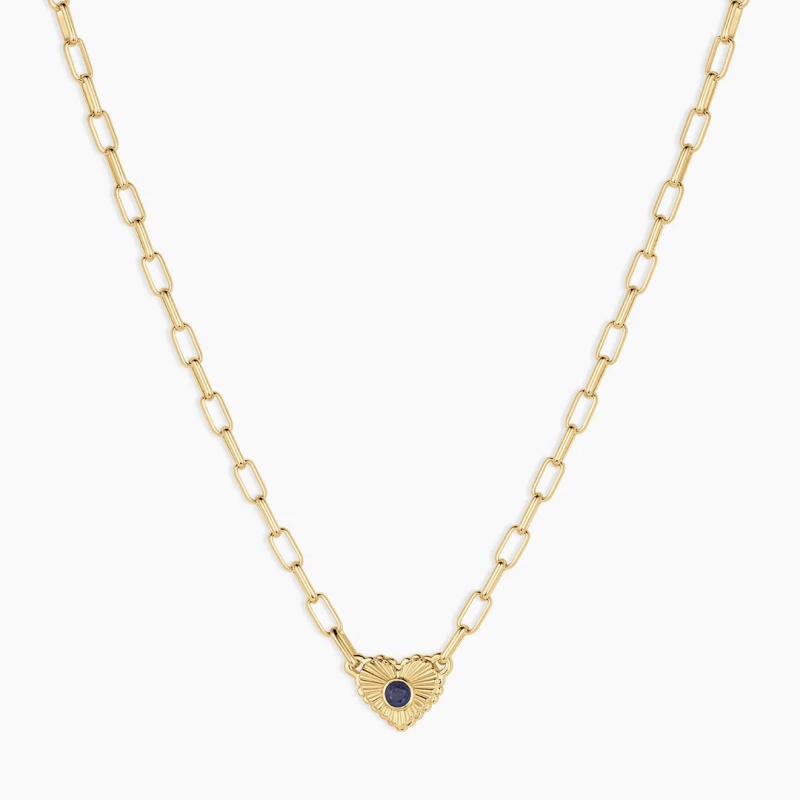
A birthstone heart necklace looks simple on a retail display: a heart-shaped metal frame, a single calibrated stone in a signature color, a chain, a clasp. Behind that simplicity sits a tightly sequenced manufacturing chain in which every millimeter of prong geometry, every tenth of a micron of plating thickness, and every degree of casting temperature determines whether ten thousand identical pendants arrive at a warehouse ready to sell—or whether a bulk order collapses into tolerance drift, stone loss, and returns. Understanding how the piece moves from CAD design to bulk production is essential for anyone sourcing, developing, or scaling a birthstone necklace program.
The Design Brief: Turning a Concept into a Production Specification
The process does not begin with a sketch. It begins with a brief that defines what the factory is actually being asked to make. For a birthstone heart necklace, the brief must specify the base metal—316L stainless steel, sterling silver, 14K gold, or a brass alloy—the stone type and grade, the heart dimensions, chain length and gauge, clasp type, plating specification, target weight with tolerance, and minimum order quantity. A reference photo alone is not a production document. Without a signed brief that translates the design into measurable specifications, sampling starts in ambiguity, and bulk production inherits that ambiguity at scale.
This is particularly important for birthstone jewelry because the stone is the product’s emotional center and its most common failure point. The brief must state whether the birthstone is natural, synthetic, cubic zirconia, glass, or enamel-filled, and whether the stones are calibrated for repeat production. Calibrated stones are sized to a tight tolerance—often ±0.1 mm or tighter in production runs—so that the same setting seat accepts every stone in the batch without individual hand-fitting. If the stones are not calibrated, the setting step becomes a manual sorting operation, and consistency across a bulk order becomes impossible to guarantee.
CAD Design: Engineering the Heart for Castability and Setting
Once the brief is confirmed, the design moves into computer-aided design. Jewelry CAD is not a decorative rendering exercise; it is the engineering stage where the physical behavior of the finished piece is determined. For a heart pendant, the CAD model defines the wall thickness of the heart frame, the geometry of the bail, the seat for the birthstone, the prong or bezel structure that will hold the stone, and the internal clearances that allow metal to flow during casting.
A well-engineered CAD file prevents three common production failures: porosity from uneven wall thickness, stone loss from undersized prongs, and plating wear from sharp internal edges that trap plating solution. The CAD engineer works to tolerances of roughly 0.05–0.1 mm on stone seats, prong height, and channel dimensions. For a heart pendant with a bezel-set birthstone, the bezel wall thickness must be controlled carefully—too thin and the stone is not secure; too thick and the pendant becomes unnecessarily heavy, raising unit metal cost and shipping weight. For a prong-set heart, the prong geometry must be robust enough to survive setting without stress-fracturing the stone, yet fine enough to preserve the visual delicacy of the heart outline.
The CAD stage also determines how the heart will be oriented on the casting tree and whether the geometry contains undercuts or thin necks that are likely to produce shrinkage porosity during solidification. A production-ready CAD file is optimized for clean casting and strong setting—not merely for a convincing render. Brands typically review renders from three or four angles and approve the file before it moves to prototyping; changes after CAD approval restart the mold and sampling chain and are expensive.
Prototyping: The First Physical Reality Check
The approved CAD file is printed at high resolution in resin or wax to create a physical prototype. This is the first moment the design exists as a tangible object, and it is where geometry errors that survived the screen become obvious: a prong too thin to hold the stone, a bail that sits awkwardly on the chain, a heart that feels too heavy or too light for its intended wear. At a 25-micron layer resolution, the prototype is fine enough to evaluate prong geometry and surface finish before committing to a production mold.
For a birthstone necklace, the prototype is also fitted with a sample stone of the specified size and shape. The setter or sample technician checks whether the stone seats cleanly, whether the prongs contact the stone at the correct tension, and whether the heart pendant hangs with the stone facing forward rather than twisting on the chain. The center of gravity of a pendant matters: a top-heavy heart with an off-center bail will rotate when worn, and no amount of polishing will correct a fundamental balance problem. If the prototype passes, the file proceeds to mold making. If not, the CAD is revised and reprinted—an iteration loop that exists precisely to prevent those problems from being multiplied across a bulk order.
Mold Making and Lost-Wax Casting: From Prototype to Metal
Bulk production of a birthstone heart necklace almost always relies on lost-wax investment casting, the industry standard for reproducing detailed jewelry forms in precious and base metals with consistency. The approved prototype is used to create a production mold, typically a rubber or silicone mold for repeatable wax injection. From this mold, wax copies of the heart pendant are injected, inspected for flash or shrinkage, and assembled onto a central wax stem called a tree. Light pieces go toward the top of the tree and heavier pieces lower down to maintain balance during casting.
The wax tree is then placed inside a steel flask and surrounded with investment plaster, a fine heat-resistant material. The flask is heated in a kiln, burning out the wax and leaving a negative cavity in the investment. Molten metal—sterling silver, gold alloy, brass, or stainless steel depending on the program—is cast into that cavity using centrifugal or vacuum-assisted casting to ensure the metal fills fine details and prong seats. After cooling, the investment is broken away, the cast tree is cut into individual pieces, and each casting is inspected for porosity, incomplete fill, and dimensional accuracy.
Casting is the highest-risk step in the entire process. A poor casting cannot be salvaged by polishing or setting. Porosity—internal voids or surface pits caused by gas entrapment or shrinkage during solidification—can appear as tiny dark spots that only become visible after polishing, or as structural weak points that cause a prong to snap during setting. Thin necks between adjacent thicker sections of a heart design are classic causes of shrinkage porosity, and the safest correction is often a design change rather than a casting parameter adjustment. For a birthstone heart necklace, the casting step must also account for metal shrinkage: as the metal cools, the piece contracts, and the mold must be scaled to compensate so that the final heart dimensions and stone seat match the CAD specification.
Stone Setting: The Skill-Dependent Heart of the Operation
Castings that pass inspection move to stone setting, where each birthstone is seated and secured into its prepared seat. This is the most labor-intensive and skill-dependent step in the process. A setter works under magnification, adjusting each prong to hold the stone at the correct tension: tight enough that the stone cannot move, loose enough that the prong does not stress-fracture the stone or itself. A brass probe is used to check tension, and each stone is inspected under 10x magnification before the piece is signed off.
Different setting styles carry different failure risks. Prong settings fail when prong geometry is undersized in CAD. Bezel settings—common in heart pendants because the continuous metal rim protects the stone and creates a clean silhouette—fail when the bezel wall is too thin to retain the stone or too thick to be pressed cleanly over the stone’s girdle. Pavé settings on a heart outline fail when the beads are too small to hold the stones. Stone loss in the field almost always traces back to a setter who skipped the tension check or to a CAD file that under-engineered the seat. For a birthstone program, where a single style may ship in twelve different stone colors, the setting team must also maintain color consistency across the batch and verify that every stone matches the approved master color reference under standardized lighting.
Pre-Polishing, Final Polishing, and Plating
Before stones are set, the metal receives a pre-polish. Surfaces that will be inaccessible once the birthstone is mounted are smoothed and brightened, and the piece is ultrasonically cleaned to remove polishing residue. Neglecting pre-polishing leads to dull patches beneath the stone or poor contact between the metal and the gem, compromising both appearance and durability.
After setting, the piece enters final polishing—a multi-stage surface refinement that progresses from coarse abrasives through fine buffs to the specified mirror or satin finish. Polishing removes casting flash, file marks, and tooling scratches, and blends the setting work so that the prongs or bezel appear integrated into the heart form. For commercial birthstone programs, the finish must be reproducible across thousands of units, which means the polishing process is documented by abrasive sequence and inspection criteria rather than left to individual bench feel.
Plating follows polishing. White metals such as sterling silver are commonly rhodium-plated for brightness and tarnish resistance; gold-toned programs use gold plating or PVD coatings; stainless steel programs may use PVD color coatings for durability. Plating thickness must be specified numerically—not as “thick plating”—because thin plating wears through at high-contact points such as the bail and clasp, exposing the base metal and creating discoloration complaints. For birthstone necklaces, plating thicknesses in the range of 0.3 μm to 3.0 μm are available depending on the brand’s durability requirements, and three-times rhodium plating is sometimes used for added protection. Anti-tarnish treatments and reinforced bezel settings directly address the two most common consumer complaints in birthstone jewelry: stone loss and discoloration.
Quality Control: Where Bulk Consistency Is Won or Lost
Quality control is not a single inspection at the end of the line. In a well-run birthstone necklace program, QC is distributed across the process. Incoming stones are batch-tested against a master color reference. Castings are inspected for porosity and dimensional accuracy before setting. Set stones are checked for tension and alignment under magnification. Plated pieces are checked for coating thickness and adhesion. Final inspection verifies stone security, dimensions, weight, clasp function, and surface finish.
The “golden sample” protocol is the backbone of bulk consistency. Once the prototype is approved, it becomes the definitive technical benchmark for the production line. The QC team compares finished pieces against the golden sample for specifications, tolerances, and finish, and multi-stage inspections ensure that every unit in the bulk order matches the approved reference. Acceptable Quality Limit (AQL) sampling plans define how many pieces are inspected and what defect levels are acceptable, while functional tests—clasp opening and closing, chain pull strength, stone security checks—verify that the necklace will survive wear. For higher-risk orders, third-party inspection and material testing may be used to confirm alloy composition, nickel release, and plating thickness against the specification.
Bulk Production: Scaling Without Drift
Bulk production begins only after the sample is approved and the golden sample is locked. Durable production molds are prepared for high-volume casting, and the factory runs the order through controlled stations: casting, assembly, laser welding for durability, stone setting, polishing, plating, and final QC. Laser welding is often used at joints and bail attachments because it produces a stronger, cleaner bond than traditional soldering and reduces the risk of heat damage to nearby stones.
The central challenge of bulk production is not making one good necklace; it is making ten thousand necklaces that are indistinguishable from the approved sample. This requires tolerance planning at every station. Stone diameters are held to tight tolerances so that setting seats do not require individual adjustment. Bezel wall thickness is standardized across pendant styles so that stone retention remains secure without adding unnecessary metal weight. Plating thickness is controlled by process parameters rather than operator judgment. Batch labeling, barcoding, and branded packaging integration allow the factory to trace which production lot a finished necklace came from, which is essential for handling any quality issue that emerges after shipment.
Lead times for bulk birthstone necklace orders typically run in the range of 25 to 45 business days after final design approval and deposit receipt, depending on volume and technical intricacy. Reorders are faster because the design files and molds are archived, and the golden sample remains the production reference. This archival infrastructure is what allows a brand to scale a birthstone heart necklace from a single sample to a seasonal collection without re-engineering the piece each time.
Conclusion: The Necklace Is the Process
A birthstone heart necklace is often marketed as a simple, emotional gift. Manufactured at scale, it is a chain of engineering decisions in which every link matters. The brief defines the stone and the metal. CAD determines whether the heart can be cast cleanly and whether the stone can be held securely. The prototype exposes what the screen concealed. Casting converts geometry into metal, and setting converts metal into a wearable piece. Polishing and plating determine how the necklace looks and how long it keeps looking that way. Quality control, distributed across every station and anchored to a golden sample, determines whether the ten-thousandth piece is as reliable as the first. Bulk production works not because any single step is complicated, but because each step is controlled, inspected, and signed off before the next one begins. For brands sourcing birthstone jewelry, the factory that treats the process as a sequence of controlled operations is the factory that delivers cross-batch consistency—and the factory that treats it as “make the piece” delivers surprises.