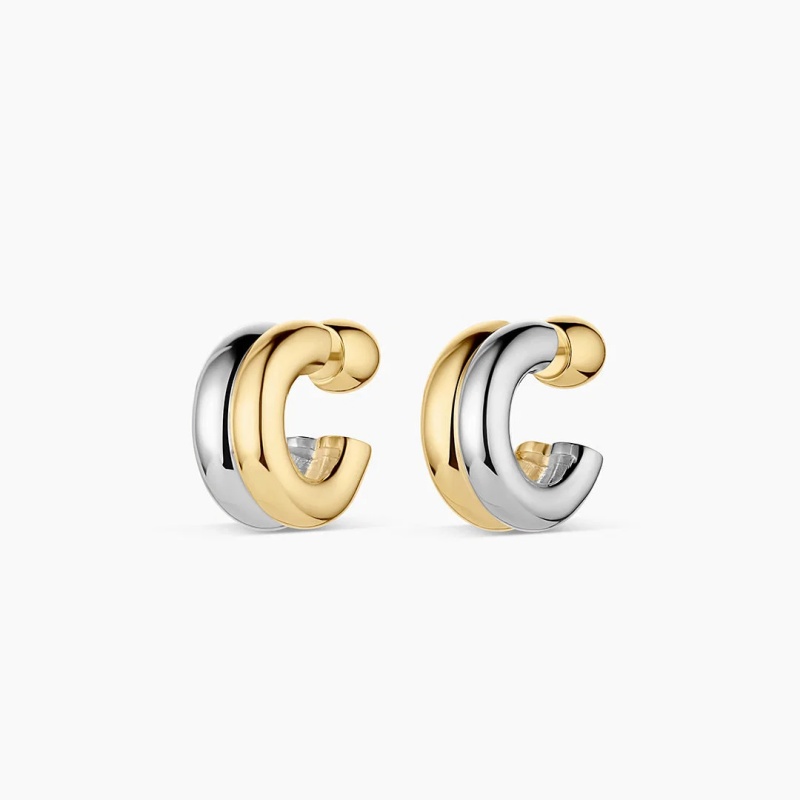
The modern earring market has undergone a structural shift. The single statement earring has given way to the curated ear—a carefully composed stack of huggies, studs, and mini hoops that climbs the earlobe in a deliberate arrangement of scale, texture, and metal tone. At the center of this movement sits the huggie: a close-fitting hoop that “hugs” the earlobe, small in diameter but substantial in styling potential. Within the category, one design direction has gained particular traction among brands and retailers: the custom mixed stacked huggie—a single earring that mimics the layered look through staggered segments, mixed surface treatments, alternating metals, enamel inlays, or stone arrangements, all built onto one hinged frame.
For jewelry brands, private labels, and entrepreneurs, bringing such a piece from concept to bulk production requires navigating a complex chain of design, engineering, material selection, tooling, casting, finishing, and quality control. This article walks through that chain step by step, examining what a custom mixed stacked huggie manufacturer actually does—and what buyers need to know at each stage.
The Design Phase: Translating a Stacked Aesthetic into a Single Wearable Object
The appeal of a mixed stacked huggie lies in visual contradiction: it must look like several pieces worn together while functioning as one comfortable, secure earring. This tension is resolved—or exposed—in the design phase.
The process begins with technical design and 3D modeling using CAD software such as RhinoGold or MatrixGold. For a huggie, the most critical engineering consideration is the hinge mechanism. Unlike a simple wire hoop with a butterfly back, a huggie typically relies on a barrel hinge and a snap-post click closure. The CAD model must account for tolerances—often around 0.2 mm between the post and the hinge tube—to ensure smooth movement without wobbling or loosening over time. A poorly engineered hinge is the single most common failure point in huggie production, and it is far cheaper to solve in CAD than in a bulk order.
For a mixed stacked design, the CAD phase carries additional complexity. The “stacked” effect may be achieved through staggered block segments, as in an open C-huggie with irregular layered geometry, or through alternating materials such as polished metal and hand-filled enamel inlay. The designer must also determine how mixed metal tones—gold and silver, or yellow and rose gold—will be distributed across the piece. If the earring combines contrasting platings, the production plan must specify masking and plating sequences that prevent cross-contamination. The front face may receive the decorative treatment, but the inner surface and closure mechanism must remain smooth, comfortable, and durable.
Once the CAD file is approved, many manufacturers produce a resin prototype via SLA or DLP 3D printing within 24 to 48 hours. This physical model allows the buyer to assess the “feel” of the piece—its weight, edge comfort, and the visual balance of the stacked segments—before committing to steel tooling. For a mixed stacked design, this is the moment to confirm that the layered geometry reads clearly at actual size and that the earring does not become excessively heavy or bulky.
Material Selection: Matching the Stacked Aesthetic to Performance
The material chosen for a mixed stacked huggie determines not only cost but also weight, durability, hypoallergenic performance, and the quality of the finish. The three dominant material directions in the huggie category are 316L stainless steel, 925 sterling silver, and brass.
316L stainless steel has become the workhorse of fashion-forward huggie manufacturing. It is medical-grade, hypoallergenic, highly resistant to corrosion, and structurally robust enough to hold complex sculpted geometries—such as molten-textured or brutallyist surfaces—without warping or flattening. For mixed stacked designs that rely on deep surface texture or bold architectural segments, stainless steel offers the necessary rigidity at a competitive cost point. It also takes PVD (physical vapor deposition) plating exceptionally well, bonding the gold or silver finish at a molecular level for tarnish resistance and water resistance.
925 sterling silver occupies the fine-jewelry tier. It casts beautifully, captures high-polish curves, and provides the substantial weight associated with precious jewelry. When paired with a gold layer of at least 2.5 microns, it qualifies as vermeil—a legally defined category in markets such as the United States. For a mixed stacked huggie intended for a premium position, sterling silver with selective gold plating can create a two-tone effect that feels intentional and luxurious.
Brass is the budget-conscious option, valued for its warmth and workability. However, brass requires rigorous anti-oxidation protection and consistent plating coverage, particularly on inner surfaces and hinge areas that experience friction. A mixed stacked brass huggie may feature enamel inlays—hand-drip epoxy filling for a uniform matte or pearlescent finish—alternating with polished gold segments.
Beyond the base metal, the “mixed” dimension introduces secondary materials: cubic zirconia in bezel or prong settings, enamel in a range of colors, or contrasting plating tones. Each added element increases the number of production steps and the points at which quality can diverge. A manufacturer experienced in mixed-material huggies will establish inspection gates for stone security, enamel adhesion, and plating consistency before assembly.
Tooling, Casting, and the Anatomy of a Stacked Huggie
Once the design and material are locked, production moves to tooling—the stage that determines consistency across thousands of units. For huggies with undercut hinge areas, a multi-piece rubber mold is typically required. A CNC-milled steel master model, cut to tolerances as tight as 0.01 mm, serves as the foundation for the production mold. This precision is non-negotiable for the hinge: a variance of even a few hundredths of a millimeter can produce a closure that feels loose, gritty, or impossible to snap shut.
The casting method depends on the metal and the complexity of the stacked geometry. Lost-wax casting remains the standard for silver and brass huggies. Wax is injected into the rubber mold under pressure—higher pressure for designs with sharp corners or deep textures to prevent rounded edges and “short shots”. The wax patterns are assembled onto a tree, invested in plaster, and fired in a burnout oven. Molten metal is then cast centrifugally or under vacuum, producing raw “blanks” that already carry the stacked silhouette but remain dull and unfinished.
For stainless steel huggies, production may instead involve CNC machining or stamping and pressing, depending on the design. Stamping is efficient for simpler profiles, while CNC machining offers greater precision for complex hinge components and interlocking stacked segments. In either case, the goal is a structurally sound blank with clean edges and consistent wall thickness—critical for a piece that will sit snug against the earlobe.
Finishing, Assembly, and the Mixed-Metal Challenge
The finishing phase transforms a raw casting or machined blank into a wearable, visually resolved earring. For a mixed stacked huggie, this is where the design’s complexity becomes most apparent.
The first step is surface preparation: filing, tumbling, and polishing to remove parting lines, sprue marks, and surface imperfections. If the design incorporates textures—hammered, twisted, grooved, or molten—those textures are refined at this stage rather than polished away. Textured huggies have become a significant trend precisely because surface variation catches light without adding visual weight or requiring larger dimensions.
Assembly follows. For a hinged huggie, the post and hinge barrel are joined to the main body, often via laser welding for durability and precision. The snap closure is fitted and tested for action: it should open smoothly, close with a secure click, and remain closed under normal wear. If the design includes enamel inlay, the enamel is hand-filled and cured, then refined to a uniform surface. If stones are set, they are secured in bezel or prong settings; bezel settings are often preferred for mixed stacked designs because they protect the stone edges and maintain a sleek, continuous surface.
Plating is the next critical step, and for mixed-metal designs it is also the most technically demanding. A two-tone huggie—say, yellow gold segments alternating with white enamel or silver-toned metal—requires selective plating. Areas that should not receive a given plating layer must be masked or otherwise protected. The plating thickness matters: for huggies that experience friction against the earlobe and hair, a thicker plate of 3 to 5 microns is recommended over thinner decorative plating. PVD plating on stainless steel offers superior color stability and resistance to tarnishing, fading, and water exposure, while electroplating on silver or brass demands rigorous cleaning and activation before the plating bath to ensure adhesion.
After plating, the earrings are ultrasonically cleaned, inspected, and—if specified—laser-engraved with the brand logo or a backside mark. Laser engraving is a common customization on the flat inner surface of a huggie, where it remains hidden during wear but reinforces brand identity.
Quality Control and the Transition to Bulk Production
Bulk production is not a single event but a series of controlled transitions. The approved pre-production sample serves as the reference standard against which every subsequent unit is measured. A reputable manufacturer establishes inspection gates at multiple points: incoming material verification, casting or forming, hinge assembly, stone setting or enamel filling, polishing, plating, and final packing.
For mixed stacked huggies, quality control must look beyond the front face. The closure action, the inner surface smoothness, the edge comfort, and the backside finish are all part of the wearer’s experience—and all are common areas where lower-cost production cuts corners. Piece-by-piece inspection is particularly important for designs that combine multiple materials or moving parts, because a single loose hinge or unsecured stone renders the entire pair unsellable.
Bulk production timelines vary by material and complexity. Stainless steel huggies with PVD plating may move from sample approval to mass production in 20 to 40 working days, while silver or brass huggies with lost-wax casting, enamel work, and multi-step plating often require 15 to 25 days after sample sign-off, depending on order volume. Minimum order quantities for custom huggies typically start in the range of 50 to 100 pieces per style or color, with some manufacturers offering lower thresholds for startups testing the market.
What Brands Should Look for in a Manufacturing Partner
The mixed stacked huggie is a deceptively demanding product. It asks a manufacturer to combine the precision of hinge engineering, the discipline of multi-material assembly, the artistry of surface finishing, and the consistency of bulk production—all while keeping the earring light, comfortable, and durable enough for daily wear. A brand evaluating a manufacturing partner should look beyond catalog images and ask specific questions: How is the hinge toleranced? What plating thickness is standard, and what masking process is used for two-tone designs? How are stones secured, and what is the inspection protocol for enamel adhesion? What is the sample turnaround, and what happens when a bulk unit fails inspection?
The manufacturers best equipped to deliver custom mixed stacked huggies are those that treat the earring as an engineered assembly rather than a decorative casting. They invest in CAD engineering before tooling, they control plating chemistry and thickness, and they maintain piece-level quality checks through every stage—from the first 3D-printed prototype to the final packed pair. In a market where the curated ear has become a defining aesthetic, the difference between a huggie that looks stacked and a huggie that works as a stacked piece lies precisely in that manufacturing discipline.