Beyond the Matching Set: How JINGYING Manufacturer Makes Custom Silver-and-Gold Jewelry the Defining Look of 2026
For decades, a quiet but rigid rule governed the jewelry box: silver belonged with silver, and gold belonged with gold. Mixing the two was treated as a styling misstep, a clash of temperatures and traditions. That rule is now not merely broken; it is being deliberately dismantled by designers, stylists, and consumers who have discovered that the tension between cool silver and warm gold is precisely what makes a piece feel modern, personal, and alive. The mixed-metal movement—particularly the silver-and-gold combination—has moved from a niche styling trick to a defining aesthetic of the moment. And for brands and designers who want to translate that aesthetic into production-ready custom jewelry, the manufacturing partner matters as much as the design itself. This is where JINGYING Manufacturer enters the story: a vertically integrated, OEM/ODM-focused jewelry factory that has spent more than two decades turning creative concepts in silver and gold into finished, market-ready pieces.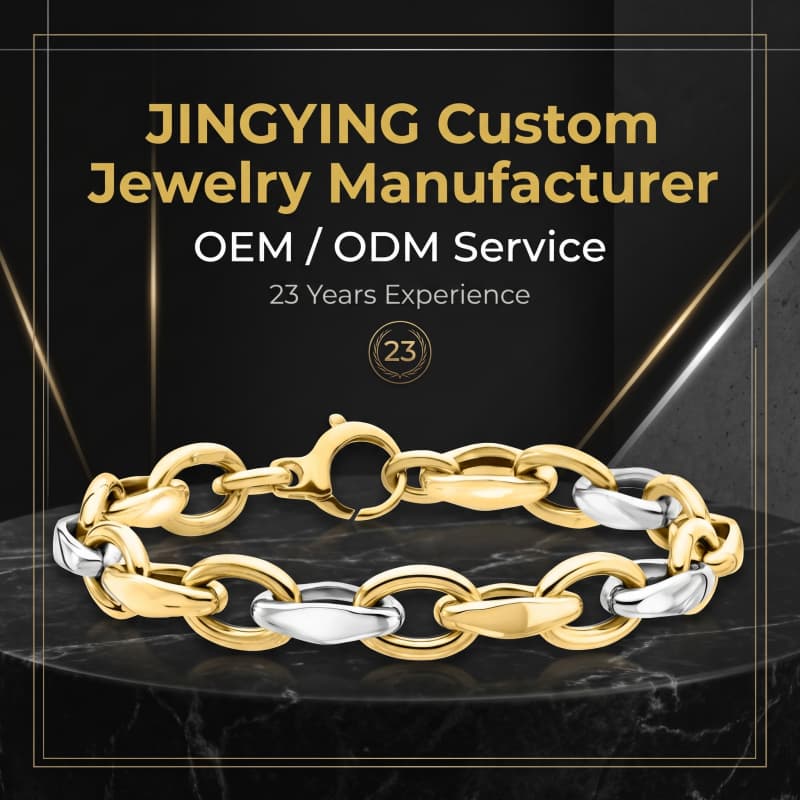
The Cultural Shift That Made Mixed Metals Inevitable
The rise of two-tone jewelry is not simply a trend cycle; it reflects a broader loosening of the formal rules that once governed personal style. As Who What Wear observed in its 2026 trend reporting, embracing two-tone jewelry means brands and stylists are no longer limited by “the dated expectation of matching every metal tone in a look.” The appeal is partly practical and partly psychological. Jewelry lovers no longer want to choose a single metal identity for life; they want pieces that move with them, layer with what they already own, and feel a little unplanned. As NYC It-girl Coco Schiffer put it, “I always mix gold and silver in my stack, and I like it when it feels a little unplanned, like everything just works together naturally.”
Search data confirms that this is more than anecdotal. Google Trends analysis cited by Coveteur identified the mixed-metal jewelry trend—specifically the silver-and-gold combination—as a style on the rise in 2026. The same report noted that celebrities and influential brands, from Hailey Bieber’s co-sign of mixed-metal earrings to the long-standing two-tone vocabulary of David Yurman and Cartier, have given consumers permission to abandon the old matching rule. Industry observers have similarly pointed out that mixed-metal pieces offer a kind of economic and emotional efficiency: they are more affordable than solid gold, more durable than pure silver, and, because they straddle two metal traditions, they tend to remain wearable even as fashion oscillates between gold-dominant and silver-dominant cycles.
For jewelry brands, this shift creates a clear commercial opening. A two-tone collection can appeal to the silver loyalist who is gold-curious, the gold devotee who wants a cooler edge, and the layered-jewelry enthusiast who wants pieces that bridge both worlds. But executing that opening at scale requires manufacturing capability that goes far beyond assembling silver components and gold components in the same box. True mixed-metal custom jewelry demands controlled bonding, plating, soldering, or inlay work—processes that separate a genuine two-tone piece from a costume approximation.
JINGYING Manufacturer: A Factory Built for Material Fluency
JINGYING’s relevance to this moment lies in its material range and its manufacturing model. The company is not a single-material specialist that has bolted on gold plating as an afterthought. Its production portfolio spans 925 sterling silver, 9K, 10K, 14K, and 18K gold, as well as copper and brass options, with finishing capabilities that include rhodium, yellow gold, rose gold, and other platings. For custom silver-and-gold work, this matters because the factory can approach a design from multiple material directions: a sterling silver base with a gold-plated or vermeil surface; a bimetal construction; a solid gold and silver assembled piece; or a selective gold inlay on a silver body.
The company’s scale and experience reinforce its suitability for OEM and ODM work. Founded in 1998, JINGYING has grown into a vertically integrated jewelry manufacturer operating four specialized facilities totaling tens of thousands of square meters and employing more than 600 skilled technicians and craftspeople. Its service model covers the full arc of custom production: interpreting client drawings, producing CAD designs, selecting materials, executing stone setting, applying finishes, and delivering private-label packaging. The factory explicitly offers full OEM/ODM solutions across necklaces, pendants, bracelets, earrings, and rings, and it signs non-disclosure agreements before manufacturing begins to protect client designs and intellectual property. For a brand developing a signature two-tone collection, that combination of material range, in-house capability, and confidentiality is not a minor convenience—it is the foundation of a viable product development cycle.
The Techniques Behind Genuine Two-Tone Custom Jewelry
Understanding how silver and gold are actually combined helps explain why manufacturer selection is so consequential. There is no single “mixed metal” method; there are several distinct techniques, each with different visual outcomes, durability profiles, and cost structures. A capable custom manufacturer should be able to advise on which method suits a given design rather than forcing every idea into a single production template.
One of the most straightforward approaches is gold plating on sterling silver, often referred to as vermeil when the gold layer meets a minimum thickness standard. In vermeil production, a sterling silver piece is electroplated with a layer of gold—commonly 24K or a karat gold matching the desired color—typically in the range of 0.5 to 3 microns, with vermeil standards generally requiring at least 2.5 microns. Plating offers even color, relatively lower material cost, and the ability to create a uniform gold surface over complex silver forms. The trade-off is that plating can wear over time, so proper surface preparation and protective finishing are essential. JINGYING’s stated focus on “quality, durability, and long-lasting plating” speaks directly to this requirement; plating longevity is not an accident but a function of substrate preparation, bath control, and post-plating protection.
A second family of techniques involves mechanical or metallurgical bonding. Bimetal sheet, for example, consists of a layer of 14K or 18K gold roll-bonded onto sterling silver. This material can be cut, bent, and soldered like a conventional sheet, allowing designers to create two-tone wedding bands, overlays on hoop earrings, and geometric pieces with a clean, graphic separation between the metals. Keum-boo, a traditional Korean technique, fuses 24K gold foil onto annealed, de-oxidized fine silver using heat and pressure, creating a durable diffusion bond without complex equipment. Mokume gane takes lamination further, stacking alternating layers of silver and gold (and sometimes copper), bonding them under heat and pressure, and then carving, twisting, or etching the surface to reveal organic, wood-grain-like patterns. Soldered gold inlays involve cutting a seat or recess into silver, placing gold wire or sheet into the recess, and using high-temperature gold-silver solder to create a precise, durable mechanical and metallurgical joint. This method is particularly effective for signet-style pieces and high-contrast graphic designs where the gold is meant to stand proud against the silver.
Each of these techniques carries different implications for tooling, labor, scrap recovery, and quality control. A brand that wants a delicate vermeil pendant may need a different production partner than a brand developing a bimetal ring with visible gold edges or a mokume gane cuff with patterned layering. JINGYING’s ability to work across silver, gold, and copper materials, and its experience with custom mechanical components and novel material combinations, positions it as a manufacturer that can help clients choose the right technique rather than simply quoting a single default method.
Designing for Contrast: What Works When Silver Meets Gold
The aesthetic success of a mixed-metal piece depends on how intentionally the two metals are deployed. The most compelling silver-and-gold jewelry tends to fall into a few design logics. Graphic separation uses clean boundaries—a gold rim on a silver disc, a silver band with a gold inlay stripe, or a bimetal sheet cut into a geometric silhouette—to make the material contrast feel deliberate and architectural. Textural counterpoint pairs a matte or brushed silver surface with a polished gold accent, or a hammered silver body with a fine gold foil motif, so that the two metals differ not only in color but in reflectivity and hand-feel. Structural integration treats gold as a functional element rather than a decorative afterthought: a gold clasp on a silver chain, gold hinges on a silver locket, or a gold inner sleeve visible through a silver cutout. Layered modularity designs a collection so that individual pieces can be worn alone or stacked, allowing the wearer to build a mixed-metal look gradually rather than committing to a fully two-tone statement piece.
For custom projects, these design logics translate into specific manufacturing questions. How thick should the gold layer be for a daily-wear ring? Should the gold be plated, inlaid, or supplied as a bimetal sheet? Will the piece be soldered, and if so, what solder chemistry will preserve the color boundary without overheating the bond zone? JINGYING’s role in the custom process is to answer these questions in production terms, using client drawings or reference samples as the starting point and applying its experience in finishes, stone settings, and material-specific fabrication. The factory’s ability to customize the manufacturing process—rather than forcing a design into a fixed catalog workflow—is especially important for mixed-metal work, where a small change in gold thickness or bonding method can alter both the look and the durability of the finished piece.
From Trend to Collection: The Strategic Case for Mixed-Metal Custom Manufacturing
The commercial logic of silver-and-gold custom jewelry extends beyond aesthetics. A two-tone strategy allows a brand to use sterling silver as the structural and volumetric foundation of a piece while reserving gold for high-impact accents, edges, or plated surfaces. This can improve material efficiency without compromising the perception of luxury. It also creates a natural bridge between a brand’s silver-based core collection and its higher-karat gold offerings, giving customers a progression path rather than a binary choice. And because mixed-metal pieces tend to be perceived as more timeless than single-tone trend pieces, they can support longer product life cycles and reduce the risk of inventory becoming obsolete when the fashion pendulum swings.
JINGYING’s OEM/ODM model is designed for exactly this kind of strategic product development. Brands can bring a concept, a sketch, a photograph, or a CAD file, and the factory can translate that input into a manufacturable design, produce samples, refine finishes, and move into production with private-label packaging. The company’s 23-year history of serving brand jewelers and its one-stop solution positioning—covering design interpretation, material sourcing, stone setting, plating, and finishing—mean that a mixed-metal collection does not require the brand to coordinate multiple specialized vendors for silver fabrication, gold component production, and surface finishing.
What to Look for in a Mixed-Metal Manufacturing Partner
For brands evaluating a custom silver-and-gold project, several capabilities are non-negotiable. First, the manufacturer should have demonstrated experience with both sterling silver and karat gold, not merely access to gold plating services. Second, it should be able to explain and execute multiple bonding or combining techniques—plating, bimetal, inlay, soldering, or fusion—and recommend the appropriate method based on wear expectations and design intent. Third, quality control must extend to the interface between metals: plating adhesion, solder joint integrity, tarnish resistance, and the long-term color stability of the gold-silver boundary. Fourth, the factory should offer finishing options that support the design, whether that means high-polish contrast, matte textures, or protective coatings. Finally, the manufacturer should have a clear process for protecting client designs and managing the transition from sample to bulk production.
JINGYING’s publicly described capabilities align with each of these criteria: multi-material production across silver and gold, custom manufacturing process adaptation, a focus on durable plating, in-house stone setting and finishing, and NDA-protected OEM/ODM workflows. For a brand that wants to enter the mixed-metal space without building an internal jewelry manufacturing capability, this combination reduces both operational risk and time to market.
Conclusion: The Metal Mix Is the Message
The silver-and-gold jewelry movement is more than a passing styling tip. It signals a broader shift in how people relate to their jewelry: less rule-bound, more layered, more interested in contrast than conformity. For designers and brands, that shift creates an opportunity to build collections that feel contemporary without being disposable—pieces that combine the brightness of silver with the warmth of gold in ways that are structurally sound and visually intentional. JINGYING Manufacturer’s role in that opportunity is not simply to produce what is drawn, but to translate the idea of mixed metals into a manufacturable reality. With more than two decades of OEM/ODM experience, a material range spanning sterling silver and karat gold, and the technical flexibility to work across plating, bonding, and assembly methods, JINGYING offers brands a practical route from the mixed-metal trend to a finished, custom collection. In a market where the old matching rules no longer apply, the manufacturers who understand how to make silver and gold coexist beautifully will be the ones who help define what comes next.