Crafting Trust: Custom 925 Silver Jewelry and the NDA-First Advantage at JINGYING
In the competitive world of fashion jewelry, a brand’s identity is built on distinctive design. Yet the very act of bringing a unique concept to life through an external manufacturing partner introduces a fundamental tension: the need for collaboration versus the need for absolute secrecy. For emerging designers and established labels alike, the fear that a proprietary design could be leaked, replicated, or sold to a competitor is not paranoia—it is a legitimate commercial risk. This is why the most sophisticated brands no longer treat confidentiality as an afterthought. They demand it as the first operational step. At JINGYING, a vertically integrated OEM and ODM manufacturer headquartered in Guangzhou, the custom design of 925 sterling silver jewelry begins not with a sketch or a quotation, but with a legally binding Non-Disclosure Agreement (NDA). This “NDA-first” philosophy, combined with two decades of manufacturing mastery, offers a compelling model for how trust and craftsmanship can coexist in the global jewelry supply chain.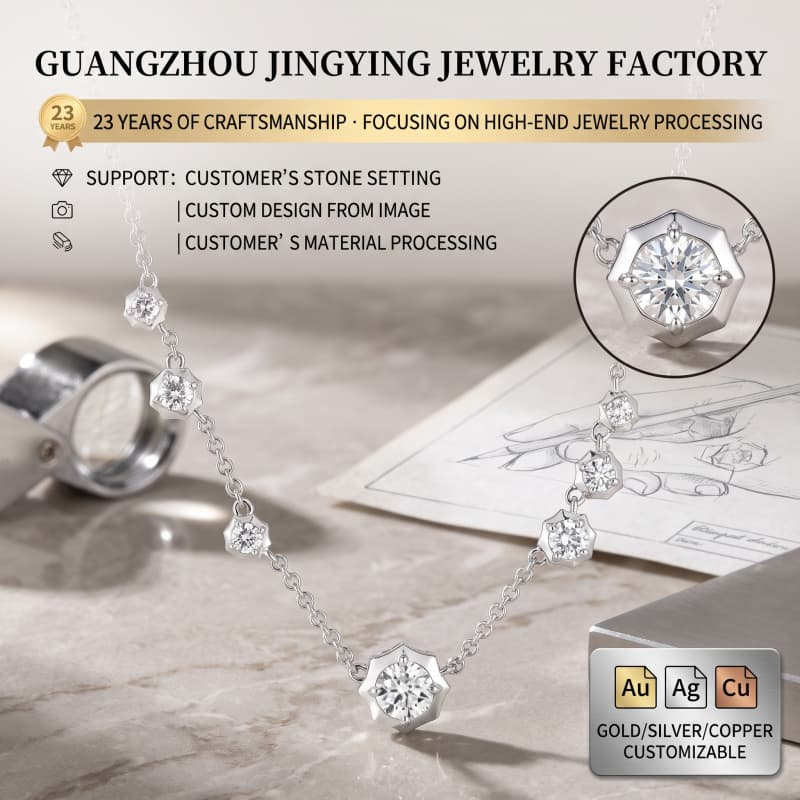
Why 925 Sterling Silver Remains the Material of Choice
Before examining the mechanics of confidentiality, it is worth understanding why 925 sterling silver occupies such a vital space in fashion jewelry. Sterling silver is an alloy composed of 92.5% pure silver and 7.5% other metals, typically copper, which adds strength and durability to an otherwise soft precious metal. This composition yields a material that is not only visually luminous but also hypoallergenic and suitable for sensitive skin. For fashion-forward collections, 925 silver strikes a balance between the perceived value of a precious material and the accessibility required for volume-driven retail. It is highly receptive to finishing techniques—from high-polish mirror surfaces to oxidized, matte, or gold-plated finishes—making it an exceptionally versatile canvas for creative expression.
JINGYING has built its reputation on this very alloy. Founded in 1998, the company has evolved from a modest workshop into a vertically integrated manufacturer specializing in 925 sterling silver and copper with genuine gold plating, achieving a monthly production capacity exceeding 100,000 pieces. For a brand seeking a custom silver collection, this scale is significant, but it is the company’s approach to intellectual property that transforms scale into a strategic advantage.
The Custom Design Journey: From Concept to Casting
The technical journey of a custom 925 silver piece at JINGYING is a study in precision engineering. The process is designed to accommodate clients at any stage of creative development. A brand may submit a finished CAD file, a reference photograph, or even a rough hand sketch. Alternatively, for clients who arrive with only a concept, JINGYING’s in-house design team can collaborate to develop the idea into a workable design.
Once a direction is established, the concept is translated into a precise three-dimensional CAD/CAM model. This stage is critical because it determines the feasibility, proportion, and structural integrity of the final product. JINGYING maintains tolerances within ±0.1 mm during this modeling phase—a level of precision that becomes indispensable when a design must be replicated consistently across thousands of units. This engineering-first mindset ensures that the designer’s vision is faithfully captured before any tooling is committed, avoiding costly surprises later in the production cycle.
The transition from digital model to physical metal relies on lost-wax casting, a technique that has endured for centuries yet benefits enormously from modern precision. Molten 925 sterling silver, heated to approximately 961°C, is poured into precision molds, capturing every curve, filigree detail, and surface texture of the original design. For copper-based pieces intended for gold plating, a parallel process is employed: the brass substrate is formed through high-resolution wax printing and plaster mold casting, then cleaned and prepared for electroplating. This dual-material capability allows a brand to serve different price points—from accessible fashion silver to premium gold-plated statements—with a single, confidentiality-conscious manufacturing partner.
The NDA-First Approach: Confidentiality as a Prerequisite
The true differentiator in JINGYING’s custom design service is not found in the furnace or the polishing wheel; it is found in the contract. In an industry where premature disclosure of a collection can erode a brand’s entire market advantage, JINGYING has institutionalized a simple but powerful rule: the cooperation process does not begin with a quotation. It begins with a legally binding NDA.
Before any design files, sketches, or CAD drawings are shared, both parties sign an agreement that establishes clear confidentiality obligations and creates legal consequences for breach. This is more than a formality. An NDA defines exactly what constitutes confidential information—covering not only CAD files and technical drawings, but also sample photos, product renderings, packaging concepts, and unreleased collection details. By signing before the first file changes hands, JINGYING removes the most common vulnerability in custom manufacturing: the period of informal discussion during which ideas are exchanged without legal protection.
Industry observers note that an NDA should be the very first document signed in any jewelry manufacturing relationship. JINGYING not only adheres to this standard but extends it through internal protocols. Access to client design files is restricted to essential personnel, and digital assets are stored on secure servers with limited access permissions. This combination of contractual obligation and operational discipline addresses the core anxiety that brands bring to an OEM partnership: that their differentiation will be diluted by the very partner entrusted with producing it.
Beyond the Contract: Operational Safeguards for High-Stakes Designs
For clients requiring an even higher level of separation, JINGYING can establish independent production lines dedicated to specific OEM projects. This means a brand’s designs never appear on the same production floor as competing products. In an industry where physical proximity often breeds information leakage, this spatial separation is a meaningful safeguard.
Equally important is the company’s explicit policy against replication and resale. Once a design is developed for a client, it remains that client’s intellectual property. JINGYING does not manufacture competing products based on proprietary designs, nor does it sell such designs to third parties. This policy transforms the NDA from a defensive legal document into a foundation for a genuine partnership—one in which the manufacturer’s commercial incentive is aligned with the brand’s long-term success rather than short-term opportunism.
Manufacturing Excellence: Where Craft Meets Consistency
Confidentiality protects the idea; manufacturing excellence protects the reputation of the finished product. Raw castings at JINGYING are not simply tumbled and shipped. Each piece undergoes meticulous hand-filing, where artisans refine edges and surfaces using files of varying grain, verifying that the form is true and that no casting defects escape detection. This is where human skill complements machine precision, ensuring that the jewelry retains a level of finish that mass-production shortcuts cannot replicate.
Polishing follows a multi-stage progression, from coarse abrasive wheels to fine cotton cloth wheels coated with polishing wax, producing a mirror-finish surface that catches light as intended. For designs requiring a matte or satin aesthetic, sanding and sandblasting techniques create controlled surface textures rather than a uniform reflective sheen.
Electroplating is where JINGYING’s technical capabilities become most tangible for brands selling into demanding retail environments. For 925 sterling silver pieces, rhodium plating is applied to enhance luster and provide tarnish resistance—a critical factor for maintaining product appeal during extended shelf life. For copper-based pieces, genuine gold plating follows a multi-layer process, with a nickel or alloy barrier layer ensuring adhesion and corrosion resistance before the gold layer is electrodeposited to the specified thickness. The company adheres to national standards, ensuring coating thickness meets or exceeds the 0.5 μm minimum required by QB/T 1131-2005, with thicker layers available for premium applications. An optional anti-tarnish e-coat—a micro-thin electrophoretic lacquer—seals the jewelry against oxidation and humidity, providing an additional layer of protection for pieces destined for humid climates or extended storage.
Quality control at JINGYING is a stage-by-stage discipline rather than a final checkpoint. The process begins with XRF testing of silver and brass alloys to verify composition and purity before any metal enters production. Wax injection and casting are inspected for dimensional accuracy and surface quality. After polishing, finish uniformity is verified. Electroplating inspection tests coating thickness, adhesion, and color consistency. The final product inspection applies 100% quality control covering dimensions, performance, and visual appearance. Material integrity is documented rather than assumed: all 925 sterling silver pieces are stamped with the “S925” hallmark, and third-party assay reports from accredited laboratories such as SGS or Bureau Veritas can be provided upon request.
Flexibility, Packaging, and the One-Stop Partnership
While JINGYING possesses the capacity for large-scale production runs, its production system is also designed to accommodate smaller batch runs for emerging designers or seasonal collections. This flexibility reflects the diverse needs of the global jewelry market, where a brand may require thousands of units for a core collection and hundreds for a limited edition.
The customization extends beyond the metal itself. JINGYING provides OEM and ODM services across rings, necklaces, pendants, earrings, bracelets, and pearl jewelry, with customization available for personalized logos, stone settings, and packaging. For a brand building a cohesive identity, the ability to source design, manufacturing, finishing, and private-label packaging from a single, NDA-bound partner reduces complexity and consolidates accountability.
Conclusion: Trust as the Ultimate Differentiator
In an era of accessible manufacturing and rapid trend cycles, the barriers to entering the fashion jewelry market have never been lower. Yet the barriers to building a lasting brand remain formidable. Differentiation depends on designs that are distinctive and protected. Quality depends on manufacturing partners who treat precision as a discipline rather than a marketing claim. And peace of mind depends on knowing that the ideas shared in confidence will remain confidential.
JINGYING’s model—a 23-year manufacturing heritage, a vertically integrated 925 silver production capability, and an uncompromising NDA-first approach—offers brands a way to navigate these demands without compromise. By signing the NDA before the first sketch is shared, by restricting access to design files, and by refusing to replicate or resell proprietary work, the company turns confidentiality from a clause into a culture. For designers and labels seeking a custom 925 silver partner, the message is clear: the conversation begins not with what can be made, but with what will be protected. In an industry built on desire, that commitment to trust may be the most valuable asset of all.