Custom 14kt Yellow Gold Jewelry Factory OEM ODM Sun Cut-Out Charm Necklace
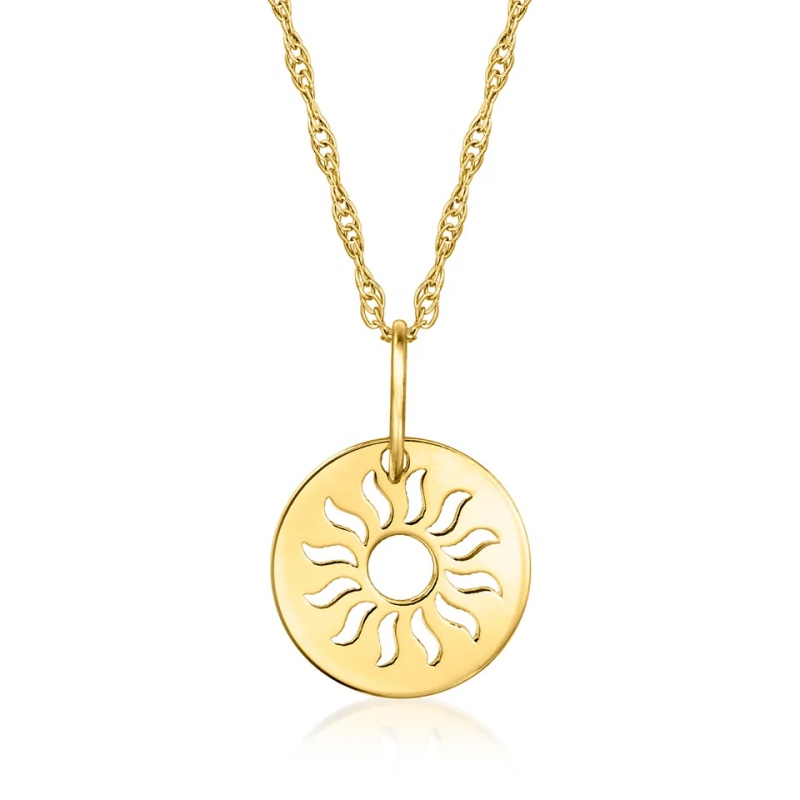
Custom 14kt Yellow Gold Jewelry Factory OEM ODM Sun Cut-Out Charm Necklace
LET’S GET STARTED : mo@kingjy.com
How to Custom 14kt Yellow Gold Jewelry: OEM/ODM Sun Cut-Out Charm Necklace
Introduction
The sun cut-out charm necklace has become a staple of contemporary fine jewelry collections—a design that balances celestial symbolism with everyday wearability. For jewelry brands, designers, and entrepreneurs, bringing such a piece to market through OEM (Original Equipment Manufacturing) or ODM (Original Design Manufacturing) partnerships offers a pathway to deliver high-quality 14kt yellow gold jewelry without the overhead of in-house production. This article provides a comprehensive guide to customizing a 14kt yellow gold sun cut-out charm necklace through OEM/ODM channels, covering material science, design development, manufacturing workflows, quality control, and branding considerations.
Understanding 14kt Yellow Gold for Jewelry Production
Before entering a manufacturing partnership, a clear grasp of the material is essential. 14kt gold is an alloy containing 58.3% pure gold, with the remaining 41.7% composed of other metals—typically copper, silver, and zinc. In the millesimal fineness system, 14kt gold carries a fineness of 583.3, which is why hallmarked pieces are stamped “585.” For yellow gold specifically, manufacturers use a balanced mix of copper and silver to approximate the warm tone of pure gold.
14kt gold occupies what industry professionals often call the “Goldilocks” zone of jewelry materials. It is significantly harder and more scratch-resistant than 18kt or higher-karat alloys, making it ideal for pieces intended for daily wear such as charm necklaces. At the same time, it retains a meaningful gold content that lower-karat alternatives cannot match, preserving both perceived and intrinsic value. For a sun cut-out charm—which by design features intricate openwork and relatively thin metal sections—the mechanical properties of 14kt gold are particularly advantageous. The alloy’s density of approximately 14.5 g/cm³ and its ability to be cold-worked up to 70% reduction between anneals make it well-suited for the stamping, laser cutting, and casting techniques used to produce cut-out designs.
The Sun Cut-Out Charm Necklace: Design Language and Symbolism
The sun cut-out charm is a design archetype that has proven enduringly popular in the fine jewelry market. Its appeal lies in the intersection of symbolic meaning and visual lightness. Sun motifs evoke warmth, optimism, and renewal—themes that resonate across cultures and consumer demographics. The cut-out technique, in which negative space is removed from a metal sheet or cast form to create the sun’s rays and central disc, produces a piece that appears delicate while maintaining structural integrity when properly engineered.
A well-executed sun cut-out charm typically features several design elements: a circular or disc-shaped central body, radiating ray cut-outs of uniform or graduated length, a polished or satin finish that plays with light, and a bail suitable for threading onto a chain of up to 2–2.5 mm in diameter. The charm may be produced as a flat stamped piece, a cast dimensional form, or a combination of both. For OEM/ODM production, the design can be adapted to different charm dimensions—common sizes range from 10 mm to 25 mm in diameter—and can incorporate additional elements such as diamond accents, milgrain detailing, or engraved personalization.
OEM vs. ODM: Choosing the Right Manufacturing Model
Understanding the distinction between OEM and ODM manufacturing is fundamental to selecting the right production partner and workflow.
OEM manufacturing operates on a client-supplied design. In this model, the brand provides sketches, CAD files, or reference samples, and the manufacturer’s role is to translate those specifications into finished jewelry. The brand retains full creative control and intellectual property ownership, while the factory contributes technical expertise in material selection, feasibility analysis, and production engineering. OEM is the preferred route for brands with established design identities or proprietary collections that must not be replicated.
ODM manufacturing, by contrast, begins with production-ready designs from the manufacturer’s catalog. The brand selects a base design—such as a sun cut-out charm—and customizes it within defined parameters: metal type, stone program, size, finishing, and packaging. The manufacturer handles the design engineering and prototyping, allowing the brand to launch faster and with lower development costs. ODM is particularly suitable for emerging brands, private labels, and retailers seeking to test a category without committing to full design development.
For a sun cut-out charm necklace, the two models can also be combined. A brand might begin with an ODM catalog design, customize it to align with brand aesthetics, and then transition to OEM production for future iterations as the relationship matures.
The Custom Manufacturing Process: From Concept to Finished Charm
The custom jewelry manufacturing process follows a structured sequence of steps, regardless of whether the project is OEM or ODM. Understanding this workflow allows brands to plan timelines, allocate resources, and communicate effectively with manufacturing partners.
Step 1: Design Brief and Feasibility Analysis. The process begins with a detailed design brief. For OEM projects, this includes sketches, CAD files, or physical reference samples along with specifications for metal, dimensions, finish, and any stone requirements. For ODM projects, the brief identifies the catalog design to be customized and the desired modifications. The manufacturer’s design and engineering team reviews the brief for production feasibility, flagging any elements—such as overly thin cut-out sections or unsupported internal angles—that could compromise structural integrity or casting quality.
Step 2: CAD Modeling and 3D Rendering. A precise 3D model is created using computer-aided design software. This model locks in exact measurements, metal thickness, bail dimensions, and the geometry of the cut-out rays. The brand receives a photorealistic render for approval before any metal is committed. For sun cut-out charms, the CAD stage is critical for ensuring that the negative space is balanced and that the remaining metal structure can withstand daily wear without bending or deforming.
Step 3: 3D Wax or Resin Printing. The approved CAD file is sent to a 3D printer that builds a physical wax or resin model layer by layer. This model serves as the master pattern for casting. Some manufacturers also use CNC milling to carve the model from a solid wax block for larger or more robust pieces.
Step 4: Wax Tree Assembly and Investment Casting. Multiple wax models are attached to a central wax stem to form a “wax tree.” The tree is encased in a plaster-like investment material, which is then heated in a furnace to melt out the wax, leaving a negative mold cavity. Molten 14kt gold—heated to the appropriate casting temperature, typically in the range of 1,350–1,400°C for 14kt yellow alloys—is poured or injected into the mold. After cooling, the plaster is broken away, and the cast metal pieces are trimmed from the tree.
Step 5: Hand Finishing and Polishing. Each cast charm undergoes hand finishing. This includes filing, sanding with progressively finer abrasives, and polishing with cotton wheels to achieve the desired surface—whether a high-polish mirror finish or a satin texture. For cut-out designs, the inner edges of the rays and negative spaces require particular attention to ensure they are smooth and free of burrs or sharp edges.
Step 6: Quality Check and Plating (If Required). Finished pieces undergo quality inspection before plating. While 14kt yellow gold does not require rhodium plating, some manufacturers apply a thin layer of 14kt or 18kt yellow gold plating to enhance color consistency across production batches or to achieve a specific tone. The plating thickness is controlled through electroplating or PVD systems, with technicians monitoring color consistency throughout the process.
Quality Control: Protecting Brand Integrity in Bulk Production
Quality control is not a single inspection at the end of the line—it is an ongoing process that spans the entire manufacturing workflow. For OEM/ODM production of 14kt gold jewelry, quality control includes dimensional checks against CAD specifications, material verification (confirming gold purity and alloy composition), structural integrity assessments, visual and finishing inspections, and functional tests for bail security and wearability.
Pre-shipment inspection is particularly critical for bulk orders. International AQL (Acceptable Quality Limit) standards such as ANSI/ASQC Z1.4 or GB/T 2828.1 guide sampling procedures. In a batch of 500 pieces, approximately 50 units would be sampled at General Inspection Level II, with acceptance determined by the number and category of defects identified. Defects are classified as critical (safety hazards or regulatory violations), major (visible cosmetic or functional issues), and minor (imperfections that do not affect function). A documented corrective loop—record, rework, re-inspect, confirm approval—ensures that non-conformities are resolved before shipment.
Brands working with OEM/ODM partners should insist on a “golden sample”—a physically approved reference piece against which all production units are compared. This protects against batch-to-batch variation in color, finish, dimensions, and cut-out geometry.
Packaging and Branding for Market Readiness
A finished necklace is not market-ready until it is packaged and branded. Packaging has become an integral part of the luxury jewelry experience, shaping the unboxing moment and reinforcing brand values. Custom jewelry boxes, branded pouches, and presentation cards can all be produced through OEM/ODM packaging partners using materials such as FSC-certified paper, velvet, and vegan-friendly leather alternatives.
For a sun cut-out charm necklace, packaging should complement the piece’s symbolic warmth and everyday wearability. Options include a compact jewelry box with a sun motif embossed or hot-stamped on the lid, a branded velvet pouch for travel-friendly storage, and a card insert describing the materials and care instructions. Many manufacturers offer custom engraving, logo stamping, and packaging development as part of their OEM/ODM service suite.
Timelines, Minimum Order Quantities, and Cost Considerations
Production timelines vary by manufacturer and order complexity. For small-batch OEM/ODM production of solid gold jewelry, standard production time is typically 7–14 days for orders of 1–10 pieces, with bulk orders requiring 20–30 days. CAD design development may take 48 hours, with sample production following design approval in 7–10 days and bulk production in 4–6 weeks after final confirmation.
Minimum order quantities (MOQs) for 14kt solid gold jewelry are generally lower than for plated or base-metal alternatives. Many manufacturers set MOQs of 10 pieces per design for solid gold, compared with 30 pieces for sterling silver and 50 pieces for gold-plated brass. For brands testing a new design, these relatively accessible MOQs make OEM/ODM production viable without excessive inventory risk.
Conclusion
Customizing a 14kt yellow gold sun cut-out charm necklace through OEM/ODM manufacturing is a structured, achievable process that allows brands to bring a meaningful design to market with professional quality and production efficiency. The key to success lies in understanding the material properties of 14kt gold, selecting the right manufacturing model for the brand’s stage and resources, collaborating closely with the manufacturer through CAD and sampling, and maintaining rigorous quality control standards throughout production. With the right partner and a clear design brief, a sun cut-out charm necklace can move from concept to finished, packaged product in a matter of weeks—ready for retail, e-commerce, or wholesale distribution.